
Question 292 marksMedium
Define or explain chain isomerism and position isomerism with examples in each case.
Confirming your payment
Sign up now and get 250 free tokens.
Organic Chemistry · Question 29 of 150
Define or explain chain isomerism and position isomerism with examples in each case.
Solution:
Concept: Both are kinds of structural isomerism: the compounds have the same molecular formula, but their atoms are linked differently.
Step 1 — Define chain isomerism.
Chain isomers have the same molecular formula but a different arrangement of the carbon chain (straight or branched).
Step 2 — Give an example of chain isomers.
gives two chain isomers:
Step 3 — Define position isomerism.
Position isomers have the same molecular formula and the same carbon chain, but differ in the position of the functional group, multiple bond or substituent.
Step 4 — Give an example of position isomers.
gives two position isomers with the double bond in different places:
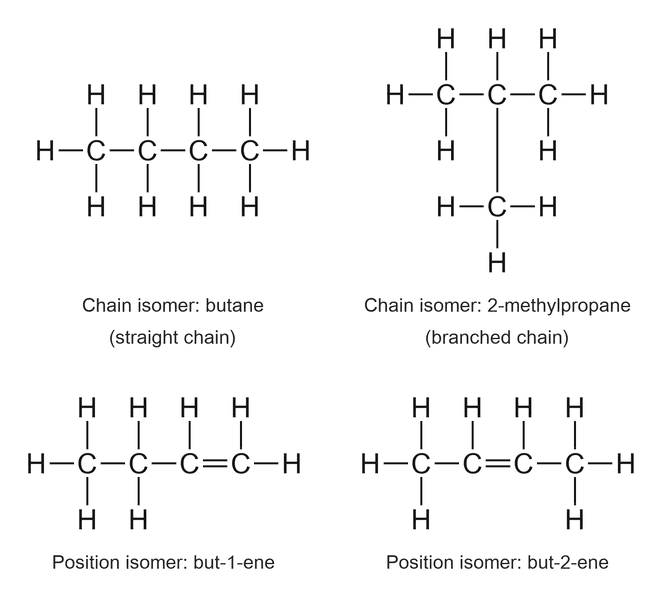
Watch out: In chain isomerism the skeleton changes; in position isomerism the skeleton stays the same and only the position of the group or bond moves.
Therefore, chain isomers differ in the carbon skeleton (butane and 2-methylpropane), and position isomers differ in the position of a bond or group (but-1-ene and but-2-ene).