Solution:
Concept: In CnH2n, n counts the carbon atoms and the number of H atoms is twice that. Alkenes need a C=C bond, so the series starts at n = 2 (ethene).
Step 1 — (a) Meaning of n and 2n.
n is the number of carbon atoms and 2n the number of hydrogen atoms in one molecule.
Step 2 — (b) and (c) The alkene with n = 4.
Four carbons give the root but- and the suffix -ene: butene. Its hydrogen count is:
2n=2×4=8
so its molecular formula is C4H8.
Step 3 — (d) The alkene with ten H atoms.
Here 2n = 10, so n = 5, and the alkene is C5H10 (pentene).
Step 4 — (e) Structure of the third member.
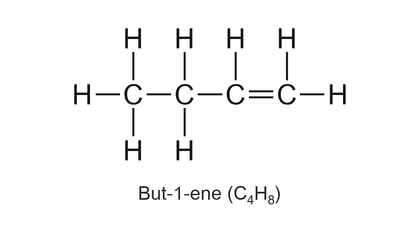
The members are ethene C2H4 (1st), propene C3H6 (2nd) and butene C4H8 (3rd). Butene (but-1-ene) is drawn below:
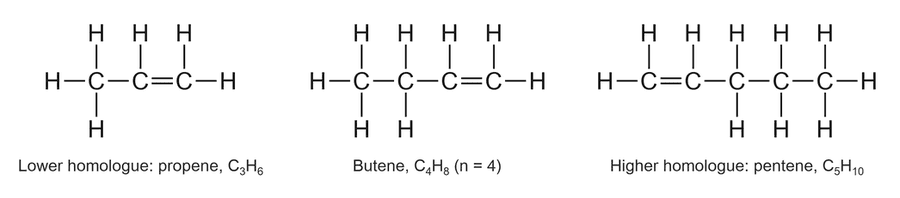
Step 5 — (f) Lower and higher homologues of C₄H₈.
Homologues differ by one CH2 group: the lower homologue is C3H6 (propene) and the higher one is C5H10 (pentene):
Watch out: The alkene series starts at two carbons, so its third member has four carbons, not three.
Therefore, (a) n = number of C atoms, 2n = number of H atoms; (b) butene; (c) C₄H₈; (d) C₅H₁₀; (e) butene, CH₂=CH–CH₂–CH₃; (f) C₃H₆ and C₅H₁₀.
