
Question 535 marksMedium
Convert :
(a) Methane into chloroform,
(b) Sodium acetate into methane,
(c) Methyl iodide into ethane,
(d) Methane to methyl alcohol
Confirming your payment
Sign up now and get 250 free tokens.
Organic Chemistry · Question 53 of 150
Convert :
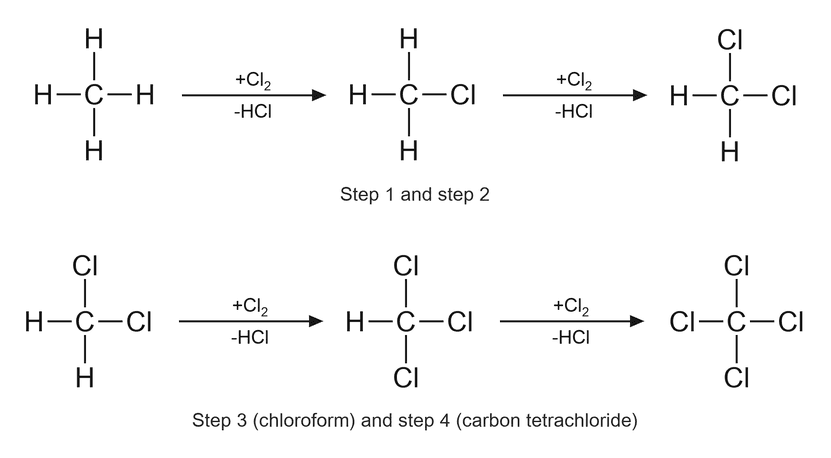
(a) Methane into chloroform,
(b) Sodium acetate into methane,
(c) Methyl iodide into ethane,
(d) Methane to methyl alcohol
Solution:
Concept: Choose the reaction that makes exactly the change needed: substitution (H → Cl), decarboxylation (remove –COONa), the Wurtz reaction (join two alkyl groups) and catalytic oxidation (put in –OH).
Step 1 — (a) Methane into chloroform.
Methane is chlorinated in diffused sunlight; three H atoms are replaced one by one:
Step 2 — (b) Sodium acetate into methane.
Sodium acetate is heated with soda lime (decarboxylation):
Step 3 — (c) Methyl iodide into ethane.
Methyl iodide is warmed with sodium in dry ether (Wurtz reaction); the two methyl groups join:
Step 4 — (d) Methane into methyl alcohol.
A 9 : 1 mixture (by volume) of methane and oxygen is compressed to about 120 atm and passed over copper tubes at 475 K:
Watch out: In (a) stop after three steps: one more substitution gives carbon tetrachloride, not chloroform.
Therefore, (a) chlorinate methane in diffused sunlight, (b) heat sodium acetate with soda lime, (c) warm methyl iodide with sodium in dry ether, (d) oxidise methane with oxygen over copper at 475 K and 120 atm.