
Question 775 marksEasy
Give a chemical test to distinguish between
(a) saturated and unsaturated compounds.
(b) ethane and ethene,
(c) ethene (ethylene) and ethyne (acetylene).
Confirming your payment
Sign up now and get 250 free tokens.
Organic Chemistry · Question 77 of 150
Give a chemical test to distinguish between
(a) saturated and unsaturated compounds.
(b) ethane and ethene,
(c) ethene (ethylene) and ethyne (acetylene).
Solution:
Concept: Unsaturated compounds decolourise bromine and alkaline (they add across the multiple bond). Only ethyne (with H on a triple-bonded carbon) gives a precipitate with ammoniacal copper (I) chloride.
Step 1 — (a) Saturated and unsaturated compounds.
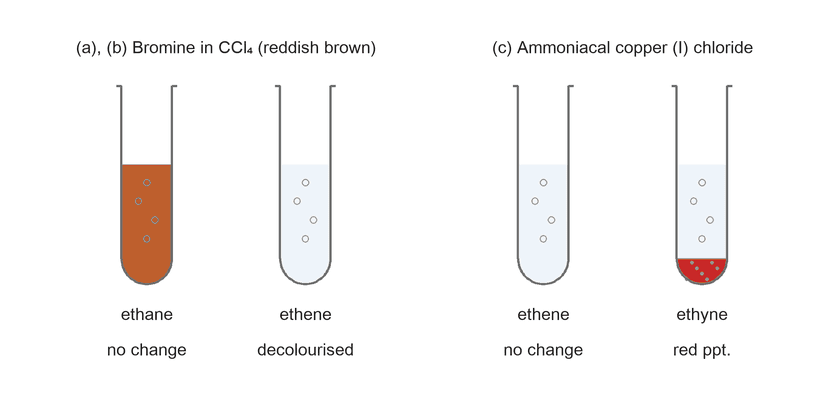
Add a few drops of bromine in carbon tetrachloride (reddish brown): an unsaturated compound decolourises it, while a saturated compound leaves it unchanged.
Step 2 — (b) Ethane and ethene.
Pass each gas through alkaline potassium permanganate (purple): with ethene the purple colour fades (Baeyer's test); with ethane there is no change. (Bromine solution gives the same result.)
Step 3 — (c) Ethene and ethyne.
Pass each gas through ammoniacal copper (I) chloride solution: ethyne gives a red precipitate of copper acetylide; ethene gives no precipitate:
Watch out: Bromine water cannot tell ethene from ethyne, because both decolourise it.
Therefore, (a) bromine in CCl₄ is decolourised only by the unsaturated compound; (b) alkaline KMnO₄ is decolourised by ethene, not ethane; (c) ammoniacal copper (I) chloride gives a red precipitate with ethyne, not ethene.