
Question 54 marksEasy
Explain the following :
(a) tetravalency,
(b) catenation.
Confirming your payment
Sign up now and get 250 free tokens.
Organic Chemistry · Question 5 of 150
Explain the following :
(a) tetravalency,
(b) catenation.
Solution:
Concept: Both are properties of the carbon atom (electronic configuration 2, 4). Tetravalency is about how many bonds a carbon atom forms; catenation is about carbon atoms bonding to each other.
Step 1 — (a) Tetravalency.
Carbon has four valence electrons. Losing or gaining four electrons needs too much energy, so carbon shares its four electrons and forms four covalent bonds. This property is called tetravalency.
For example, in methane, , the carbon atom shares one pair of electrons with each of four hydrogen atoms:

Step 2 — (b) Catenation.
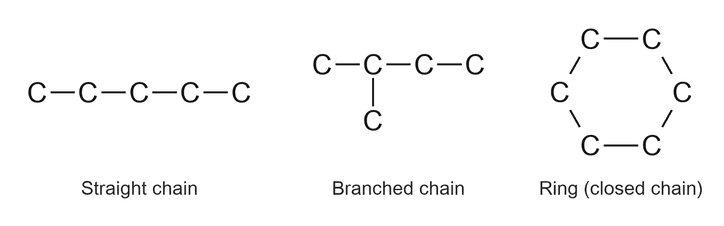
Catenation is the property of self-linking of carbon atoms by covalent bonds to form straight chains, branched chains and rings of different sizes.
It is possible because the C–C bond is strong and each carbon, being tetravalent, still has bonds left for hydrogen or other atoms after joining other carbons:
Watch out: Catenation is carbon bonding to carbon; bonding to hydrogen or oxygen is not catenation.
Therefore, (a) tetravalency is the power of carbon to form four covalent bonds; (b) catenation is the self-linking of carbon atoms into chains and rings.