Solution:
Concept: From the name we get the chain length (root word) and the functional group (suffix); we place the group and fill each carbon up to four bonds with H.
Step 1 — (a) Isomer of n-butane.
The isomer is isobutane (2-methylpropane), CH3−CH(CH3)−CH3.

Step 2 — (b) Vinegar.
Vinegar is a dilute solution of ethanoic (acetic) acid, CH3COOH.

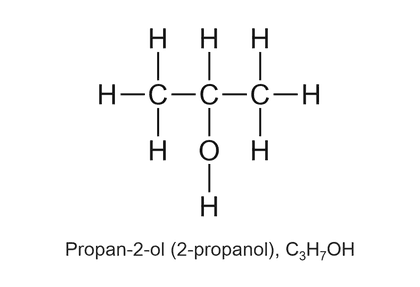
Step 3 — (c) 2-propanol (propan-2-ol).
Three carbons with –OH on the middle carbon: CH3CH(OH)CH3.
Step 4 — (d) Ethanal.
A two-carbon aldehyde: CH3CHO.

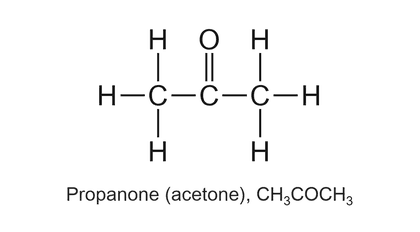
Step 5 — (e) Acetone (propanone).
A ketone with the C=O on the middle carbon: CH3COCH3.
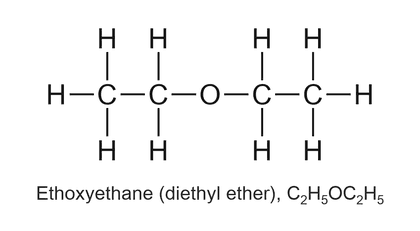
Step 6 — (f) Diethyl ether (ethoxyethane).
Two ethyl groups joined through an oxygen atom: C2H5OC2H5.
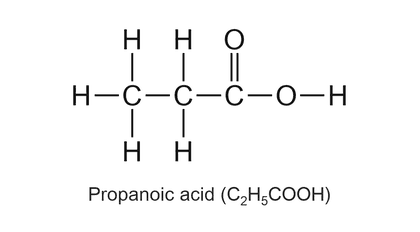
Step 7 — (g) Propanoic acid.
Three carbons including the –COOH carbon: C2H5COOH.
Step 8 — (h) Pentan-2-ol.
Five carbons with –OH on C-2: CH3CH(OH)CH2CH2CH3.

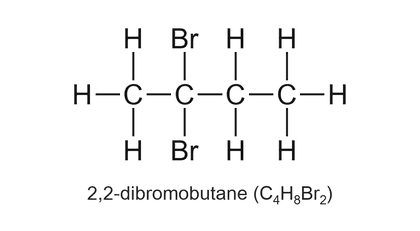
Step 9 — (i) 2,2-dibromobutane.
Four carbons with both Br atoms on C-2: CH3CBr2CH2CH3.
Step 10 — Describe them together.
Each compound is a hydrocarbon or is made from one by putting in a functional group (–OH, –CHO, >C=O, –O–, –COOH, –Br), so together they are organic compounds: hydrocarbons and their derivatives.
Watch out: In propanoic acid the –COOH carbon is one of the three carbons, so the formula is C2H5COOH, not C3H7COOH.
Therefore, the nine structures are drawn above, and taken together these compounds are organic compounds (hydrocarbons and their derivatives).
