Solution:
Concept: Read each name in three parts: the root gives the number of carbons in the main chain (meth 1, eth 2, prop 3, but 4); the ending gives the bond or group (-ane, -ene, -yne, -ol, -al, -oic acid, -one); the number says which carbon carries it. Then give every carbon four bonds by adding H atoms.
Step 1 — (a) Ethanoic acid.
Two carbons, the second being the –COOH carbon: CH3COOH.

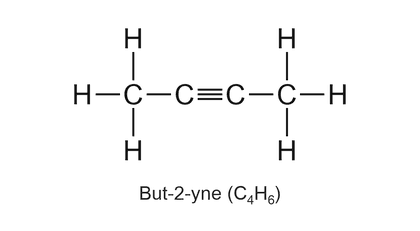
Step 2 — (b) But-2-yne.
Four carbons with the triple bond between C-2 and C-3: CH3−C≡C−CH3.
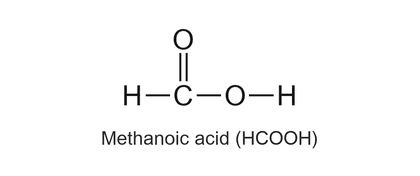
Step 3 — (c) Methanoic acid.
One carbon, which is the –COOH carbon: HCOOH.
Step 4 — (d) Ethanal.
Two carbons, C-1 being the –CHO carbon: CH3CHO.

Step 5 — (e) Ethyne.
Two carbons joined by a triple bond: HC≡CH.

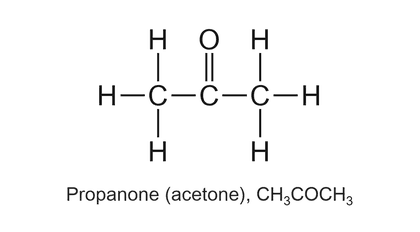
Step 6 — (f) Acetone (propanone).
Three carbons with the >C=O on the middle one: CH3COCH3.
Step 7 — (g) and (h) 2-methylpropane, the isomer of n-butane.
A three-carbon chain with a methyl on C-2: CH3−CH(CH3)−CH3. The isomer of n-butane asked in (h) is this same compound (isobutane); both are C4H10.

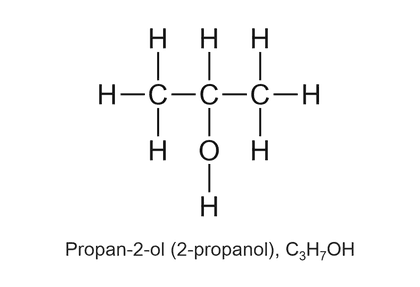
Step 8 — (i) 2-propanol (propan-2-ol).
The –OH is on the middle carbon: CH3−CH(OH)−CH3.
Step 9 — (j) Ethanol.
Two carbons with –OH on C-1: CH3CH2OH.

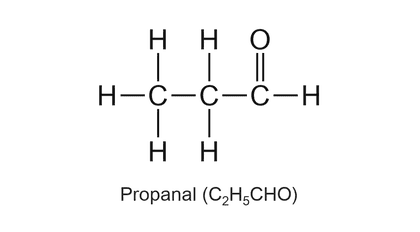
Step 10 — (k) 1-propanal (propanal).
Three carbons with the –CHO carbon as C-1: CH3CH2CHO.
Step 11 — (l) Ethanoic acid.
This is the same compound as (a), CH3COOH.
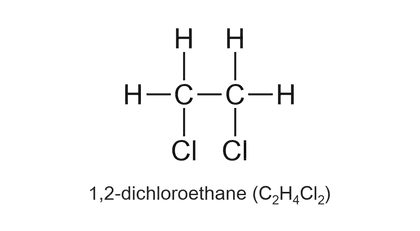
Step 12 — (m) 1,2-dichloroethane.
One Cl on each of the two carbons: CH2Cl−CH2Cl.
Watch out: Check every structure: each carbon has four bonds and each oxygen two.
Therefore, the thirteen structures are drawn above; (h) is 2-methylpropane, the same as (g), and (l) is the same as (a).
