
Question 225 marksMedium
Draw the structures of the following compounds:
(a) Prop-1-ene, (b) 2, 3-dimethyl butane,
(c) 2-methyl propane, (d) 3-hexene,
(e) Prop-1-yne, (f) 2-methyl prop-1-ene,
(g) Alcohol with molecular formula .
Confirming your payment
Sign up now and get 250 free tokens.
Organic Chemistry · Question 22 of 150
Draw the structures of the following compounds:
(a) Prop-1-ene, (b) 2, 3-dimethyl butane,
(c) 2-methyl propane, (d) 3-hexene,
(e) Prop-1-yne, (f) 2-methyl prop-1-ene,
(g) Alcohol with molecular formula .
Solution:
Concept: Read a name backwards: the root word gives the chain length, the suffix the bond or group, and the locant where it sits. Draw the chain, put in the bond or branch, then add H atoms until every carbon has four bonds.
Step 1 — (a) Prop-1-ene.
Three carbons with a double bond between C-1 and C-2: .

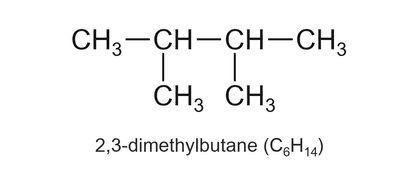
Step 2 — (b) 2,3-dimethylbutane.
A 4 C chain with one methyl on C-2 and one on C-3: .
Step 3 — (c) 2-methylpropane.
A 3 C chain with a methyl on C-2 (isobutane): .

Step 4 — (d) 3-hexene (hex-3-ene).
A 6 C chain with the double bond between C-3 and C-4: .

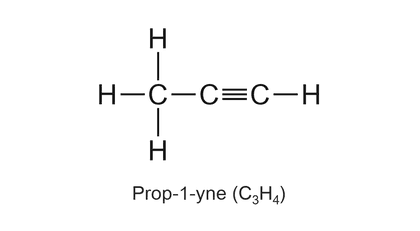
Step 5 — (e) Prop-1-yne.
Three carbons with a triple bond between C-1 and C-2: .
Step 6 — (f) 2-methylprop-1-ene.
A 3 C chain with the double bond from C-1 and a methyl on C-2: .

Step 7 — (g) An alcohol C₄H₁₀O.
is , a four-carbon alcohol, for example butan-1-ol, :

Four alcohols have this formula, and any one of them is correct:

Watch out: After drawing, count the H atoms against the formula (for example 2,3-dimethylbutane must be ).
Therefore, the structures are (a) CH₃–CH=CH₂, (b) CH₃–CH(CH₃)–CH(CH₃)–CH₃, (c) CH₃–CH(CH₃)–CH₃, (d) CH₃CH₂–CH=CH–CH₂CH₃, (e) CH₃–C≡CH, (f) CH₂=C(CH₃)–CH₃ and (g) CH₃CH₂CH₂CH₂OH (butan-1-ol).