
Question 805 marksMedium
Name the products formed and write an equation when ethyne is added to the following in an inert solvent :
(a) chlorine, (b) bromine,
(c) iodine, (d) hydrogen.
(e) excess of hydrochloric acid.
Confirming your payment
Sign up now and get 250 free tokens.
Organic Chemistry · Question 80 of 150
Name the products formed and write an equation when ethyne is added to the following in an inert solvent :
(a) chlorine, (b) bromine,
(c) iodine, (d) hydrogen.
(e) excess of hydrochloric acid.
Solution:
Concept: The triple bond adds two molecules in two stages: first to an ethene derivative (C=C), then to a saturated ethane derivative.
Step 1 — (a) Chlorine.
Ethyne gives 1,2-dichloroethene, then 1,1,2,2-tetrachloroethane:
Step 2 — (b) Bromine.
Ethyne gives 1,2-dibromoethene, then 1,1,2,2-tetrabromoethane; the reddish-brown colour disappears:
Step 3 — (c) Iodine.
Iodine reacts slowly and stops at the first stage, giving 1,2-di-iodoethene:
Step 4 — (d) Hydrogen.
Over nickel at 200 °C ethyne gives ethene, then ethane:
Step 5 — (e) Excess hydrogen chloride.
Ethyne gives chloroethene (vinyl chloride), then 1,1-dichloroethane; the second Cl goes to the carbon that already has one:
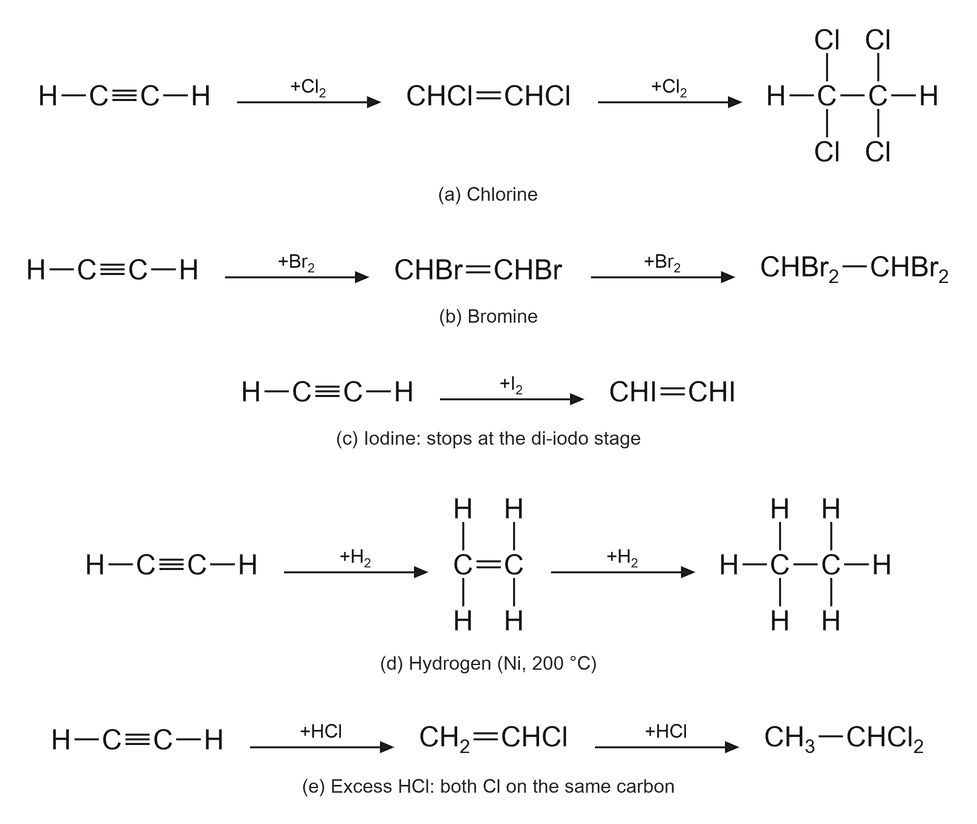
Watch out: In (e) the product is 1,1-dichloroethane, not 1,2-dichloroethane: both Cl atoms end on the same carbon.
Therefore, the final products are (a) 1,1,2,2-tetrachloroethane, (b) 1,1,2,2-tetrabromoethane, (c) 1,2-di-iodoethene, (d) ethane and (e) 1,1-dichloroethane.