Solution:
Concept: Name each process or class from what happens to the molecule.
Step 1 — (a) Ethene to ethane.
Hydrogen adds across the C=C bond over a nickel catalyst: hydrogenation.
Step 2 — (b) Greenhouse hydrocarbon.
Methane absorbs the heat radiated by the earth, so it is a greenhouse gas.
Step 3 — (c) Ethanol and acetic acid.
With conc. H2SO4 they give the ester ethyl acetate and water: esterification.
Step 4 — (d) Self-linking into chains and rings.
This property is catenation.
Step 5 — (e) Alkyl halide and alcoholic KOH.
Alcoholic KOH removes H and the halogen (as HX) from neighbouring carbons, giving an alkene: dehydrohalogenation:
C2H5Br+KOHalcoholicboilC2H4+KBr+H2O

Step 6 — (f) Compounds with the >C=O group between carbons.
These are the ketones (e.g. acetone, propanone), where the >C=O group is joined to two carbon atoms:
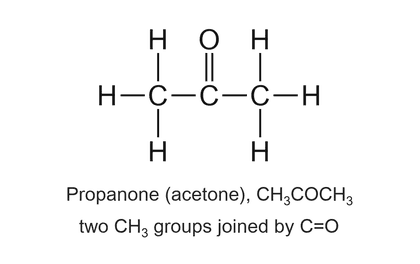
Note: the stem calls them "hydrocarbons", but ketones contain oxygen, so strictly they are hydrocarbon derivatives.
Therefore, (a) hydrogenation, (b) methane, (c) esterification, (d) catenation, (e) dehydrohalogenation, (f) ketones.
