
Opening your dashboard
Class 10 Chemistry Chapter 12 Organic Chemistry: Previous Year Questions
96 questions on Chapter 12, each solved step by step. Class 10 Chemistry, ICSE 2026-27.
96 questions with solutions
1–6 marks · Mixed difficulty
The first 67 solutions are on this page. This chapter is a long one, so the rest open on their own page to keep this one quick to load.
- 11 mark
Question 1
Fill in the blanks with the choices given in brackets.
Conversion of ethene to ethane is an example of ...............(hydration/hydrogenation).
Solve with AIWritten solution
Solution:
Concept: Hydrogenation is the addition of hydrogen to an unsaturated compound. Ethene and hydrogen passed over finely divided nickel at about 200 °C (or platinum/palladium at room temperature) give ethane.
Step 1 — Compare the two words.
Hydrogenation means adding hydrogen; hydration means adding water.
Step 2 — See what is added.
Ethene () becomes ethane (): two hydrogen atoms are added across the double bond and no oxygen is involved, so this is hydrogenation.
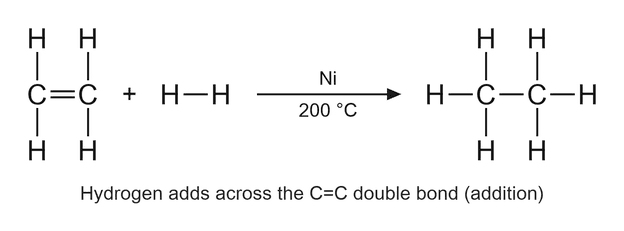
Watch out: Ethene + WATER would give ethanol (hydration); ethene + HYDROGEN gives ethane (hydrogenation).
Therefore, conversion of ethene to ethane is an example of hydrogenation.
- 21 mark
Question 2
Write balanced chemical equations for each of the following:
Preparation of ethanol from Ethyl Chloride.
Solve with AIWritten solution
Solution:
Concept: Dehydrohalogenation: boiling a haloalkane with alcoholic KOH removes a hydrogen halide (H from one carbon, halogen from the next), forming a double bond. With aqueous alkali the halogen is replaced by –OH instead, giving an alcohol.
Step 1 — Choose the reagent.
Ethyl chloride (chloroethane, ) must keep its two carbons and swap Cl for –OH, so it is boiled with aqueous sodium hydroxide.
Step 2 — Write the balanced equation.
The –OH of the alkali replaces the chlorine atom, and sodium chloride forms. Check: C 2 = 2, H 5 + 1 = 6, Cl 1 = 1, Na 1 = 1, O 1 = 1.
Aqueous potassium hydroxide works the same way, giving KCl instead of NaCl.

Watch out: AQUEOUS alkali gives the alcohol; ALCOHOLIC alkali gives the alkene.
Therefore, C₂H₅Cl + NaOH (aqueous) → C₂H₅OH + NaCl.
- 31 mark
Question 3
Identify the term/substance in each of the following:
The catalyst used in the conversion of ethyne to ethane.
Solve with AIWritten solution
Solution:
Concept: Hydrogen adds to ethyne in the presence of a finely divided metal catalyst, first giving ethene and then ethane.
Step 1 — Ethyne to ethene.
The first molecule of hydrogen opens one bond of the triple bond.
Step 2 — Ethene to ethane.
The second molecule of hydrogen saturates the double bond.
Step 3 — Name the catalyst.
Both steps use the same catalyst, finely divided nickel at about 200 °C (platinum or palladium also work).
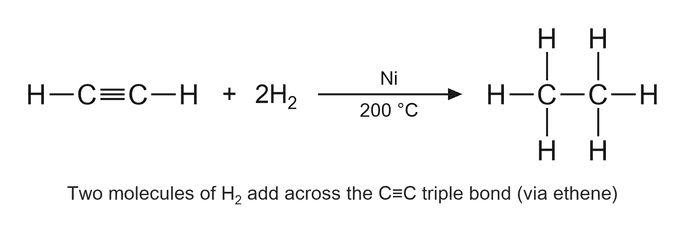
Therefore, the catalyst is finely divided nickel.
- 41 mark
Question 4
Identify the term/substance in each of the following:
The type of reactions alkenes undergo
Solve with AIWritten solution
Solution:
Concept: Unsaturated hydrocarbons (alkenes C=C, alkynes C≡C) react by addition: one bond of the double or triple bond opens and a molecule such as H₂, Cl₂ or Br₂ adds across it, giving a single product.
Step 1 — Look at the bond in an alkene.
An alkene has a C=C double bond, so it is unsaturated and can take on more atoms.
Step 2 — Name the reaction type.
Molecules such as , , or HCl add across the double bond to give a single saturated product, so alkenes undergo addition reactions. Hydrogenation of ethene is one such reaction.
Watch out: Substitution is the typical reaction of ALKANES, not alkenes.
Therefore, alkenes undergo addition reactions.
- 55 marks
Question 5
(i) Write the IUPAC names of each of the following:

(ii) Rewrite the following sentences by using the correct symbol > (greater than) or < (less than) in the blanks given:
(a) The ionization potential of Potassium is .............. that of Sodium.
(b) The electronegativity of Iodine is .............. that of Chlorine.
Solve with AIWritten solution
Solution:
Concept: An IUPAC name is built as locant + prefix (branch or halogen) + root + suffix. The root counts the carbons of the longest chain that contains the functional group or multiple bond (meth 1, eth 2, prop 3, but 4, pent 5). The chain is numbered from the end that gives the lowest number to the functional group (a –CHO or –COOH carbon is always C-1), then to the double or triple bond, then to the branches. The suffix shows the family: -ane, -ene, -yne, -ol, -al, -oic acid.
Step 1 — (i)(a) Name the first structure.
The chain has 3 carbons with a double bond between C-1 and C-2: , so it is prop-1-ene (propene).
Step 2 — (i)(b) Name the second structure.
The chain has 4 carbons with a triple bond between C-2 and C-3 (the same from either end): , so it is but-2-yne.
Step 3 — (i)(c) Name the third structure.
There are 2 carbons and the end carbon carries the aldehyde group (–CHO is C-1): , so it is ethanal (acetaldehyde).
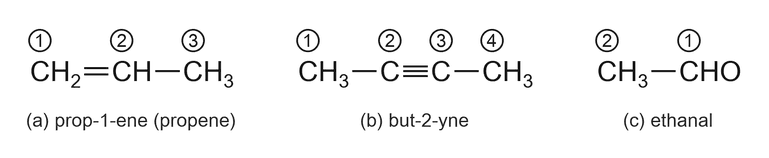
Step 4 — (ii)(a) Compare the ionisation potentials.
Potassium is below sodium in Group 1. Its outermost electron is in a shell farther from the nucleus and more shielded, so less energy is needed to remove it: the ionisation potential of K is less than that of Na.
Step 5 — (ii)(b) Compare the electronegativities.
Iodine is below chlorine in Group 17. It is a larger atom, so its nucleus attracts a shared pair of electrons less strongly: the electronegativity of I is less than that of Cl.
Watch out: Always find the longest chain first and number it from the end nearer the functional group, multiple bond or branch.
Therefore, (i) (a) prop-1-ene, (b) but-2-yne, (c) ethanal; (ii) (a) K < Na, (b) I < Cl.
- 63 marks
Question 6
Write a balanced chemical equation for each of the following:
(i) Burning of ethane in plentiful supply of air.
(ii) Action of water on Calcium carbide.
(iii) Heating of Ethanol at 170°C in the presence of conc. Sulphuric acid.
Solve with AIWritten solution
Solution:
Concept: Write the correct formula of every substance, then balance the atoms of each element.
Step 1 — (i) Burning of ethane in plenty of air.
Ethane burns completely to carbon dioxide and water. Two give 4 and 6 , which need 8 + 6 = 14 O atoms, that is 7 . Check: C 4 = 4, H 12 = 12, O 14 = 14.
Step 2 — (ii) Water on calcium carbide.
Calcium carbide reacts with water at room temperature, giving ethyne (acetylene) and calcium hydroxide. Check: Ca 1 = 1, C 2 = 2, H 4 = 2 + 2, O 2 = 2.
Step 3 — (iii) Ethanol with conc. sulphuric acid at 170 °C.
Dehydration: concentrated sulphuric acid (in excess, at 170 °C) removes a molecule of water from ethanol (–OH from one carbon, –H from the next), forming the C=C double bond of ethene.

Watch out: In (i), multiply the whole equation by 2 to avoid writing 7/2 O₂.
Therefore, (i) 2C₂H₆ + 7O₂ → 4CO₂ + 6H₂O; (ii) CaC₂ + 2H₂O → Ca(OH)₂ + C₂H₂; (iii) C₂H₅OH → C₂H₄ + H₂O (conc. H₂SO₄, 170 °C).
- 73 marks
Question 7
Give the structural formulae of each of the following :
(i) 2-methyl propane
(ii) Ethanoic acid
(iii) Butan-2-ol
Solve with AIWritten solution
Solution:
Concept: To draw a structure from a name, read it backwards: the root gives the chain length, the suffix the bond or group, and the locant where it sits. Draw the chain, put in the bond, group or branch, then add H atoms until every carbon has four bonds (O two, H and halogens one).
Step 1 — (i) 2-methylpropane.
Draw a 3-carbon chain (propane) and put a – branch on C-2. The formula is , an isomer of butane.
Step 2 — (ii) Ethanoic acid.
Two carbons; C-1 is the carboxyl carbon (–COOH): .
Step 3 — (iii) Butan-2-ol.
Butan-2-ol has a 4-carbon chain with the –OH group on C-2: , formula .
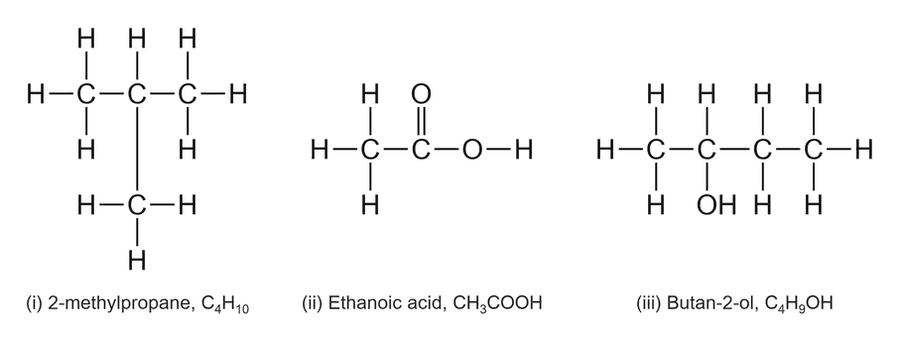
In each structure every carbon atom has exactly four bonds.
Watch out: Count four bonds on every carbon before you finish; a missing H is the commonest slip.
Therefore, the structures are 2-methylpropane CH₃–CH(CH₃)–CH₃, ethanoic acid CH₃COOH and butan-2-ol CH₃–CH(OH)–CH₂–CH₃, as drawn.
- 82 marks
Question 8
Equation for the reaction when compound A is bubbled through bromine dissolved in carbon tetrachloride is as follows:
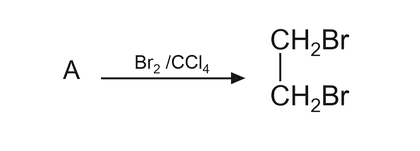
(i) Draw the structure of A.
(ii) State your observation during this reaction.
Solve with AIWritten solution
Solution:
Concept: The product has one bromine atom on each of two neighbouring carbons. That happens when adds across a C=C double bond, so A is an alkene with two carbons.
Step 1 — (i) Work out A.
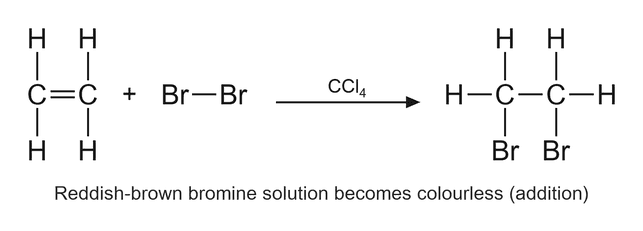
Removing the two Br atoms from the product leaves , so A is ethene, : two carbon atoms joined by a double bond, each also carrying two hydrogen atoms.
Step 2 — (i) Write the reaction.
Bromine adds across the double bond.
Step 3 — (ii) State the observation.
The reddish-brown colour of the bromine solution disappears (it becomes colourless), because the bromine is used up to form colourless 1,2-dibromoethane.
Watch out: This decolourisation is the test for unsaturation; alkanes do not decolourise bromine in CCl₄ in the dark.
Therefore, (i) A is ethene, CH₂=CH₂; (ii) the reddish-brown colour of bromine disappears.
- 91 mark
Question 9
Fill in the blanks from the choices given in brackets:
The compound formed when ethene reacts with Hydrogen is .............. (, , )
Solve with AIWritten solution
Solution:
Concept: Hydrogenation is the addition of hydrogen to an unsaturated compound. Ethene and hydrogen passed over finely divided nickel at about 200 °C (or platinum/palladium at room temperature) give ethane.
Step 1 — Count the carbons.
Ethene has two carbon atoms. Adding hydrogen does not change the number of carbons, so the product also has two.
Step 2 — Write the reaction.
One molecule of hydrogen adds across the double bond.
has one carbon and has three, so neither can come from ethene by adding hydrogen.
Therefore, the compound formed is C₂H₆ (ethane).
- 101 mark
Question 10
If the molecular formula of an organic compound is it is:
Solve with AIAnswer
(A) alkene
(B) alkane
- Correct
(C) alkyne
(D) Not a hydrocarbon
Answer: (C) alkyne
Concept: Each hydrocarbon series has a general formula: alkanes (single bonds) , alkenes (one C=C) , alkynes (one C≡C) , where n is the number of carbon atoms.
Step 1 — Count the atoms.
In there are n = 10 carbon atoms and 18 hydrogen atoms.
Step 2 — Test each general formula with n = 10.
Put n = 10 into each formula and compare with 18:
- alkane, : 2 × 10 + 2 = 22, which does not fit;
- alkene, : 2 × 10 = 20, which does not fit;
- alkyne, : 2 × 10 − 2 = 18, which fits.
Step 3 — Conclude.
fits the alkyne formula, for example dec-1-yne.
Watch out: is also the formula of dienes and of ring compounds with one double bond, but at this level it is the alkyne formula.
Why the other options are wrong:
- (A) alkene: an alkene with ten carbons is , with two more hydrogen atoms.
- (B) alkane: an alkane with ten carbons is decane, .
- (D) Not a hydrocarbon: the compound contains only carbon and hydrogen, so it is a hydrocarbon.
Therefore, C₁₀H₁₈ is an alkyne, option (C).
- 111 mark
Question 11
Identify the substance underlined, in each of the following cases:
An organic compound containing -- COOH functional group.
Solve with AIWritten solution
Solution:
Concept: The –COOH group is the carboxyl group, the functional group of the carboxylic acids.
Step 1 — Name the group.
–COOH is a C=O and an –OH on the same carbon: the carboxyl group.
Step 2 — Name the compound.
An organic compound containing it is a carboxylic acid; the common example is acetic acid (ethanoic acid), . Methanoic acid (HCOOH) and propanoic acid () also contain it.

Watch out: –CHO is the aldehyde group and –OH the alcohol group; only –COOH makes an acid.
Therefore, the compound is a carboxylic acid, e.g. ethanoic (acetic) acid, CH₃COOH.
- 121 mark
Question 12
Write a balanced chemical equation for each of the following:
Preparation of methane from iodomethane.
Solve with AIWritten solution
Solution:
Concept: Nascent hydrogen [H], made by a zinc–copper couple in alcohol, reduces a haloalkane: the halogen atom is replaced by a hydrogen atom, giving the alkane.
Step 1 — Choose the reagent.
Iodomethane (methyl iodide, ) is reduced by nascent hydrogen from a zinc–copper couple and alcohol.
Step 2 — Write the balanced equation.
Two [H] are used: one replaces the iodine atom, the other takes it away as HI. Check: C 1 = 1, H 5 = 4 + 1, I 1 = 1.
[H] stands for nascent (newly formed) hydrogen.
Therefore, CH₃I + 2[H] → CH₄ + HI (Zn–Cu couple, alcohol).
- 131 mark
Question 13
State one relevant observation for each of the following reactions:
Addition of ethyl alcohol to acetic acid in the presence of concentrated Sulphuric acid.
Solve with AIWritten solution
Solution:
Concept: Esterification: a carboxylic acid and an alcohol, warmed with a little concentrated sulphuric acid, form an ester and water. The acid catalyses the reaction and takes up the water. Esters have a pleasant, fruity smell.
Step 1 — Name the reaction.
Acetic acid and ethyl alcohol with conc. sulphuric acid undergo esterification, forming ethyl acetate (ethyl ethanoate).
Step 2 — State the observation.
A pleasant, fruity smell is noticed: the smell of the ester ethyl acetate.

Watch out: The vinegar smell of the acid is replaced by a fruity smell; that change is the observation.
Therefore, a pleasant fruity smell (of ethyl acetate) is observed.
- 145 marks
Question 14
(i) Draw the structural formula for each of the following:
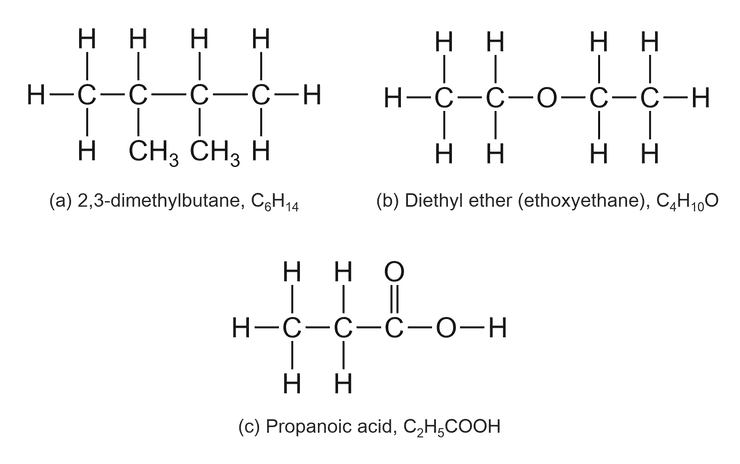
(a) 2, 3 – dimethyl butane
(b) Diethyl ether
(c) Propanoic acid
(ii) From the list of terms given, choose the most appropriate term to match the given description.
(calcination, roasting, pulverisation, smelting)
(a) Crushing of the ore into a fine powder.
(b) Heating of the ore in the absence of air to a high temperature.
Solve with AIWritten solution
Solution:
Concept: To draw a structure from a name, read it backwards: the root gives the chain length, the suffix the bond or group, and the locant where it sits. Draw the chain, put in the bond, group or branch, then add H atoms until every carbon has four bonds (O two, H and halogens one).
Step 1 — (i)(a) 2,3-dimethylbutane.
2,3-dimethylbutane has a 4-carbon chain with one – on C-2 and one on C-3: , formula .
Step 2 — (i)(b) Diethyl ether (ethoxyethane).
Diethyl ether has two ethyl groups joined through an oxygen atom: , formula .
Step 3 — (i)(c) Propanoic acid.
Propanoic acid has a 3-carbon chain ending in the carboxyl group: .
Step 4 — (ii)(a) Crushing the ore.
Crushing the ore into a fine powder is pulverisation.
Step 5 — (ii)(b) Heating without air.
Heating the ore to a high temperature in the absence (or limited supply) of air is calcination. Roasting is heating in excess air, and smelting is reducing the ore in a furnace.
Watch out: Count four bonds on every carbon before you finish; a missing H is the commonest slip.
Therefore, (i) the three structures are as drawn; (ii) (a) pulverisation, (b) calcination.
- 154 marks
Question 15
Identify the term or substance based on the descriptions given below:
(i) Ice like crystals formed on cooling an organic acid sufficiently.
(ii) Hydrocarbon containing a triple bond used for welding purposes.
(iii) The property by virtue of which the compound has the same molecular formula but different structural formulae.
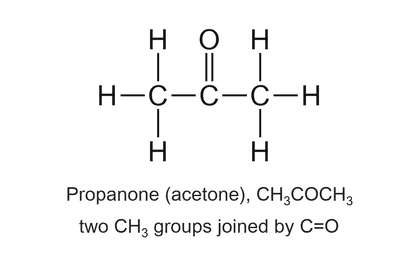
(iv) The compound formed where two alkyl groups are linked by group.
Solve with AIWritten solution
Solution:
Concept: Each description is a property, use or structural feature named in the chapter.
Step 1 — (i) Ice-like crystals of an organic acid.
Pure (anhydrous) acetic acid freezes at about 17 °C (16.6 °C) into an ice-like solid that looks like a glacier, so it is called glacial acetic acid.
Step 2 — (ii) Hydrocarbon with a triple bond used for welding.
Ethyne (acetylene), , burns in oxygen with a very hot flame (the oxy-acetylene flame) used to cut and weld metals.
Step 3 — (iii) Same molecular formula, different structures.
This property is isomerism.
Step 4 — (iv) Two alkyl groups linked by a C=O group.
A carbonyl group joined to two alkyl groups makes a ketone; the simplest is propanone (acetone), .
Watch out: If the C=O carbon carries an H atom, the compound is an aldehyde, not a ketone.
Therefore, (i) glacial acetic acid; (ii) ethyne (acetylene); (iii) isomerism; (iv) a ketone, e.g. propanone.
- 162 marks
Question 16
Give a balanced chemical equation for each of the following:
(i) Preparation of ethane from Sodium propionate
(ii) Action of alcoholic KOH on bromoethane.
Solve with AIWritten solution
Solution:
Concept: Decarboxylation: the sodium salt of a carboxylic acid heated with soda lime (NaOH + CaO) loses its –COONa group as sodium carbonate, giving an alkane with one carbon fewer. Dehydrohalogenation: boiling a haloalkane with alcoholic KOH removes a hydrogen halide (H from one carbon, halogen from the next), forming a double bond. With aqueous alkali the halogen is replaced by –OH instead, giving an alcohol.
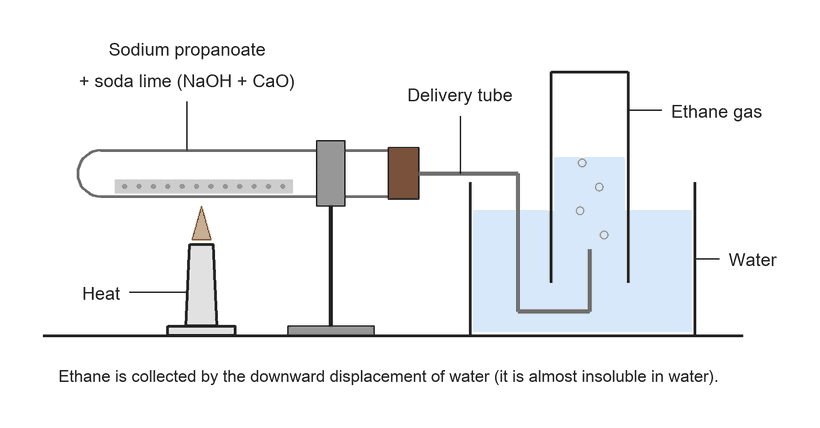
Step 1 — (i) Ethane from sodium propionate.
Sodium propionate (sodium propanoate) has 3 carbons; heated with soda lime it gives ethane, which has one carbon fewer (two). Check: C 3 = 2 + 1, H 6 = 6, O 3 = 3, Na 2 = 2.
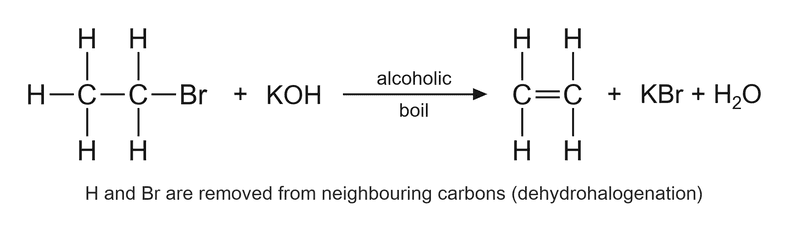
Step 2 — (ii) Alcoholic KOH on bromoethane.
Boiling with alcoholic KOH removes HBr, forming ethene. Check: C 2 = 2, H 6 = 4 + 2, Br 1 = 1, K 1 = 1, O 1 = 1.
Watch out: AQUEOUS alkali gives the alcohol; ALCOHOLIC alkali gives the alkene.
Therefore, (i) C₂H₅COONa + NaOH → C₂H₆ + Na₂CO₃ (CaO, heat); (ii) C₂H₅Br + KOH (alc.) → C₂H₄ + KBr + H₂O.
- 171 mark
Question 17
The organic compound which undergoes substitution reaction is:
Solve with AIAnswer
(A)
(B)
(C)
- Correct
(D)
Answer: (D)
Concept: Saturated hydrocarbons (alkanes) have only single bonds, so nothing can add to them. They react by substitution: a hydrogen atom is replaced by another atom, such as chlorine, in sunlight.
Step 1 — Classify each formula.
fits (for n = 2 the formula gives 2 × 2 + 2, six hydrogen atoms), so it is ethane, an alkane; and fit and fits , so they are unsaturated.
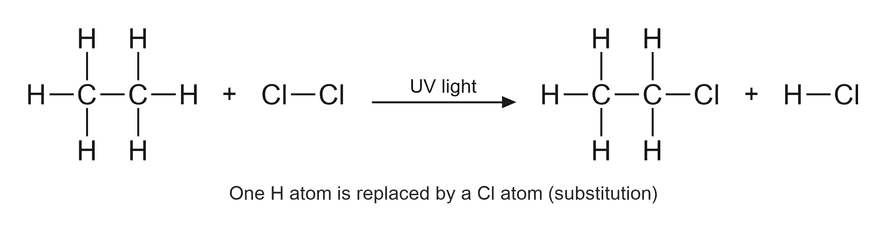
Step 2 — Show the substitution.
In ultraviolet light a hydrogen atom of ethane is replaced by chlorine.
Watch out: Unsaturated hydrocarbons CAN be substituted under special conditions, but their characteristic reaction is addition.
Why the other options are wrong:
- (A) : is ethyne, an alkyne with a triple bond; its characteristic reactions are additions.
- (B) : is ethene, an alkene with a double bond; it undergoes addition.
- (C) : fits , an unsaturated (alkyne) formula, so it too undergoes addition.
Therefore, the compound that undergoes substitution is C₂H₆, option (D).
- 181 mark
Question 18
The IUPAC name of dimethyl ether is:
Solve with AIAnswer
(A) Ethoxy methane
- Correct
(B) Methoxy methane
(C) Methoxy ethane
(D) Ethoxy ethane
Answer: (B) Methoxy methane
Concept: An ether R–O–R′ is named alkoxy + alkane: the smaller group with the oxygen becomes the alkoxy prefix (methoxy, ethoxy) and the larger group gives the alkane name.
Step 1 — Write the structure.
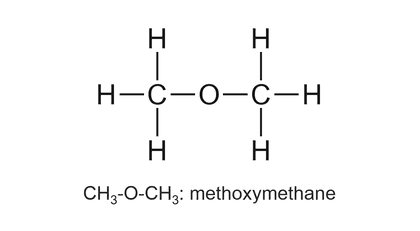
Dimethyl ether is : two methyl groups joined by an oxygen atom.
Step 2 — Name it.
One part is the methoxy group and the other part is methane, so the name is methoxymethane.
Why the other options are wrong:
- (A) Ethoxy methane: ethoxymethane is , which has an ethyl group.
- (C) Methoxy ethane: methoxyethane is , the same compound as (A), again with an ethyl group.
- (D) Ethoxy ethane: ethoxyethane is diethyl ether, .
Therefore, the IUPAC name of dimethyl ether is methoxymethane, option (B).
- 191 mark
Question 19
Give one word or a phrase for the following statements:
The tendency of an element to form chains of identical atoms.
Solve with AIWritten solution
Solution:
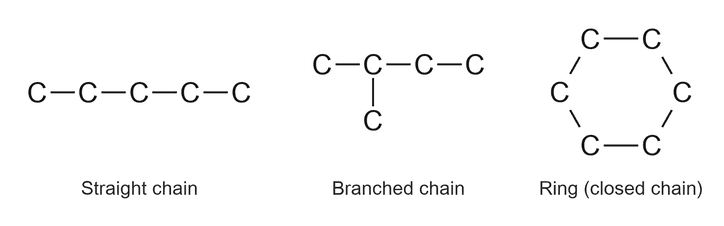
Concept: Catenation is the property of an element to link with atoms of the same element to form long straight chains, branched chains and rings. Carbon shows it most, because the C–C bond is strong and carbon has a valency of four.
Step 1 — Read the description.
Forming chains of identical atoms means an atom bonding to atoms of its own element again and again.
Step 2 — Name the property.
This is catenation; the chains may be straight, branched or closed into rings.
Therefore, the term is catenation.
- 205 marks
Question 20
(i) Give the IUPAC name for each of the following:
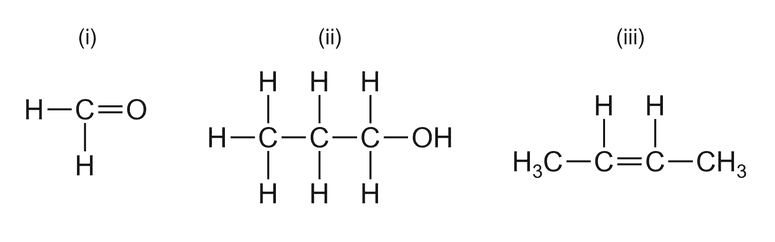
(ii) Write the structural formula of the two isomers of butane.
Solve with AIWritten solution
Solution:
Concept: An IUPAC name is built as locant + prefix (branch or halogen) + root + suffix. The root counts the carbons of the longest chain that contains the functional group or multiple bond (meth 1, eth 2, prop 3, but 4, pent 5). The chain is numbered from the end that gives the lowest number to the functional group (a –CHO or –COOH carbon is always C-1), then to the double or triple bond, then to the branches. The suffix shows the family: -ane, -ene, -yne, -ol, -al, -oic acid. Isomers are compounds with the same molecular formula but different structural formulae; the property is called isomerism. Different structures give different properties (e.g. boiling points).
Step 1 — (i)(1) Name HCHO.
HCHO has one carbon carrying the aldehyde group, so it is methanal (formaldehyde).
Step 2 — (i)(2) Name the alcohol.
has three carbons with –OH on the end carbon, numbered C-1: propan-1-ol.
Step 3 — (i)(3) Name the alkene.
has four carbons with the double bond starting at C-2: but-2-ene.

Step 4 — (ii) Draw the two isomers of butane.
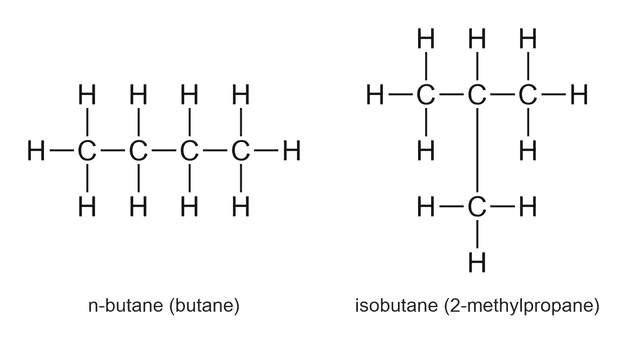
Four carbon atoms () can be joined in only two ways:
- n-butane (butane): a straight chain, ;
- isobutane (2-methylpropane): a 3-carbon chain with a – on the middle carbon, .
Watch out: Always find the longest chain first and number it from the end nearer the functional group, multiple bond or branch.
Therefore, (i) methanal, propan-1-ol, but-2-ene; (ii) n-butane and 2-methylpropane (isobutane).
- 211 mark
Question 21
Name the gas that is produced in each of the following cases:
Reaction of ethanol and sodium.
Solve with AIWritten solution
Solution:
Concept: Sodium reacts with the –OH group of ethanol (as with water, but more gently), setting free hydrogen and forming sodium ethoxide.
Step 1 — Write the reaction.
Sodium displaces hydrogen from the –OH group of ethanol. Check: C 4 = 4, H 12 = 10 + 2, O 2 = 2, Na 2 = 2.
Step 2 — Name the gas.
The gas given off is hydrogen; the other product is sodium ethoxide. The gas burns with a 'pop' sound.

Therefore, the gas produced is hydrogen.
- 226 marks
Question 22
Complete the following table which relates to the homologous series of hydrocarbons.
General formula IUPAC name of the homologous series Characteristic bond type IUPAC name of the first member of the series (A) ............... (B) ............... (C)............... (D)............... (E) ............... (F)............... Solve with AIWritten solution
Solution:
Concept: Each hydrocarbon series has a general formula: alkanes (single bonds) , alkenes (one C=C) , alkynes (one C≡C) , where n is the number of carbon atoms.
Step 1 — Identify the series.
is the alkynes (one C≡C triple bond); is the alkanes (single bonds only).
Step 2 — Find the first alkyne.
A triple bond needs two carbon atoms, so the smallest alkyne has n = 2. Its number of hydrogen atoms is:
This gives , ethyne.
Step 3 — Find the first alkane.
The smallest alkane has n = 1. Its number of hydrogen atoms is:
This gives , methane.
Step 4 — Complete the table.
The table is completed with these results:
General formula Series Characteristic bond First member (A) Alkynes (B) Triple bond (C≡C) (C) Ethyne (D) Alkanes (E) Single bond (C–C) (F) Methane 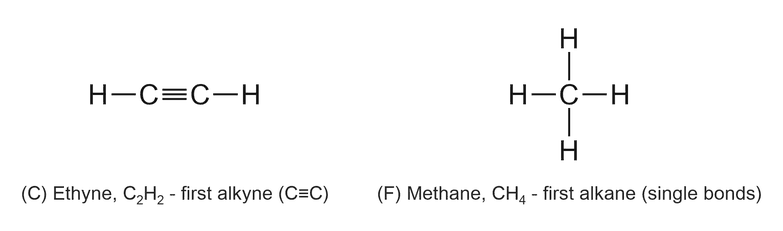
Watch out: The first alkyne cannot have n = 1: one carbon cannot form a C≡C bond.
Therefore, (A) alkynes, (B) triple bond, (C) ethyne, (D) alkanes, (E) single bond, (F) methane.
- 234 marks
Question 23
A compound X (having vinegar like smell) when treated with ethanol in the presence of the acid Z, gives a compound Y which has a fruity smell.
The reaction is:
(i) Identify Y and Z.
(ii) Write the structural formula of X.
(iii) Name the above reaction.
Solve with AIWritten solution
Solution:
Concept: A vinegar-like smell means acetic (ethanoic) acid. Esterification: a carboxylic acid and an alcohol, warmed with a little concentrated sulphuric acid, form an ester and water. The acid catalyses the reaction and takes up the water. Esters have a pleasant, fruity smell.
Step 1 — Identify X.
X smells of vinegar and reacts with ethanol, so X is acetic acid (ethanoic acid).
Step 2 — (i) Identify Y and Z.
Y, the fruity-smelling product, is the ester ethyl acetate (ethyl ethanoate), . Z is concentrated sulphuric acid, which catalyses the reaction and takes up the water.
Step 3 — (ii) Structural formula of X.
Acetic acid is a methyl group joined to the carboxyl group: .

Step 4 — (iii) Name the reaction.
An acid and an alcohol forming an ester and water is esterification.
Watch out: Z is only a catalyst: it is written over the arrow, not as a reactant.
Therefore, (i) Y is ethyl acetate and Z conc. H₂SO₄; (ii) X is CH₃COOH; (iii) esterification.
- 241 mark
Question 24
A hydrocarbon which is a greenhouse gas is:
Solve with AIAnswer
(A) Acetylene
(B) Ethylene
(C) Ethane
- Correct
(D) Methane
Answer: (D) Methane
Concept: A greenhouse gas lets sunlight through but absorbs the heat (infrared) radiated back by the earth, so it traps heat in the atmosphere.
Step 1 — Methane traps heat.
Methane, the main part of natural gas, absorbs the heat radiated by the earth, so it adds to the greenhouse effect. Over 100 years one kilogram of methane traps about 28 times as much heat as one kilogram of carbon dioxide.
Step 2 — Its sources.
Paddy fields, cattle, landfills, marshes, coal mines and leaks of natural gas release it in large amounts.
Why the other options are wrong:
- (A) Acetylene: acetylene (ethyne) is made for welding and as a chemical; it is not released into the air in large amounts and is not one of the main greenhouse gases.
- (B) Ethylene: ethylene (ethene) is used to make polythene and to ripen fruit; it is not the hydrocarbon named as a greenhouse gas.
- (C) Ethane: ethane occurs with methane in natural gas, but in much smaller amounts; methane is the hydrocarbon listed as the greenhouse gas.
Therefore, the hydrocarbon that is a greenhouse gas is methane, option (D).
- 251 mark
Question 25
Fill in the blanks with the choices given in brackets:
Conversion of ethanol to ethene by the action of concentrated sulphuric acid is an example of ............... (dehydration/dehydrogenation/dehydrohalogenation)
Solve with AIWritten solution
Solution:
Concept: Dehydration: concentrated sulphuric acid (in excess, at 170 °C) removes a molecule of water from ethanol (–OH from one carbon, –H from the next), forming the C=C double bond of ethene.
Step 1 — See what is removed.
Ethanol () becomes ethene (): the difference is , so water is removed.
Step 2 — Compare the three words.
Dehydrogenation removes hydrogen alone; dehydrohalogenation removes a hydrogen halide (as when bromoethane gives ethene with alcoholic KOH); removing water is dehydration.
Therefore, conversion of ethanol to ethene by conc. H₂SO₄ is an example of dehydration.
- 261 mark
Question 26
Fill in the blanks with the choices given in brackets:
Substitution reactions are characteristic reactions of ............... (alkynes / alkenes / alkanes)
Solve with AIWritten solution
Solution:
Concept: Saturated hydrocarbons (alkanes) have only single bonds, so nothing can add to them. They react by substitution: a hydrogen atom is replaced by another atom, such as chlorine, in sunlight.
Step 1 — Choose the saturated series.
Alkanes have only single bonds; alkenes and alkynes are unsaturated and react by addition.
Step 2 — Show a substitution.
In diffused sunlight one hydrogen atom of methane is replaced by chlorine.

Therefore, substitution reactions are characteristic reactions of alkanes.
- 271 mark
Question 27
Write a balanced chemical equation for each of the following reactions:
Chlorine gas is reacted with ethene.
Solve with AIWritten solution
Solution:
Concept: Unsaturated hydrocarbons (alkenes C=C, alkynes C≡C) react by addition: one bond of the double or triple bond opens and a molecule such as H₂, Cl₂ or Br₂ adds across it, giving a single product.
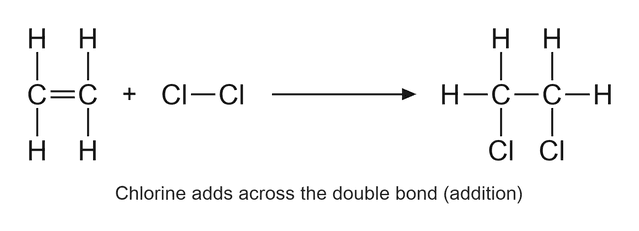
Step 1 — Decide the type of reaction.
Ethene is unsaturated, so chlorine adds across its double bond, one chlorine atom on each carbon.
Step 2 — Write the balanced equation.
Check: C 2 = 2, H 4 = 4, Cl 2 = 2.
The product is 1,2-dichloroethane.
Watch out: This is addition, so no HCl is formed (HCl forms only in substitution).
Therefore, CH₂=CH₂ + Cl₂ → CH₂Cl–CH₂Cl.
- 285 marks
Question 28
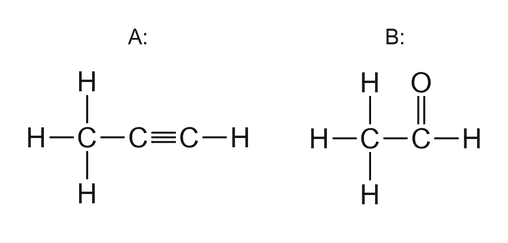
(i) Give the IUPAC name of the following organic compounds:
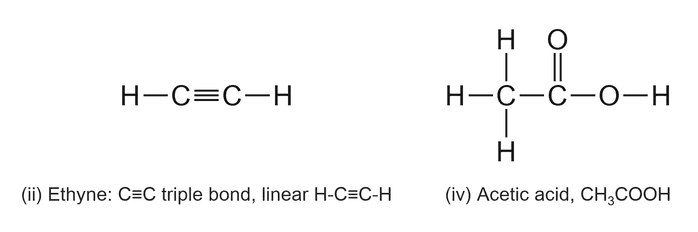
(ii) What is the special feature of the structure of ethyne?
(iii) Name the saturated hydrocarbon containing two carbon atoms.
(iv) Give the structural formula of acetic acid.
Solve with AIWritten solution
Solution:
Concept: An IUPAC name is built as locant + prefix (branch or halogen) + root + suffix. The root counts the carbons of the longest chain that contains the functional group or multiple bond (meth 1, eth 2, prop 3, but 4, pent 5). The chain is numbered from the end that gives the lowest number to the functional group (a –CHO or –COOH carbon is always C-1), then to the double or triple bond, then to the branches. The suffix shows the family: -ane, -ene, -yne, -ol, -al, -oic acid.
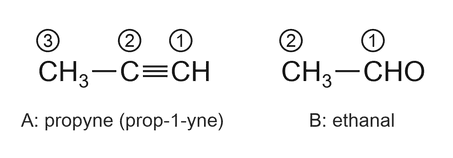
Step 1 — (i) Name A.
has three carbons with the triple bond starting at C-1: propyne (prop-1-yne).
Step 2 — (i) Name B.
has two carbons, the end one carrying the aldehyde group: ethanal.
Step 3 — (ii) Special feature of ethyne.
The two carbon atoms are joined by a triple covalent bond (C≡C), and each also holds one hydrogen atom. The molecule H–C≡C–H is linear: all four atoms lie in a straight line. The triple bond makes ethyne highly unsaturated and reactive.
Step 4 — (iii) Saturated hydrocarbon with two carbons.
The alkane with n = 2 is ethane, .
Step 5 — (iv) Structural formula of acetic acid.
Acetic acid is a methyl group joined to the carboxyl group: .
Watch out: Always find the longest chain first and number it from the end nearer the functional group, multiple bond or branch.
Therefore, (i) A propyne, B ethanal; (ii) a C≡C triple bond in a linear molecule; (iii) ethane; (iv) CH₃COOH as drawn.
- 291 mark
Question 29
Arrange the following according to the instructions given in brackets:
Ethane, methane, ethene, ethyne. (In the increasing order of the molecular weight) [H = 1, C = 12]
Solve with AIWritten solution
Solution:
Concept: The molecular weight is the sum of the atomic masses of all the atoms (C = 12, H = 1).
Step 1 — Work out each molecular weight.
Add 12 for each carbon and 1 for each hydrogen:
- methane, : 12 + 4 × 1 = 16;
- ethyne, : 2 × 12 + 2 × 1 = 26;
- ethene, : 2 × 12 + 4 × 1 = 28;
- ethane, : 2 × 12 + 6 × 1 = 30.
Step 2 — Arrange them.
Arranged in increasing order, the values are 16 < 26 < 28 < 30. The three two-carbon compounds differ only in their number of hydrogen atoms.
Therefore, the order is methane < ethyne < ethene < ethane.
- 303 marks
Question 30
Write a balanced chemical equation for the preparation of:
(i) Ethene from bromoethane
(ii) Ethyne using calcium carbide
(iii) Methane from sodium acetate.
Solve with AIWritten solution
Solution:
Concept: (i) Dehydrohalogenation: boiling a haloalkane with alcoholic KOH removes a hydrogen halide (H from one carbon, halogen from the next), forming a double bond. With aqueous alkali the halogen is replaced by –OH instead, giving an alcohol. (ii) Calcium carbide reacts with water at room temperature, giving ethyne (acetylene) and calcium hydroxide. (iii) Decarboxylation: the sodium salt of a carboxylic acid heated with soda lime (NaOH + CaO) loses its –COONa group as sodium carbonate, giving an alkane with one carbon fewer.
Step 1 — (i) Ethene from bromoethane.
Bromoethane is boiled with alcoholic KOH. Check: C 2 = 2, H 6 = 6, Br 1 = 1, K 1 = 1, O 1 = 1.
Step 2 — (ii) Ethyne from calcium carbide.
Water is added to calcium carbide at room temperature.
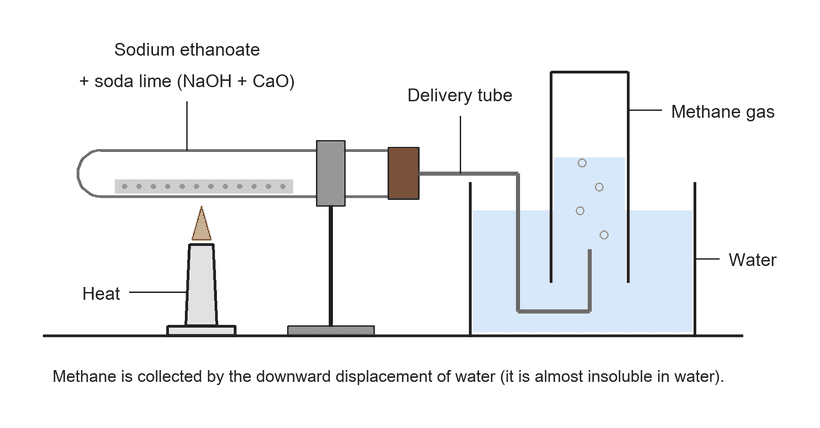
Step 3 — (iii) Methane from sodium acetate.
Sodium acetate (sodium ethanoate) is heated with soda lime. Check: C 2 = 1 + 1, H 4 = 4, O 3 = 3, Na 2 = 2.
Watch out: AQUEOUS alkali gives the alcohol; ALCOHOLIC alkali gives the alkene.
Therefore, (i) C₂H₅Br + KOH (alc.) → C₂H₄ + KBr + H₂O; (ii) CaC₂ + 2H₂O → Ca(OH)₂ + C₂H₂; (iii) CH₃COONa + NaOH → CH₄ + Na₂CO₃.
- 314 marks
Question 31
Name the following organic compounds:
(i) The compound with 3 carbon atoms whose functional group is a carboxyl.
(ii) The first homologue whose general formula is
(iii) The compound that reacts with acetic acid to form ethyl ethanoate.
(iv) The compound formed by complete chlorination of ethyne.
Solve with AIWritten solution
Solution:
Concept: Match each clue with a name: the number of carbon atoms gives the root, and the functional group or bond gives the ending.
Step 1 — (i) Three carbons with a carboxyl group.
The root prop- with the ending -oic acid gives propanoic acid, .
Step 2 — (ii) First member of the alkenes.
is the general formula of the alkenes; a double bond needs two carbons, so the smallest has n = 2: ethene, .
Step 3 — (iii) Reacts with acetic acid to give ethyl ethanoate.
The ethyl part of the ester comes from the alcohol, so it is ethanol, .
Step 4 — (iv) Complete chlorination of ethyne.
Two molecules of chlorine add across the triple bond, giving 1,1,2,2-tetrachloroethane. Check: C 2 = 2, H 2 = 2, Cl 4 = 4.
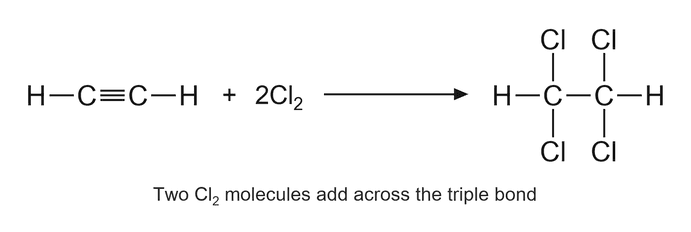
Therefore, (i) propanoic acid; (ii) ethene; (iii) ethanol; (iv) 1,1,2,2-tetrachloroethane.
- 321 mark
Question 32
The organic compound having a triple carbon-carbon covalent bond, is:
Solve with AIAnswer
- Correct
(A)
(B)
(C)
(D)
Answer: (A)
Concept: A carbon–carbon triple bond makes a compound an alkyne, general formula .
Step 1 — Test the three-carbon formulae.
For three carbons (n = 3) the alkyne formula gives this number of hydrogen atoms:
So the three-carbon alkyne is .
Step 2 — Name it.
is propyne, .
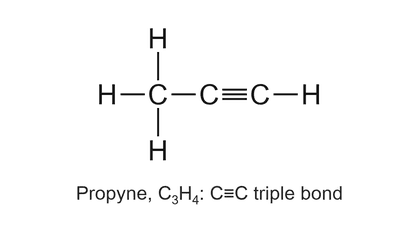
Why the other options are wrong:
- (B) : fits : propene, with a C=C double bond.
- (C) : fits : propane, single bonds only.
- (D) : fits : butane, single bonds only.
Therefore, the compound with a carbon–carbon triple bond is C₃H₄, option (A).
- 331 mark
Question 33
State one relevant observation for each of the following reactions:
(iii) A piece of sodium metal is put into ethanol at room temperature.
Solve with AIWritten solution
Solution:
Concept: Sodium reacts with the –OH group of ethanol (as with water, but more gently), setting free hydrogen and forming sodium ethoxide.
Step 1 — Write the reaction.
Sodium displaces hydrogen from ethanol.
Step 2 — State the observation.
There is brisk effervescence: bubbles of a colourless gas (hydrogen) are given off, and the piece of sodium gets smaller and finally disappears. The gas burns with a 'pop' sound.
Watch out: The reaction is much gentler than that of sodium with water: the sodium does not catch fire.
Therefore, brisk effervescence of hydrogen gas is seen and the sodium slowly disappears.
- 341 mark
Question 34
Write a balanced chemical equation for each of the following:
(iv) Producing ethane from bromo ethane using Zn/Cu couple in alcohol.
Solve with AIWritten solution
Solution:
Concept: Nascent hydrogen [H], made by a zinc–copper couple in alcohol, reduces a haloalkane: the halogen atom is replaced by a hydrogen atom, giving the alkane.
Step 1 — Choose the reagent.
Bromoethane is reduced by nascent hydrogen from a zinc–copper couple in alcohol.
Step 2 — Write the balanced equation.
The bromine atom is replaced by hydrogen and leaves as HBr. Check: C 2 = 2, H 7 = 6 + 1, Br 1 = 1.
Therefore, C₂H₅Br + 2[H] → C₂H₆ + HBr (Zn–Cu couple, alcohol).
- 351 mark
Question 35
Write a balanced chemical equation for each of the following:
(v) Complete combustion of ethane.
Solve with AIWritten solution
Solution:
Concept: In complete combustion (plenty of air) every carbon atom of a hydrocarbon becomes carbon dioxide and every hydrogen atom ends up in water; a large amount of heat is given out.
Step 1 — Write the products.
Ethane burns completely to carbon dioxide and water.
Step 2 — Balance the equation.
Two give 4 and 6 , which need 8 + 6 = 14 O atoms, that is 7 . Check: C 4 = 4, H 12 = 12, O 14 = 14.
Watch out: With too little air, carbon monoxide (and soot) forms instead: that is incomplete combustion.
Therefore, 2C₂H₆ + 7O₂ → 4CO₂ + 6H₂O.
- 365 marks
Question 36
(i) Draw the structural formula for each of the following:
-
2,2 dimethyl pentane
-
methanol
-
Iso propane
(ii) Write the IUPAC name for the following compounds:
-
acetaldehyde
-
acetylene
Solve with AIWritten solution
Solution:
Concept: To draw a structure from a name, read it backwards: the root gives the chain length, the suffix the bond or group, and the locant where it sits. Draw the chain, put in the bond, group or branch, then add H atoms until every carbon has four bonds (O two, H and halogens one).
Step 1 — (i)1. 2,2-dimethylpentane.
2,2-dimethylpentane has a 5-carbon chain with two – groups on C-2; its formula is .
Step 2 — (i)2. Methanol.
Methanol, , has one carbon with three H atoms and an –OH group.
Step 3 — (i)3. Iso propane.
Propane, , has only one possible structure, , because three carbon atoms can form only one chain, so no compound is called iso propane. The structure drawn is propane. If isopropyl alcohol was meant, it is propan-2-ol, , also drawn.
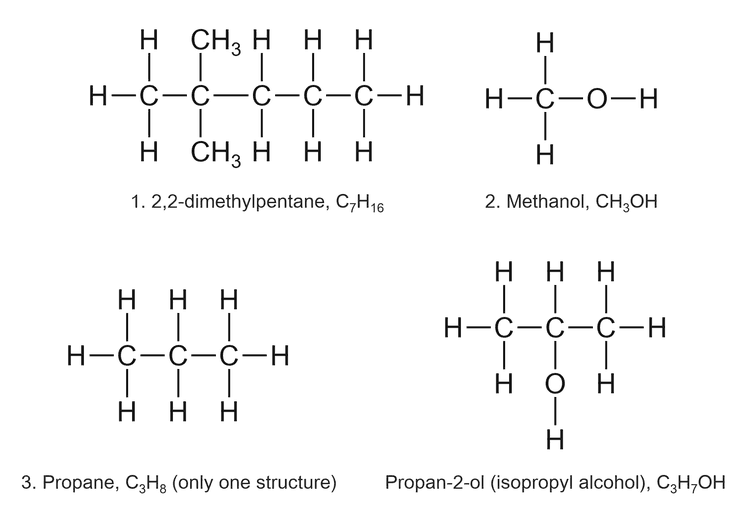
Step 4 — (ii)1. Acetaldehyde.
has two carbons and the aldehyde group: ethanal.
Step 5 — (ii)2. Acetylene.
, H–C≡C–H, has two carbons and a triple bond: ethyne.
Watch out: Count four bonds on every carbon before you finish; a missing H is the commonest slip.
Note: As printed, "iso propane" names no real compound; propane (and propan-2-ol, in case isopropyl alcohol was meant) is drawn.
Therefore, (i) the structures are as drawn (iso propane is just propane); (ii) ethanal and ethyne.
-
- 371 mark
Question 37
State one relevant reason for each of the following:
(ii) Soda lime is preferred to sodium hydroxide in the laboratory preparation of methane.
Solve with AIWritten solution
Solution:
Concept: Decarboxylation: the sodium salt of a carboxylic acid heated with soda lime (NaOH + CaO) loses its –COONa group as sodium carbonate, giving an alkane with one carbon fewer. Sodium hydroxide alone is deliquescent: it absorbs moisture from the air and becomes wet and sticky.
Step 1 — Problem with NaOH alone.
Sodium hydroxide absorbs moisture and becomes a sticky mass, and when fused it attacks the glass of the test tube.
Step 2 — How soda lime helps.
In soda lime the calcium oxide keeps the mixture dry. Soda lime is a porous, granular solid, so it mixes well with sodium acetate, the methane escapes easily, and the glass is not attacked.
Therefore, soda lime is preferred because sodium hydroxide alone is deliquescent (and attacks glass), while soda lime stays dry and porous.
- 381 mark
Question 38
Give one word or a phrase for the following statements:
(v) The reaction in which carboxylic acid reacts with alcohol in the presence of conc. to form a substance having a fruity smell.
Solve with AIWritten solution
Solution:
Concept: Esterification: a carboxylic acid and an alcohol, warmed with a little concentrated sulphuric acid, form an ester and water. The acid catalyses the reaction and takes up the water. Esters have a pleasant, fruity smell.
Step 1 — Recognise the reaction.
A carboxylic acid and an alcohol with conc. sulphuric acid give a fruity product, an ester.
Step 2 — Name it.
Making an ester is esterification; here ethanoic acid and ethanol give ethyl ethanoate.
Therefore, the reaction is esterification.
- 393 marks
Question 39
Draw the structures of isomers of pentane.
Solve with AIWritten solution
Solution:
Concept: Chain isomers have the same molecular formula but different arrangements of the carbon chain. Five carbon atoms () can be arranged in exactly three ways.
Step 1 — All five carbons in a line.
The straight chain is n-pentane (pentane), .
Step 2 — Four in the chain, one branch.
With one – on C-2 the isomer is isopentane (2-methylbutane), .
Step 3 — Three in the chain, two branches.
With two – groups on the middle carbon the isomer is neopentane (2,2-dimethylpropane), .
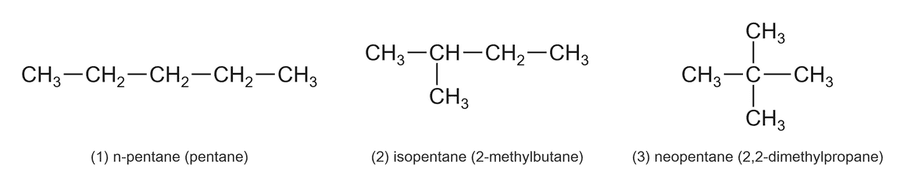
All three are but have different structures, so they have different properties (such as boiling points).
Watch out: A methyl on C-1 is not a branch: it just makes the chain longer.
Therefore, the three isomers are n-pentane, 2-methylbutane and 2,2-dimethylpropane.
- 404 marks
Question 40
Copy and complete the following paragraph using the options given in brackets:
Alkenes are a homologous series of (i) ............... (saturated / unsaturated) hydrocarbons characterized by the general formula (ii) ............... ( / ). Alkenes undergo (iii) ............... (addition / substitution) reactions and also undergo (iv) ............... (hydrogenation / dehydrogenation) to form alkanes.
Solve with AIWritten solution
Solution:
Concept: Alkenes contain one C=C double bond, so they are unsaturated and react by addition.
Step 1 — (i) and (ii) Type and formula.
One C=C bond makes them unsaturated, with the general formula .
Step 2 — (iii) Type of reaction.
The double bond opens and atoms add across it: addition reactions.
Step 3 — (iv) Forming alkanes.
Adding hydrogen gives the saturated alkane: hydrogenation.
Watch out: Dehydrogenation REMOVES hydrogen; an alkene becomes an alkane by ADDING hydrogen.
Therefore, (i) unsaturated, (ii) , (iii) addition, (iv) hydrogenation.
- 411 mark
Question 41
The IUPAC name of formic acid:
Solve with AIAnswer
(A) Propanoic acid
- Correct
(B) Methanoic acid
(C) Ethanoic acid
(D) Butanoic acid
Answer: (B) Methanoic acid
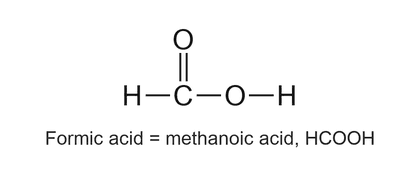
Concept: Formic acid is HCOOH. Its one carbon atom is the carboxyl carbon, so the root is meth- and a carboxylic acid ends in -oic acid.
Step 1 — Count the carbons.
HCOOH has one carbon, so the root is meth-.
Step 2 — Add the ending.
Methane + -oic acid gives methanoic acid.
Why the other options are wrong:
- (A) Propanoic acid: propanoic acid has three carbons, .
- (C) Ethanoic acid: ethanoic acid has two carbons, (acetic acid).
- (D) Butanoic acid: butanoic acid has four carbons, .
Therefore, the IUPAC name of formic acid is methanoic acid, option (B).
- 421 mark
Question 42
The catalyst used for the conversion of ethene to ethane:
Solve with AIAnswer
(A) Iron
- Correct
(B) Nickel
(C) Cobalt
(D) Molybdenum
Answer: (B) Nickel
Concept: Hydrogenation is the addition of hydrogen to an unsaturated compound. Ethene and hydrogen passed over finely divided nickel at about 200 °C (or platinum/palladium at room temperature) give ethane.
Step 1 — Write the reaction.
Ethene adds hydrogen over a heated metal catalyst.
Step 2 — Name the catalyst.
The catalyst used is finely divided nickel.
Why the other options are wrong:
- (A) Iron: iron is the catalyst of the Haber process for ammonia.
- (C) Cobalt: cobalt is not the catalyst used for this reaction; nickel, platinum or palladium are used.
- (D) Molybdenum: molybdenum is the promoter used with iron in the Haber process, not the hydrogenation catalyst.
Therefore, the catalyst for ethene to ethane is nickel, option (B).
- 431 mark
Question 43
Define:
(a) Isomerism
Solve with AIWritten solution
Solution:
Concept: Isomers are compounds with the same molecular formula but different structural formulae; the property is called isomerism. Different structures give different properties (e.g. boiling points).
Step 1 — State the definition.
Isomerism is the existence of two or more organic compounds with the same molecular formula but different structural formulae (and so different properties).
Step 2 — Give an example.
Butane, , has two isomers: n-butane (straight chain) and isobutane, 2-methylpropane (branched chain).
Watch out: Isomers share the MOLECULAR formula, not the structural formula.
Therefore, isomerism is the existence of compounds with the same molecular formula but different structures.
- 442 marks
Question 44
Name the following:
(a) The property by which carbon links with itself to form a long chain.
(b) The saturated hydrocarbons having general formula .
Solve with AIWritten solution
Solution:
Concept: Catenation is the property of an element to link with atoms of the same element to form long straight chains, branched chains and rings. Carbon shows it most, because the C–C bond is strong and carbon has a valency of four. Each hydrocarbon series has a general formula: alkanes (single bonds) , alkenes (one C=C) , alkynes (one C≡C) , where n is the number of carbon atoms.
Step 1 — (a) Carbon linking with itself.
The property is catenation.
Step 2 — (b) Series with this general formula.
is the general formula of the alkynes (first member ethyne, ).
Note: As printed, (b) calls these hydrocarbons "saturated", but alkynes contain a C≡C triple bond and are unsaturated; is the alkyne formula, so the answer is alkynes.
Therefore, (a) catenation; (b) alkynes.
- 453 marks
Question 45
Draw the structural diagram of:
(a) pentanal
(b) propanol
(c) 2-butene
Solve with AIWritten solution
Solution:
Concept: To draw a structure from a name, read it backwards: the root gives the chain length, the suffix the bond or group, and the locant where it sits. Draw the chain, put in the bond, group or branch, then add H atoms until every carbon has four bonds (O two, H and halogens one).
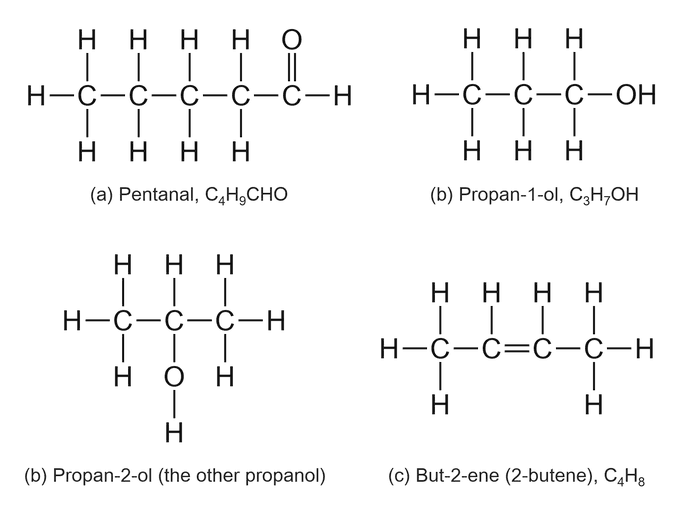
Step 1 — (a) Pentanal.
A 5-carbon chain whose C-1 is the aldehyde group: .
Step 2 — (b) Propanol.
Propanol has a 3-carbon chain with an –OH group. The usual answer is propan-1-ol, . The –OH can also sit on the middle carbon, giving its isomer propan-2-ol, ; both are drawn.
Step 3 — (c) 2-butene (but-2-ene).
But-2-ene has a 4-carbon chain with the double bond between C-2 and C-3: .
Watch out: Count four bonds on every carbon before you finish; a missing H is the commonest slip.
Therefore, the structures are pentanal, propan-1-ol (and propan-2-ol) and but-2-ene, as drawn.
- 463 marks
Question 46
Complete and balance the following chemical equations:
(a)
(b) [excess]
(c) [excess]
Solve with AIWritten solution
Solution:
Concept: (a) Unsaturated hydrocarbons (alkenes C=C, alkynes C≡C) react by addition: one bond of the double or triple bond opens and a molecule such as H₂, Cl₂ or Br₂ adds across it, giving a single product. (b), (c) In complete combustion (plenty of air) every carbon atom of a hydrocarbon becomes carbon dioxide and every hydrogen atom ends up in water; a large amount of heat is given out.
Step 1 — (a) Ethene with chlorine.
Chlorine adds across the double bond, giving 1,2-dichloroethane.
Step 2 — (b) Ethane in excess oxygen.
Check: C 4 = 4, H 12 = 12, O 14 = 14.
Step 3 — (c) Methane in excess oxygen.
One gives one and two , which need 4 O atoms, that is 2 . Check: C 1 = 1, H 4 = 4, O 4 = 4.
Therefore, (a) CH₂=CH₂ + Cl₂ → CH₂Cl–CH₂Cl; (b) 2C₂H₆ + 7O₂ → 4CO₂ + 6H₂O; (c) CH₄ + 2O₂ → CO₂ + 2H₂O.
- 473 marks
Question 47
Give the IUPAC name for the following:
 Solve with AI
Written solution
Solution:
Concept: An IUPAC name is built as locant + prefix (branch or halogen) + root + suffix. The root counts the carbons of the longest chain that contains the functional group or multiple bond (meth 1, eth 2, prop 3, but 4, pent 5). The chain is numbered from the end that gives the lowest number to the functional group (a –CHO or –COOH carbon is always C-1), then to the double or triple bond, then to the branches. The suffix shows the family: -ane, -ene, -yne, -ol, -al, -oic acid.
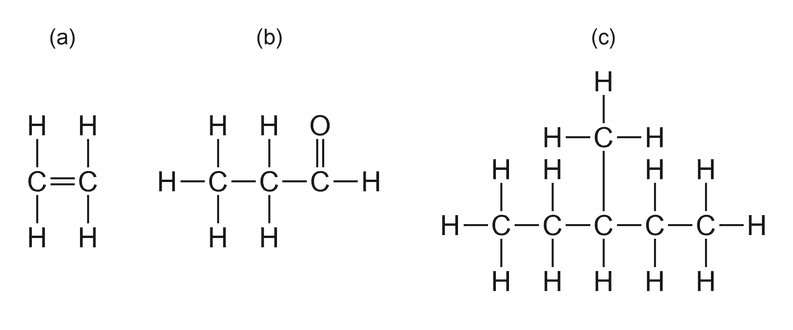
Step 1 — (a) Name the first structure.
The first structure has two carbons joined by a double bond, so it is ethene ().
Step 2 — (b) Name the second structure.
Three carbons; the end carbon is the aldehyde group (–CHO is C-1): propanal ().
Step 3 — (c) Name the third structure.
The longest chain has five carbons (pentane). The – drawn above is on C-3, counting from either end, so the name is 3-methylpentane ().

Watch out: Always find the longest chain first and number it from the end nearer the functional group, multiple bond or branch.
Therefore, (a) ethene, (b) propanal, (c) 3-methylpentane.
- 483 marks
Question 48
Match column A with column B:
Name (A) Functional group (B) 1. Aldehyde (a) —OH 2. Carboxylic acids (b) —CHO 3. Alcohol (c) —COOH Solve with AIWritten solution
Solution:
Concept: Each class of organic compound is known by its functional group.
Step 1 — Match each class.
An aldehyde has –CHO, a carboxylic acid –COOH and an alcohol –OH.
Name (A) Functional group (B) 1. Aldehyde (b) —CHO 2. Carboxylic acids (c) —COOH 3. Alcohol (a) —OH Step 2 — Give examples.
Examples are ethanal (aldehyde), ethanoic acid (carboxylic acid), ethanol (alcohol).
Watch out: –COOH contains an –OH, but as part of the carboxyl group it makes an acid, not an alcohol.
Therefore, 1 – (b), 2 – (c), 3 – (a).
- 491 mark
Question 49
An example of a cyclic organic compound is:
Solve with AIAnswer
(A) Propene
(B) Pentene
(C) Butene
- Correct
(D) Benzene
Answer: (D) Benzene
Concept: In a cyclic (closed-chain) compound the carbon atoms are joined in a ring; in an open-chain compound they form a chain with two ends.
Step 1 — Look at benzene.
Benzene, , has six carbon atoms joined in a ring, each carbon carrying one hydrogen atom, with alternate double bonds.
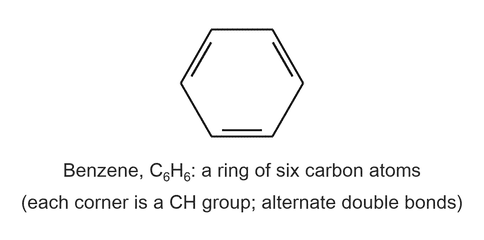
Step 2 — Look at the other three.
Propene, pentene and butene are alkenes: chains with two ends and one double bond.
Why the other options are wrong:
- (A) Propene: propene, , is an open-chain alkene.
- (B) Pentene: pentene is an open chain of five carbons with one double bond.
- (C) Butene: butene is an open chain of four carbons with one double bond.
Therefore, the cyclic compound is benzene, option (D).
- 501 mark
Question 50
The hydrocarbon formed when sodium propanoate and soda lime are heated together:
Solve with AIAnswer
(A) Methane
- Correct
(B) Ethane
(C) Ethene
(D) Propane
Answer: (B) Ethane
Concept: Decarboxylation: the sodium salt of a carboxylic acid heated with soda lime (NaOH + CaO) loses its –COONa group as sodium carbonate, giving an alkane with one carbon fewer.
Step 1 — Count the carbons.
Sodium propanoate, , has 3 carbons, so the alkane formed has one carbon fewer, two carbons: ethane.
Step 2 — Write the equation.
The –COONa carbon leaves as sodium carbonate.
Watch out: The product has ONE carbon fewer than the salt: propanoate gives ethane, not propane.
Why the other options are wrong:
- (A) Methane: methane is made this way from sodium ethanoate (sodium acetate), .
- (C) Ethene: ethene is unsaturated; it is made from ethanol (conc. sulphuric acid, 170 °C) or bromoethane (alcoholic KOH), not by heating a salt with soda lime.
- (D) Propane: propane has as many carbons as the propanoate, but one carbon is lost as sodium carbonate.
Therefore, the hydrocarbon formed is ethane, option (B).
- 511 mark
Question 51
The general formula of hydrocarbons with single covalent bonds is:
Solve with AIAnswer
- Correct
(A)
(B)
(C)
(D)
Answer: (A)
Concept: Hydrocarbons with only single covalent bonds are the alkanes (saturated hydrocarbons); each carbon holds as many hydrogen atoms as it can.
Step 1 — Check with examples.
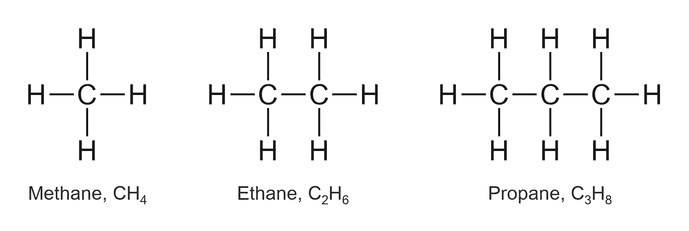
Put n = 1, 2 and 3 into 2n + 2 and compare with the hydrogen counts:
- methane : 2 × 1 + 2 gives 4 H;
- ethane : 2 × 2 + 2 gives 6 H;
- propane : 2 × 3 + 2 gives 8 H.
All three fit .
Why the other options are wrong:
- (B) : is the general formula of the alkenes, which have a C=C double bond.
- (C) : is the general formula of the alkynes, which have a C≡C triple bond.
- (D) : fits benzene and its homologues (), which have double bonds in a ring.
Therefore, the general formula of hydrocarbons with single bonds is , option (A).
- 521 mark
Question 52
Fill in the blanks with the choices given in the brackets:
(e) Conversion of ethene to ethane is an example of ............... . [hydration / hydrogenation]
Solve with AIWritten solution
Solution:
Concept: Hydrogenation is the addition of hydrogen to an unsaturated compound. Ethene and hydrogen passed over finely divided nickel at about 200 °C (or platinum/palladium at room temperature) give ethane.
Step 1 — See what is added.
Ethene becomes ethane by adding two hydrogen atoms across the double bond; no water is involved.
Step 2 — Name the process.
Adding hydrogen is hydrogenation (adding water would be hydration).
Therefore, conversion of ethene to ethane is an example of hydrogenation.
- 531 mark
Question 53
State the terms/process for the following:
(b) Tendency of an element to form chains of identical atoms.
Solve with AIWritten solution
Solution:
Concept: Catenation is the property of an element to link with atoms of the same element to form long straight chains, branched chains and rings. Carbon shows it most, because the C–C bond is strong and carbon has a valency of four.
Step 1 — Read the description.
Forming chains of identical atoms means an atom bonding to atoms of its own element again and again.
Step 2 — Name the property.
This tendency is catenation, shown most by carbon.
Therefore, the term is catenation.
- 545 marks
Question 54
(a) Give the structural formula of the following organic compounds:
-
2-chlorobutane
-
Methanal
-
But-2-yne
(b) Give the IUPAC name of the following organic compounds:
 Solve with AI
Written solution
Solution:
Concept: To draw a structure from a name, read it backwards: the root gives the chain length, the suffix the bond or group, and the locant where it sits. Draw the chain, put in the bond, group or branch, then add H atoms until every carbon has four bonds (O two, H and halogens one). An IUPAC name is built as locant + prefix (branch or halogen) + root + suffix. The root counts the carbons of the longest chain that contains the functional group or multiple bond (meth 1, eth 2, prop 3, but 4, pent 5). The chain is numbered from the end that gives the lowest number to the functional group (a –CHO or –COOH carbon is always C-1), then to the double or triple bond, then to the branches. The suffix shows the family: -ane, -ene, -yne, -ol, -al, -oic acid.
Step 1 — (a)1. 2-chlorobutane.
2-chlorobutane has a 4-carbon chain with Cl on C-2: ().
Step 2 — (a)2. Methanal.
Methanal, HCHO, has one carbon bearing the aldehyde group.
Step 3 — (a)3. But-2-yne.
But-2-yne has a 4-carbon chain with the triple bond between C-2 and C-3: .

Step 4 — (b)1. Name the first structure.
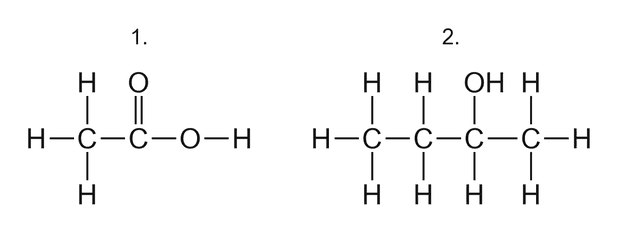
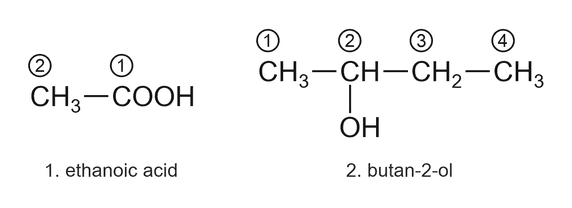
has two carbons with the carboxyl group on C-1: ethanoic acid (acetic acid).
Step 5 — (b)2. Name the second structure.
has four carbons with –OH on the third carbon from the left. Numbering from the right end gives the –OH the lower number, 2: butan-2-ol.
Watch out: Always find the longest chain first and number it from the end nearer the functional group, multiple bond or branch.
Therefore, (a) the structures are as drawn; (b) 1. ethanoic acid, 2. butan-2-ol.
-
- 553 marks
Question 55
Give a balanced chemical equation for the following conversions with conditions:
(a) Ethene from ethanol
(b) Ethyne from calcium carbide
(c) Monochloromethane from methane
Solve with AIWritten solution
Solution:
Concept: (a) Dehydration: concentrated sulphuric acid (in excess, at 170 °C) removes a molecule of water from ethanol (–OH from one carbon, –H from the next), forming the C=C double bond of ethene. (b) Calcium carbide reacts with water at room temperature, giving ethyne (acetylene) and calcium hydroxide. (c) Saturated hydrocarbons (alkanes) have only single bonds, so nothing can add to them. They react by substitution: a hydrogen atom is replaced by another atom, such as chlorine, in sunlight.
Step 1 — (a) Ethene from ethanol.
Ethanol is heated with excess conc. sulphuric acid at 170 °C.
Step 2 — (b) Ethyne from calcium carbide.
Water is added to calcium carbide at room temperature.
Step 3 — (c) Monochloromethane from methane.
Methane and chlorine react in diffused sunlight; one hydrogen atom is replaced by chlorine.
Watch out: In (c) use DIFFUSED sunlight; in direct sunlight the mixture can explode.
Therefore, (a) C₂H₅OH → C₂H₄ + H₂O (conc. H₂SO₄, 170 °C); (b) CaC₂ + 2H₂O → Ca(OH)₂ + C₂H₂; (c) CH₄ + Cl₂ → CH₃Cl + HCl (diffused sunlight).
- 562 marks
Question 56
Name the following:
(a) Organic compounds with same molecular formula but different structural formula.
(b) Group of organic compounds where the successive members follow a regular structural pattern, successive compounds differ by a '' group.
Solve with AIWritten solution
Solution:
Concept: Isomers are compounds with the same molecular formula but different structural formulae; the property is called isomerism. Different structures give different properties (e.g. boiling points). A homologous series is a family of compounds with the same general formula and functional group, whose successive members differ by a group.
Step 1 — (a) Same formula, different structures.
Such compounds are isomers. Example: n-butane and isobutane, both .
Step 2 — (b) Members differing by CH₂.
Such a group is a homologous series. Example: methane , ethane , propane (the alkanes).
Therefore, (a) isomers; (b) a homologous series.
- 571 mark
Question 57
Unsaturated hydrocarbons undergo:
Solve with AIAnswer
- Correct
(A) Addition reaction
(B) Substitution reaction
(C) Oxidation reaction
(D) Redox reaction
Answer: (A) Addition reaction
Concept: Unsaturated hydrocarbons (alkenes C=C, alkynes C≡C) react by addition: one bond of the double or triple bond opens and a molecule such as H₂, Cl₂ or Br₂ adds across it, giving a single product.
Step 1 — Give an example.
Ethene adds hydrogen over nickel to form ethane: two atoms add across the double bond.
Why the other options are wrong:
- (B) Substitution reaction: substitution is the characteristic reaction of saturated hydrocarbons (alkanes), which have no double or triple bond to add to.
- (C) Oxidation reaction: unsaturated hydrocarbons do burn (an oxidation), but so do saturated ones; oxidation is not the reaction that marks out unsaturation.
- (D) Redox reaction: a redox reaction is any oxidation–reduction; it is not the characteristic reaction of unsaturated hydrocarbons.
Therefore, unsaturated hydrocarbons undergo addition reactions, option (A).
- 581 mark
Question 58
Reaction of an alcohol with a carboxylic acid in the presence of concentrated is termed as:
Solve with AIAnswer
(A) Halogenation
- Correct
(B) Esterification
(C) Hydrogenation
(D) Dehydrohalogenation
Answer: (B) Esterification
Concept: Esterification: a carboxylic acid and an alcohol, warmed with a little concentrated sulphuric acid, form an ester and water. The acid catalyses the reaction and takes up the water. Esters have a pleasant, fruity smell.
Step 1 — Write the reaction.
Ethanoic acid and ethanol, for example, give ethyl ethanoate and water.
Why the other options are wrong:
- (A) Halogenation: halogenation is the reaction with a halogen such as chlorine or bromine.
- (C) Hydrogenation: hydrogenation is the addition of hydrogen to an unsaturated compound.
- (D) Dehydrohalogenation: dehydrohalogenation is the removal of a hydrogen halide, as when bromoethane gives ethene with alcoholic KOH.
Therefore, the reaction is esterification, option (B).
- 591 mark
Question 59
Conversion of Ethanol to Ethene by the action of concentrated sulphuric acid involves:
Solve with AIAnswer
- Correct
(A) Dehydration
(B) Dehydrogenation
(C) Dehydrohalogenation
(D) Hydrolysis
Answer: (A) Dehydration
Concept: Dehydration: concentrated sulphuric acid (in excess, at 170 °C) removes a molecule of water from ethanol (–OH from one carbon, –H from the next), forming the C=C double bond of ethene.
Step 1 — Write the reaction.
Ethanol loses a water molecule.
Step 2 — Name the change.
Removing water is dehydration.
Why the other options are wrong:
- (B) Dehydrogenation: dehydrogenation removes hydrogen alone; here water is removed.
- (C) Dehydrohalogenation: dehydrohalogenation removes a hydrogen halide such as HBr; ethanol has no halogen.
- (D) Hydrolysis: hydrolysis is a reaction with water that splits a compound; here water is removed, not added.
Therefore, the conversion involves dehydration, option (A).
- 601 mark
Question 60
State the terms for the following:
(a) The group obtained by removing one hydrogen atom from the parent alkane.
Solve with AIWritten solution
Solution:
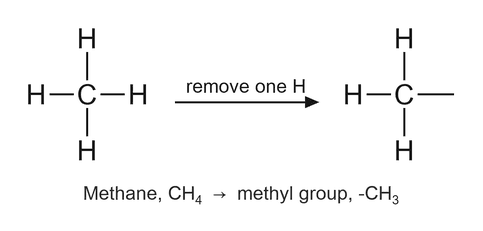
Concept: Taking one hydrogen atom away from an alkane leaves a group with one free bond.
Step 1 — Name the group.
It is an alkyl group, general formula , written R–.
Step 2 — Give examples.
Methane gives the methyl group –; ethane gives the ethyl group –.
Therefore, the term is alkyl group.
- 615 marks
Question 61
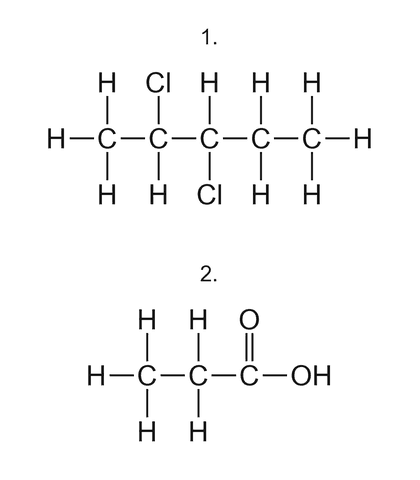
(a) Give the IUPAC names of the organic compounds represented by the structural formulae given below:
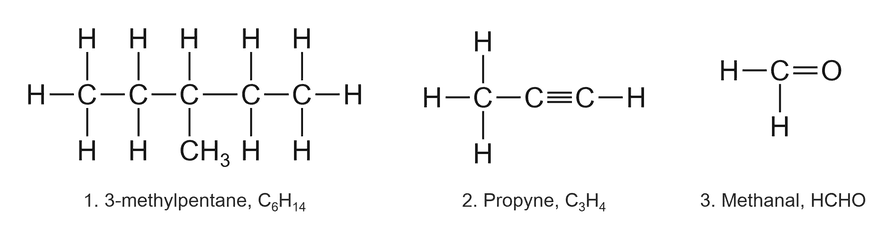
(b) Draw the structural diagram for the following organic compounds:
-
3-methyl pentane
-
propyne
-
methanal
Solve with AIWritten solution
Solution:
Concept: An IUPAC name is built as locant + prefix (branch or halogen) + root + suffix. The root counts the carbons of the longest chain that contains the functional group or multiple bond (meth 1, eth 2, prop 3, but 4, pent 5). The chain is numbered from the end that gives the lowest number to the functional group (a –CHO or –COOH carbon is always C-1), then to the double or triple bond, then to the branches. The suffix shows the family: -ane, -ene, -yne, -ol, -al, -oic acid. To draw a structure from a name, read it backwards: the root gives the chain length, the suffix the bond or group, and the locant where it sits. Draw the chain, put in the bond, group or branch, then add H atoms until every carbon has four bonds (O two, H and halogens one).
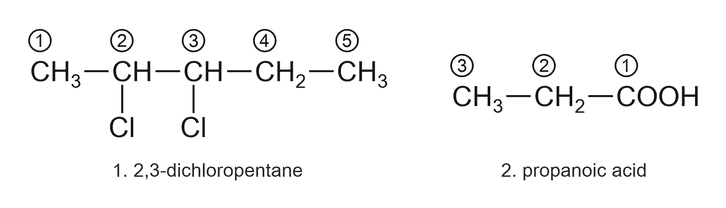
Step 1 — (a)1. Name the first structure.
The chain has five carbons with one Cl on C-2 and one on C-3 from the left (from the right they would be 3 and 4; the lower set wins): 2,3-dichloropentane ().
Step 2 — (a)2. Name the second structure.
The second structure has three carbons with the carboxyl group on C-1, so it is propanoic acid ().
Step 3 — (b)1. 3-methylpentane.
3-methylpentane has a 5-carbon chain with a – group on C-3.
Step 4 — (b)2. Propyne.
Propyne, , has three carbons with a triple bond from C-1.
Step 5 — (b)3. Methanal.
Methanal, HCHO, has one carbon with the aldehyde group.
Watch out: Always find the longest chain first and number it from the end nearer the functional group, multiple bond or branch.
Therefore, (a) 1. 2,3-dichloropentane, 2. propanoic acid; (b) the structures are as drawn.
-
- 623 marks
Question 62
Complete and balance the following equations:
(a)
(b)
(c) + alcoholic KOH
Solve with AIWritten solution
Solution:
Concept: (a) Aluminium oxide is amphoteric, so it dissolves in sodium hydroxide, forming sodium aluminate (Baeyer's process). (b) Decarboxylation: the sodium salt of a carboxylic acid heated with soda lime (NaOH + CaO) loses its –COONa group as sodium carbonate, giving an alkane with one carbon fewer. (c) Alcoholic KOH removes two HBr molecules from 1,2-dibromoethane, forming a triple bond.
Step 1 — (a) Aluminium oxide with sodium hydroxide.
Check: Al 2 = 2, O 3 + 2 = 4 + 1, Na 2 = 2, H 2 = 2.
Step 2 — (b) Sodium propanoate with soda lime.
Ethane forms; one carbon is lost as sodium carbonate.
Step 3 — (c) 1,2-dibromoethane with alcoholic KOH.
Two HBr are removed from neighbouring carbons, giving ethyne. Check: C 2 = 2, H 4 + 2 = 2 + 4, Br 2 = 2, K 2 = 2, O 2 = 2.

Watch out: In (c) TWO KOH are needed; one KOH would give only vinyl bromide.
Therefore, (a) Al₂O₃ + 2NaOH → 2NaAlO₂ + H₂O; (b) C₂H₅COONa + NaOH → C₂H₆ + Na₂CO₃; (c) C₂H₄Br₂ + 2KOH → C₂H₂ + 2KBr + 2H₂O.
- 633 marks
Question 63
Choose the organic compound from the list given below to answer the following questions:
(a) The compound which does not have a double bond in its structure.
(b) The compound which in its pure form turns into an ice like solid on cooling.
(c) The compound which is used for artificial ripening of fruits.
Solve with AIWritten solution
Solution:
Concept: Draw each compound and look for a C=C or C=O double bond.
Step 1 — (a) No double bond.
Ethene has C=C, and ethanoic acid and methanal each have C=O. Ethanol, , has only single bonds.
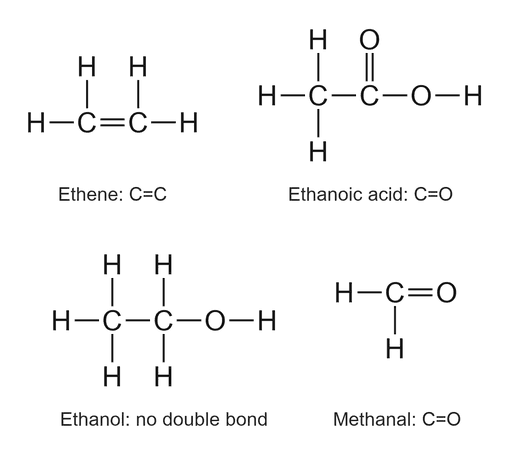
Step 2 — (b) Ice-like solid on cooling.
Pure (glacial) ethanoic acid freezes at about 17 °C (16.6 °C) into ice-like crystals.
Step 3 — (c) Artificial ripening of fruits.
Ethene is the plant hormone gas used to ripen fruits.
Therefore, (a) ethanol; (b) ethanoic acid; (c) ethene.
- 641 mark
Question 64
Differentiate between the following pairs based on the criteria given:
(b) Unsaturated and Saturated hydrocarbons (type of bond present)
Solve with AIWritten solution
Solution:
Concept: The type of carbon–carbon bond decides whether a hydrocarbon is saturated.
Step 1 — Compare the bonds.
A saturated hydrocarbon has only single bonds; an unsaturated one has at least one double or triple bond.
Saturated hydrocarbons Unsaturated hydrocarbons All carbon–carbon bonds are single covalent bonds (C–C). At least one carbon–carbon double (C=C) or triple (C≡C) covalent bond. Ethane, Ethene, ; ethyne, 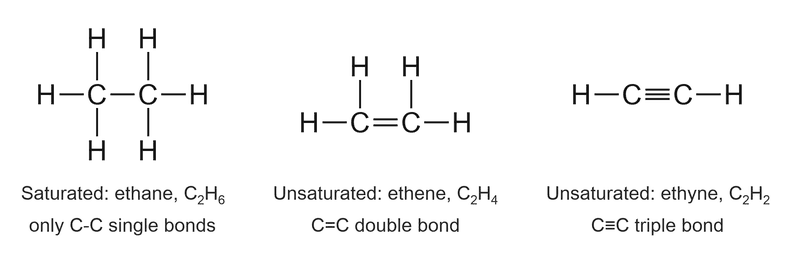
Therefore, saturated hydrocarbons have only C–C single bonds; unsaturated ones have a C=C or C≡C bond.
- 651 mark
Question 65
Identify the gas evolved in each of the following reactions:
(a) Methane undergoes complete combustion.
Solve with AIWritten solution
Solution:
Concept: In complete combustion (plenty of air) every carbon atom of a hydrocarbon becomes carbon dioxide and every hydrogen atom ends up in water; a large amount of heat is given out.
Step 1 — Write the reaction.
Methane burns completely in plenty of air. Check: C 1 = 1, H 4 = 4, O 4 = 2 + 2.
Step 2 — Name the gas.
The gas evolved is carbon dioxide, along with water vapour. Methane burns with a bluish, non-sooty flame and gives out a large amount of heat.
Watch out: With too little air carbon monoxide forms; complete combustion gives carbon dioxide.
Therefore, the gas evolved is carbon dioxide, CO₂.
- 661 mark
Question 66
Which formula represents a saturated hydrocarbon?
Solve with AIAnswer
(A)
- Correct
(B)
(C)
(D)
Answer: (B)
Concept: A saturated hydrocarbon (alkane) fits .
Step 1 — Test C5H12.
For n = 5, 2 × 5 + 2 = 12 hydrogen atoms, so fits; it is pentane.
Why the other options are wrong:
- (A) : : 2 × 4 = 8, so it fits : butene, an alkene (unsaturated).
- (C) : : 2 × 4 − 2 = 6, so it fits : butyne, an alkyne (unsaturated).
- (D) : : 2 × 5 = 10, so it fits : pentene, an alkene (unsaturated).
Therefore, the saturated hydrocarbon is C₅H₁₂, option (B).
- 671 mark
Question 67
Which of the following options has all the compounds which are members of the same homologous series?
Solve with AIAnswer
- Correct
(A) , ,
(B) , ,
(C) , ,
(D) , ,
Answer: (A) , ,
Concept: Members of one homologous series have the same general formula and differ from one another by a group.
Step 1 — Check option (A).
, and all fit (n = 1, 2, 3), and each differs from the next by . They are the first three alkanes.
Why the other options are wrong:
- (B) , , : fits (an alkene), while the other two are alkanes.
- (C) , , : all three have three carbons: is an alkyne, an alkene and an alkane, three different series.
- (D) , , : and are alkenes, but is an alkane.
Therefore, the members of one homologous series are CH₄, C₂H₆, C₃H₈, option (A).
- 681 mark
Question 68
State the terms for the following:
Undistilled alcohol containing a large amount of methanol.
- 691 mark
Question 69
State the terms for the following:
Organic compounds having the same molecular formula but different structural formula.
- 701 mark
Question 70
Match the Column A with Column B:
Column A Column B (d) 1. Vanadium Pentoxide 2. Nickel 3. Iron 4. Concentrated Sulphuric acid 5. Platinum - 715 marks
Question 71
(a) Draw the structural diagram for the following organic compounds:
(1) 2-methyl propene
(2) butanal
(b) Give IUPAC name for the following organic compounds:
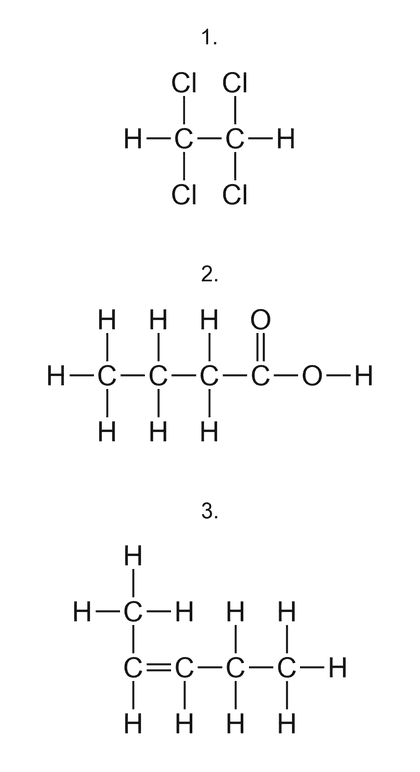
- 722 marks
Question 72
Complete and balance the following equations:
(a)
(b)
- 733 marks
Question 73
Given below are organic compounds labelled A to F. Answer the questions that follow:

(a) Which compound forms a single product with bromine?
(b) Which two compounds have the same molecular formula?
(c) Which two compounds will react together in the presence of concentrated to form a product with a fruity smell?
- 741 mark
Question 74
An alkane with molecular mass 44 is:
- 751 mark
Question 75
The gas evolved in the diagrammatic set up given below turns calcium hydroxide solution milky. The gas evolved is:
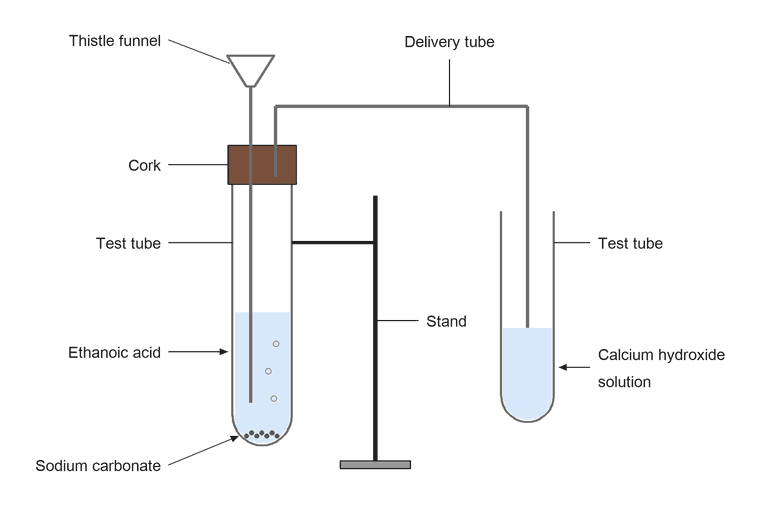
- 761 mark
Question 76
State the terms for the following:
The type of reaction characteristic for alkanes.
- 775 marks
Question 77
(a) Draw the structural diagram for the following organic compounds:
(1) bromoethane
(2) methanal
(3) but-2-yne
(b) Give IUPAC name for the following organic compounds:
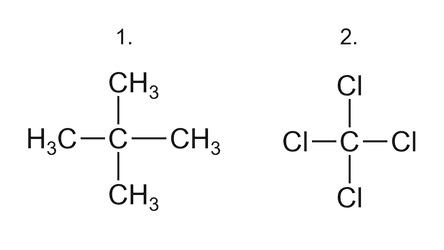
- 781 mark
Question 78
Smith wrote the following statements incorrectly. Insert a word to correct the statements.
Bromoethane reacts with sodium hydroxide to produce ethanol and sodium bromide.
- 791 mark
Question 79
Write the balanced equations for the following reactions:
Laboratory preparation of ethane using soda lime.
- 801 mark
Question 80
Define:
Catenation
- 813 marks
Question 81
Complete and balance the following equation:
(a) (alcoholic)
(b)
(c)
- 821 mark
Question 82
Identify the equation that shows the reaction of ethane with chlorine in the presence of ultraviolet light.
- 831 mark
Question 83
A hydrocarbon X undergoes the reaction under suitable conditions as shown below:
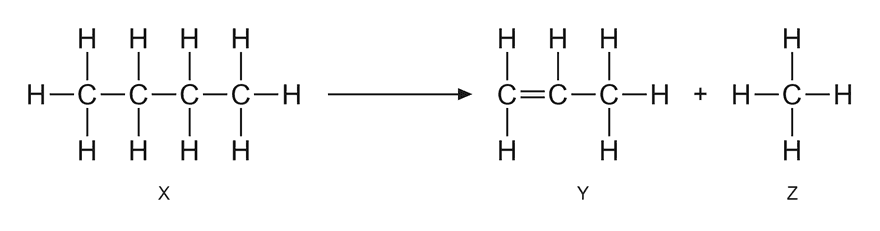
Which compound(s) is/are unsaturated?
- 841 mark
Question 84
An unsaturated hydrocarbon with three atoms of carbon and six atoms of hydrogen is:
- 851 mark
Question 85
Identify the following terms / compounds:
A compound which reacts with water to give acetylene gas.
- 861 mark
Question 86
Identify the following terms / compounds:
The gas evolved when sodium propanoate is heated with soda lime.
- 875 marks
Question 87
(a) Give the IUPAC name for the following organic compounds:
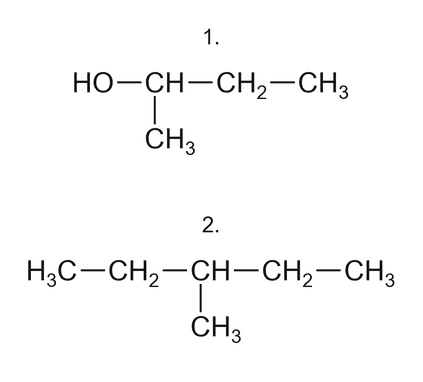
(b) Draw the structural diagram for each of the following organic compounds:
(1) butanal
(2) pent-2-yne
(3) The isomer of n-butane
- 881 mark
Question 88
Complete and balance the following equations:
(alcoholic)
- 893 marks
Question 89
An unsaturated hydrocarbon having two carbon atoms was made to react with two moles of hydrogen gas in the presence of a catalyst to give a saturated hydrocarbon. Using the above information, answer the following questions:
(a) The type of reaction that occurred is ............... . (addition / substitution)
(b) Name a suitable catalyst which is used in the reaction.
(c) Write a balanced chemical equation for the above reaction.
- 901 mark
Question 90
State whether the following statements are True or False:
Organic compounds having different molecular formula, but same structural formula are called isomers.
- 913 marks
Question 91
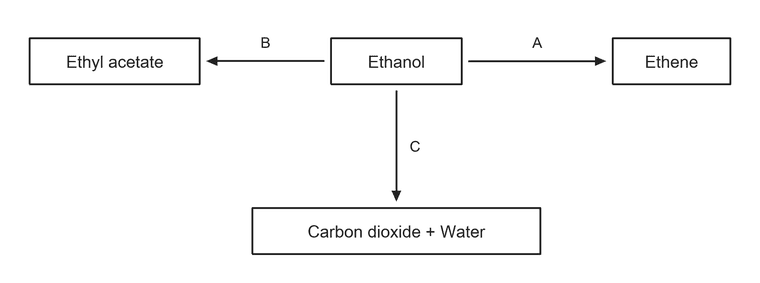
Study the reaction scheme shown below and identify the reactants A, B and C.
- 921 mark
Question 92
The organic compound which undergoes substitution reaction is:
- 931 mark
Question 93
Complete the following sentences by choosing the correct word(s) from the brackets.
The IUPAC name for formaldehyde is ............... (methanal / ethanal)
- 945 marks
Question 94
(a) Draw the structural diagram for the following organic compounds.
(1) ethanal
(2) acetic acid
(3) 2-bromo propane
(b) Give IUPAC name for the following organic compounds.

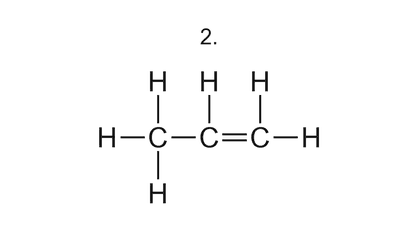
- 953 marks
Question 95
You are given the following molecular formulae of some hydrocarbons:
(a) Which two compounds represent unsaturated hydrocarbons having triple bonds?
(b) Identify the formula which represents a cyclic compound.
- 964 marks
Question 96
The following diagram shows the laboratory preparation of a gaseous hydrocarbon (P) containing two carbon atoms.

(a) Identify the gaseous product P.
(b) Give the general formula of the homologous series which P belongs to.
(c) Write a balanced equation for the reaction that takes place.
(d) State the type of reaction that P undergoes when it reacts with hydrogen.