
Question 303 marksAsked 2019Easy
Write a balanced chemical equation for the preparation of:
(i) Ethene from bromoethane
(ii) Ethyne using calcium carbide
(iii) Methane from sodium acetate.
Confirming your payment
Sign up now and get 250 free tokens.
Previous Year Questions · Question 30 of 96
Write a balanced chemical equation for the preparation of:
(i) Ethene from bromoethane
(ii) Ethyne using calcium carbide
(iii) Methane from sodium acetate.
Solution:
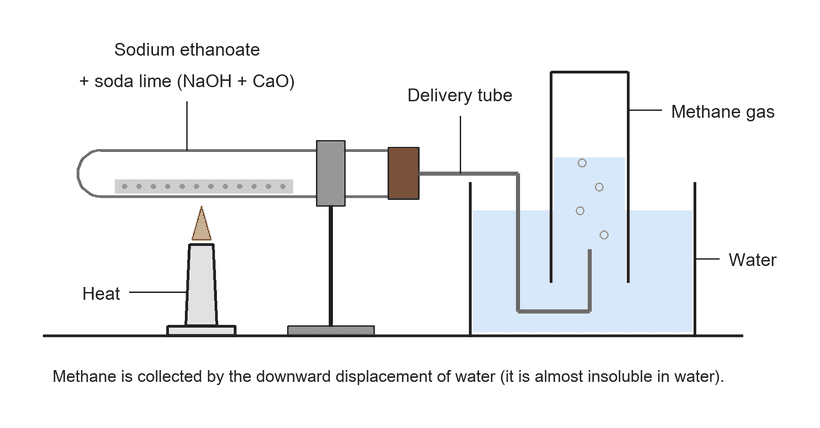
Concept: (i) Dehydrohalogenation: boiling a haloalkane with alcoholic KOH removes a hydrogen halide (H from one carbon, halogen from the next), forming a double bond. With aqueous alkali the halogen is replaced by –OH instead, giving an alcohol. (ii) Calcium carbide reacts with water at room temperature, giving ethyne (acetylene) and calcium hydroxide. (iii) Decarboxylation: the sodium salt of a carboxylic acid heated with soda lime (NaOH + CaO) loses its –COONa group as sodium carbonate, giving an alkane with one carbon fewer.
Step 1 — (i) Ethene from bromoethane.
Bromoethane is boiled with alcoholic KOH. Check: C 2 = 2, H 6 = 6, Br 1 = 1, K 1 = 1, O 1 = 1.
Step 2 — (ii) Ethyne from calcium carbide.
Water is added to calcium carbide at room temperature.
Step 3 — (iii) Methane from sodium acetate.
Sodium acetate (sodium ethanoate) is heated with soda lime. Check: C 2 = 1 + 1, H 4 = 4, O 3 = 3, Na 2 = 2.
Watch out: AQUEOUS alkali gives the alcohol; ALCOHOLIC alkali gives the alkene.
Therefore, (i) C₂H₅Br + KOH (alc.) → C₂H₄ + KBr + H₂O; (ii) CaC₂ + 2H₂O → Ca(OH)₂ + C₂H₂; (iii) CH₃COONa + NaOH → CH₄ + Na₂CO₃.