Solution:
Concept: Match each clue with a name: the number of carbon atoms gives the root, and the functional group or bond gives the ending.
Step 1 — (i) Three carbons with a carboxyl group.
The root prop- with the ending -oic acid gives propanoic acid, C2H5COOH.
Step 2 — (ii) First member of the alkenes.
CnH2n is the general formula of the alkenes; a double bond needs two carbons, so the smallest has n = 2: ethene, C2H4.
Step 3 — (iii) Reacts with acetic acid to give ethyl ethanoate.
The ethyl part of the ester comes from the alcohol, so it is ethanol, C2H5OH.
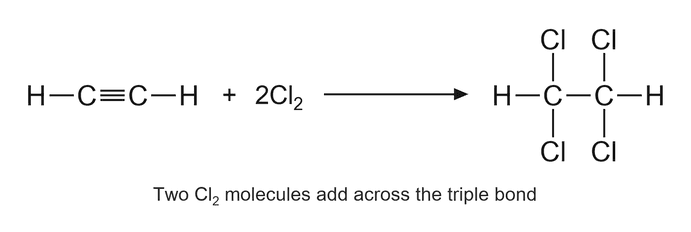
Step 4 — (iv) Complete chlorination of ethyne.
Two molecules of chlorine add across the triple bond, giving 1,1,2,2-tetrachloroethane. Check: C 2 = 2, H 2 = 2, Cl 4 = 4.
C2H2+2Cl2⟶CHCl2−CHCl2
Therefore, (i) propanoic acid; (ii) ethene; (iii) ethanol; (iv) 1,1,2,2-tetrachloroethane.
