Solution:
Concept: An IUPAC name is built as locant + prefix (branch or halogen) + root + suffix. The root counts the carbons of the longest chain that contains the functional group or multiple bond (meth 1, eth 2, prop 3, but 4, pent 5). The chain is numbered from the end that gives the lowest number to the functional group (a –CHO or –COOH carbon is always C-1), then to the double or triple bond, then to the branches. The suffix shows the family: -ane, -ene, -yne, -ol, -al, -oic acid.
Step 1 — (i) Name A.
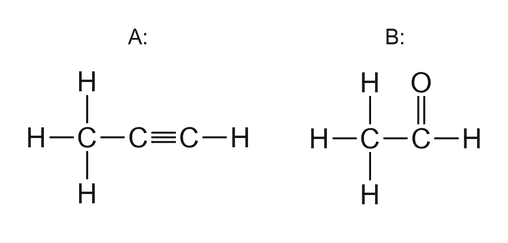
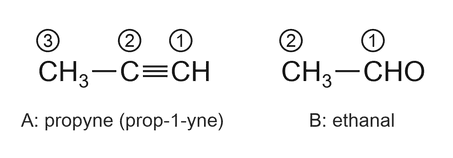
CH3−C≡CH has three carbons with the triple bond starting at C-1: propyne (prop-1-yne).
Step 2 — (i) Name B.
CH3−CHO has two carbons, the end one carrying the aldehyde group: ethanal.
Step 3 — (ii) Special feature of ethyne.
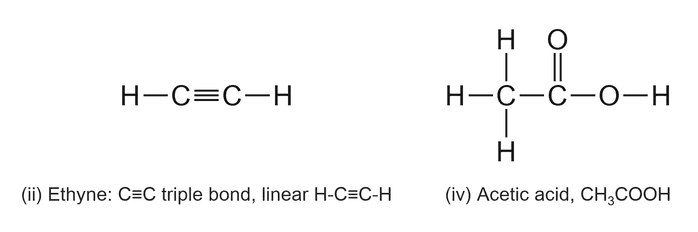
The two carbon atoms are joined by a triple covalent bond (C≡C), and each also holds one hydrogen atom. The molecule H–C≡C–H is linear: all four atoms lie in a straight line. The triple bond makes ethyne highly unsaturated and reactive.
Step 4 — (iii) Saturated hydrocarbon with two carbons.
The alkane with n = 2 is ethane, C2H6.
Step 5 — (iv) Structural formula of acetic acid.
Acetic acid is a methyl group joined to the carboxyl group: CH3COOH.
Watch out: Always find the longest chain first and number it from the end nearer the functional group, multiple bond or branch.
Therefore, (i) A propyne, B ethanal; (ii) a C≡C triple bond in a linear molecule; (iii) ethane; (iv) CH₃COOH as drawn.