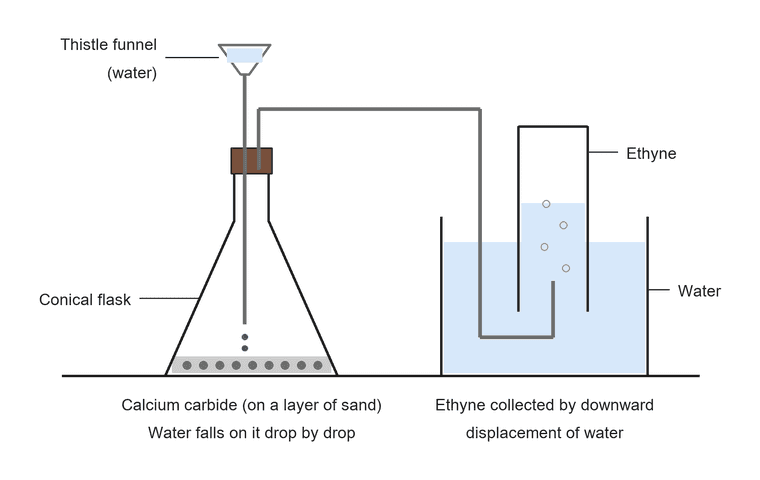
The following diagram shows the laboratory preparation of a gaseous hydrocarbon (P) containing two carbon atoms.
Question 964 marksAsked 2026Easy
The following diagram shows the laboratory preparation of a gaseous hydrocarbon (P) containing two carbon atoms.
(a) Identify the gaseous product P.
(b) Give the general formula of the homologous series which P belongs to.
(c) Write a balanced equation for the reaction that takes place.
(d) State the type of reaction that P undergoes when it reacts with hydrogen.
Solution:
Concept:Calcium carbide reacts with water at room temperature, giving ethyne (acetylene) and calcium hydroxide. Ethyne is only slightly soluble in water, so it is collected by downward displacement of water.
Step 1 — (a) Identify P.
Water dropped on calcium carbide gives a two-carbon gas: ethyne (acetylene), C2H2.
Step 2 — (b) Its homologous series.
Ethyne has a triple bond, so it is an alkyne; general formula CnH2n−2.
Step 3 — (c) Balanced equation.
Check: Ca 1 = 1, C 2 = 2, H 4 = 2 + 2, O 2 = 2.
CaC2+2H2O⟶Ca(OH)2+C2H2↑
Step 4 — (d) Reaction with hydrogen.
With hydrogen over nickel, ethyne undergoes addition (hydrogenation), first to ethene and then to ethane.
C2H2+2H2Ni200 °CC2H6
Therefore, (a) P is ethyne; (b) CnH2n−2; (c) CaC₂ + 2H₂O → Ca(OH)₂ + C₂H₂; (d) addition.