
Question 813 marksAsked 2025Easy
Complete and balance the following equation:
(a) (alcoholic)
(b)
(c)
Confirming your payment
Sign up now and get 250 free tokens.
Previous Year Questions · Question 81 of 96
Complete and balance the following equation:
(a) (alcoholic)
(b)
(c)
Solution:
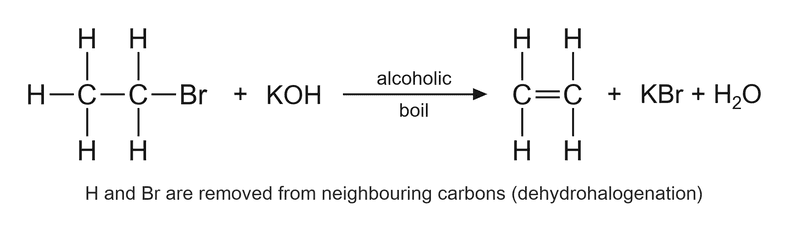
Concept: (a) Dehydrohalogenation: boiling a haloalkane with alcoholic KOH removes a hydrogen halide (H from one carbon, halogen from the next), forming a double bond. With aqueous alkali the halogen is replaced by –OH instead, giving an alcohol. (b) Dehydration: concentrated sulphuric acid (in excess, at 170 °C) removes a molecule of water from ethanol (–OH from one carbon, –H from the next), forming the C=C double bond of ethene. (c) Saturated hydrocarbons (alkanes) have only single bonds, so nothing can add to them. They react by substitution: a hydrogen atom is replaced by another atom, such as chlorine, in sunlight.
Step 1 — (a) Bromoethane with alcoholic KOH.
HBr is removed, giving ethene.
Step 2 — (b) Ethanol with conc. sulphuric acid at 170 °C.
Water is removed, giving ethene.
Step 3 — (c) Methane with chlorine.
In diffused sunlight one hydrogen atom is replaced by chlorine, giving chloromethane and hydrogen chloride.
Watch out: AQUEOUS alkali gives the alcohol; ALCOHOLIC alkali gives the alkene.
Therefore, (a) C₂H₅Br + KOH → C₂H₄ + KBr + H₂O; (b) C₂H₅OH → C₂H₄ + H₂O; (c) CH₄ + Cl₂ → CH₃Cl + HCl.