Solution:
Concept: To draw a structure from a name, read it backwards: the root gives the chain length, the suffix the bond or group, and the locant where it sits. Draw the chain, put in the bond, group or branch, then add H atoms until every carbon has four bonds (O two, H and halogens one).
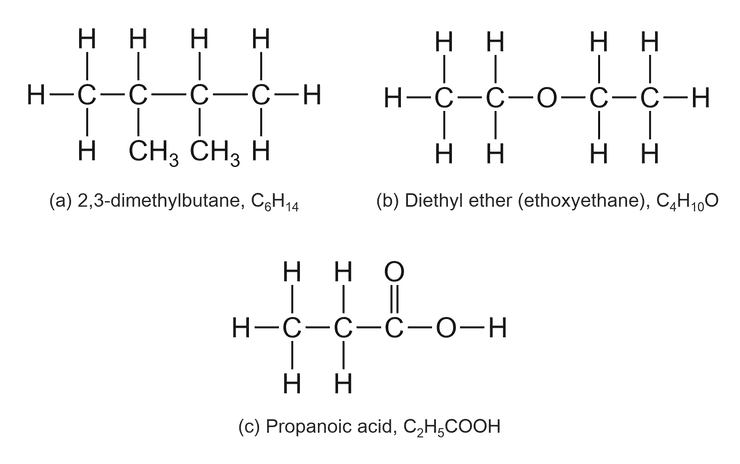
Step 1 — (i)(a) 2,3-dimethylbutane.
2,3-dimethylbutane has a 4-carbon chain with one –CH3 on C-2 and one on C-3: CH3−CH(CH3)−CH(CH3)−CH3, formula C6H14.
Step 2 — (i)(b) Diethyl ether (ethoxyethane).
Diethyl ether has two ethyl groups joined through an oxygen atom: C2H5−O−C2H5, formula C4H10O.
Step 3 — (i)(c) Propanoic acid.
Propanoic acid has a 3-carbon chain ending in the carboxyl group: C2H5COOH.
Step 4 — (ii)(a) Crushing the ore.
Crushing the ore into a fine powder is pulverisation.
Step 5 — (ii)(b) Heating without air.
Heating the ore to a high temperature in the absence (or limited supply) of air is calcination. Roasting is heating in excess air, and smelting is reducing the ore in a furnace.
Watch out: Count four bonds on every carbon before you finish; a missing H is the commonest slip.
Therefore, (i) the three structures are as drawn; (ii) (a) pulverisation, (b) calcination.
