Solution:
Concept: Each description is a property, use or structural feature named in the chapter.
Step 1 — (i) Ice-like crystals of an organic acid.
Pure (anhydrous) acetic acid freezes at about 17 °C (16.6 °C) into an ice-like solid that looks like a glacier, so it is called glacial acetic acid.
Step 2 — (ii) Hydrocarbon with a triple bond used for welding.
Ethyne (acetylene), C2H2, burns in oxygen with a very hot flame (the oxy-acetylene flame) used to cut and weld metals.
Step 3 — (iii) Same molecular formula, different structures.
This property is isomerism.
Step 4 — (iv) Two alkyl groups linked by a C=O group.
A carbonyl group joined to two alkyl groups makes a ketone; the simplest is propanone (acetone), CH3COCH3.
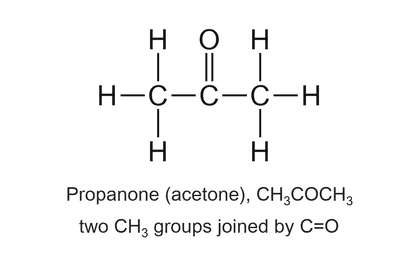
Watch out: If the C=O carbon carries an H atom, the compound is an aldehyde, not a ketone.
Therefore, (i) glacial acetic acid; (ii) ethyne (acetylene); (iii) isomerism; (iv) a ketone, e.g. propanone.
