Solution:
Concept: An IUPAC name is built as locant + prefix (branch or halogen) + root + suffix. The root counts the carbons of the longest chain that contains the functional group or multiple bond (meth 1, eth 2, prop 3, but 4, pent 5). The chain is numbered from the end that gives the lowest number to the functional group (a –CHO or –COOH carbon is always C-1), then to the double or triple bond, then to the branches. The suffix shows the family: -ane, -ene, -yne, -ol, -al, -oic acid.
Step 1 — (i)(a) Name the first structure.
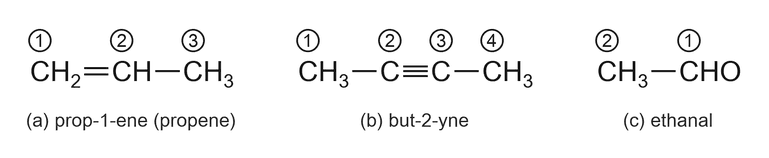
The chain has 3 carbons with a double bond between C-1 and C-2: CH2=CH−CH3, so it is prop-1-ene (propene).
Step 2 — (i)(b) Name the second structure.
The chain has 4 carbons with a triple bond between C-2 and C-3 (the same from either end): CH3−C≡C−CH3, so it is but-2-yne.
Step 3 — (i)(c) Name the third structure.
There are 2 carbons and the end carbon carries the aldehyde group (–CHO is C-1): CH3−CHO, so it is ethanal (acetaldehyde).
Step 4 — (ii)(a) Compare the ionisation potentials.
Potassium is below sodium in Group 1. Its outermost electron is in a shell farther from the nucleus and more shielded, so less energy is needed to remove it: the ionisation potential of K is less than that of Na.
Step 5 — (ii)(b) Compare the electronegativities.
Iodine is below chlorine in Group 17. It is a larger atom, so its nucleus attracts a shared pair of electrons less strongly: the electronegativity of I is less than that of Cl.
Watch out: Always find the longest chain first and number it from the end nearer the functional group, multiple bond or branch.
Therefore, (i) (a) prop-1-ene, (b) but-2-yne, (c) ethanal; (ii) (a) K < Na, (b) I < Cl.

