Solution:
Concept: Each hydrocarbon series has a general formula: alkanes (single bonds) CnH2n+2, alkenes (one C=C) CnH2n, alkynes (one C≡C) CnH2n−2, where n is the number of carbon atoms.
Step 1 — Identify the series.
CnH2n−2 is the alkynes (one C≡C triple bond); CnH2n+2 is the alkanes (single bonds only).
Step 2 — Find the first alkyne.
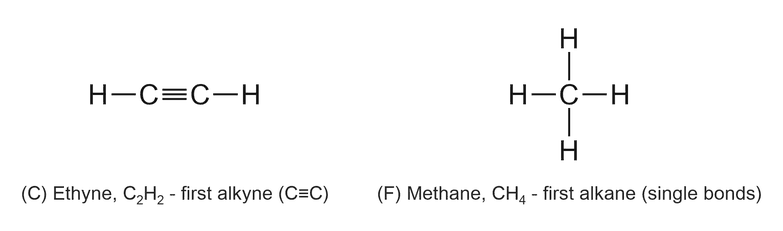
A triple bond needs two carbon atoms, so the smallest alkyne has n = 2. Its number of hydrogen atoms is:
2n−2=2×2−2=2
This gives C2H2, ethyne.
Step 3 — Find the first alkane.
The smallest alkane has n = 1. Its number of hydrogen atoms is:
2n+2=2×1+2=4
This gives CH4, methane.
Step 4 — Complete the table.
The table is completed with these results:
| General formula | Series | Characteristic bond | First member |
|---|
| CnH2n−2 | (A) Alkynes | (B) Triple bond (C≡C) | (C) Ethyne |
| CnH2n+2 | (D) Alkanes | (E) Single bond (C–C) | (F) Methane |
Watch out: The first alkyne cannot have n = 1: one carbon cannot form a C≡C bond.
Therefore, (A) alkynes, (B) triple bond, (C) ethyne, (D) alkanes, (E) single bond, (F) methane.
