Solution:
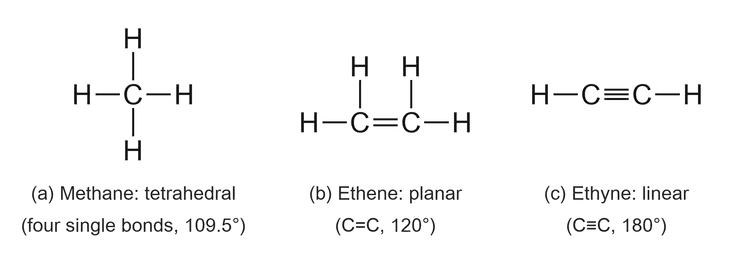
Concept: The shape follows the bonds: single bonds only → tetrahedral, a double bond → planar, a triple bond → linear. The other parts recall the old names and tests of hydrocarbons.
Step 1 — (a) to (c) Shapes.
Methane (CH4) is tetrahedral (H–C–H 109.5°), ethene (C2H4) is planar (bond angles 120°), and ethyne (C2H2) is linear (H–C≡C–H in a straight line):
Step 2 — (d) Red precipitate with ammoniacal copper (I) chloride.
Ethyne has H atoms on its triple-bonded carbons and forms red copper acetylide.
Step 3 — (e) and (f) Old names.
Alkanes (e.g. methane) are called paraffins ("little affinity", because they react little); alkenes (e.g. ethene) are called olefins.
Step 4 — (g) Gives ethyne with water.
Calcium carbide, CaC2 (itself an inorganic compound):
CaC2+2H2O⟶Ca(OH)2+C2H2
Therefore, (a) methane, (b) ethene, (c) ethyne, (d) ethyne, (e) alkanes (methane), (f) alkenes (ethene), (g) calcium carbide.
