
Question 1121 markMCQEasy
Which of the following statements is wrong about alkanes ?
Confirming your payment
Sign up now and get 250 free tokens.
Organic Chemistry · Question 112 of 150
Which of the following statements is wrong about alkanes ?
(A) They are all saturated hydrocarbons.
(B) They can undergo addition as well as substitution reaction.
(C) They are almost non polar in nature.
(D) On complete combustion give out carbon dioxide and water.
Answer: (B) They can undergo addition as well as substitution reaction.
Concept: Alkanes are saturated: every carbon already has four single bonds, so there is no double or triple bond for new atoms to add across. Alkanes react by substitution only.
Step 1 — Test the statement about reactions.
An alkane can only have an H atom replaced, for example by chlorine in diffused sunlight:
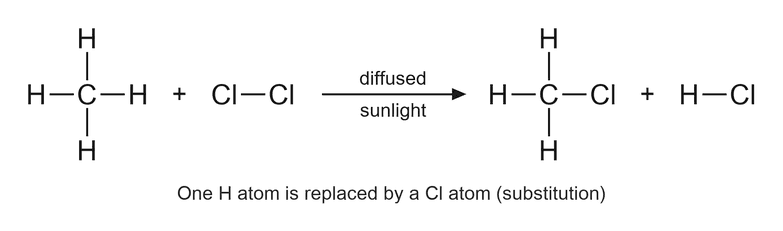
So "they can undergo addition" is wrong: statement (B) is the false one.
Step 2 — Check the other statements.
The other three statements are all true of alkanes, so they are not the answer.
Watch out: The question asks for the wrong statement; the three true statements are the distractors.
Why the other options are wrong:
Therefore, the wrong statement is that alkanes undergo addition, option (B).