
Question 915 marksMedium
Complete and balance the following equations. State the conditions wherever necessary.
(a) ________ ________
(b) ________
(c) ________
(d) ________
(e) ________
(f) ________
Confirming your payment
Sign up now and get 250 free tokens.
Organic Chemistry · Question 91 of 150
Complete and balance the following equations. State the conditions wherever necessary.
(a) ________ ________
(b) ________
(c) ________
(d) ________
(e) ________
(f) ________
Solution:
Concept: (a), (b), (c) and (e) are addition reactions: the double or triple bond opens and new atoms join the two carbons. (d) is the hydrolysis of calcium carbide, and (f) is the oxidation of ethanol through the aldehyde to the acid.
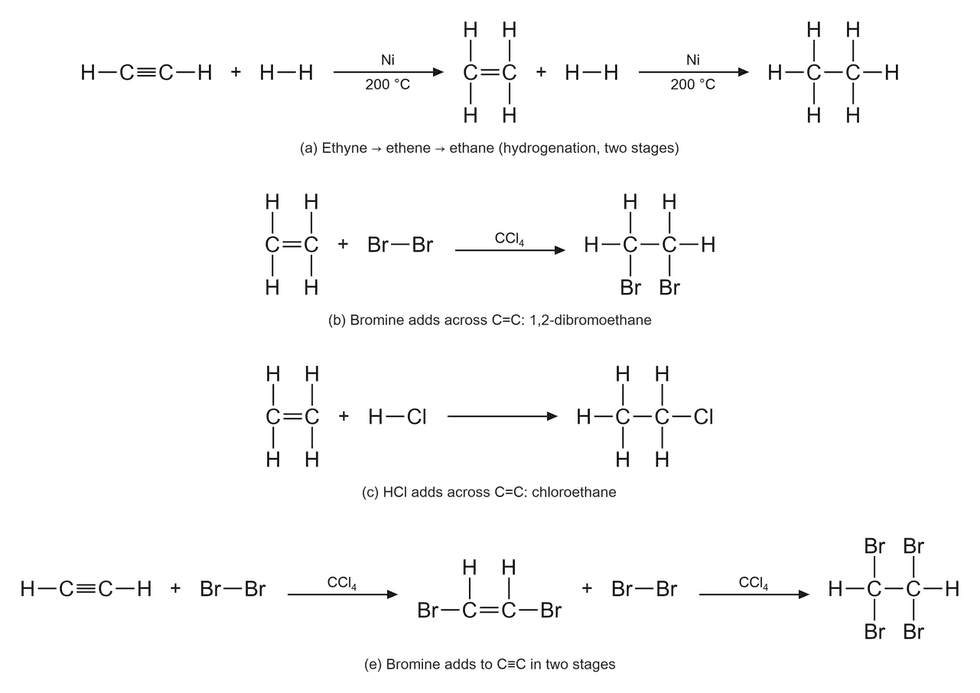
Step 1 — (a) Ethyne and hydrogen.
Over finely divided nickel at about 200 °C, ethyne takes up one to become ethene, then a second to become ethane:
Step 2 — (b) Ethene and bromine.
In carbon tetrachloride at room temperature, 1,2-dibromoethane forms and the bromine colour disappears:
Step 3 — (c) Ethene and hydrogen chloride.
HCl adds to give chloroethane (ethyl chloride):
Step 4 — (d) Calcium carbide and water.
At room temperature ethyne and calcium hydroxide form:
Step 5 — (e) Ethyne and bromine.
In bromine adds in two stages: first 1,2-dibromoethene, then 1,1,2,2-tetrabromoethane:
Step 6 — (f) Ethanol and [O].
Warm acidified potassium dichromate oxidises ethanol first to ethanal, then to ethanoic acid:
Therefore, the products are (a) ethene, then ethane; (b) 1,2-dibromoethane; (c) chloroethane; (d) ethyne and calcium hydroxide; (e) 1,2-dibromoethene, then 1,1,2,2-tetrabromoethane; (f) ethanal, then ethanoic acid.