
Question 735 marksMedium
How is ethyne prepared in the laboratory ?
(a) Draw a diagram. (b) Give an equation.
(c) How is pure dry gas collected ?
Confirming your payment
Sign up now and get 250 free tokens.
Organic Chemistry · Question 73 of 150
How is ethyne prepared in the laboratory ?
(a) Draw a diagram. (b) Give an equation.
(c) How is pure dry gas collected ?
Solution:
Concept: Water is dropped onto calcium carbide; ethyne is given off at room temperature without heating, because the reaction is exothermic.
Step 1 — (a) Set up the apparatus.
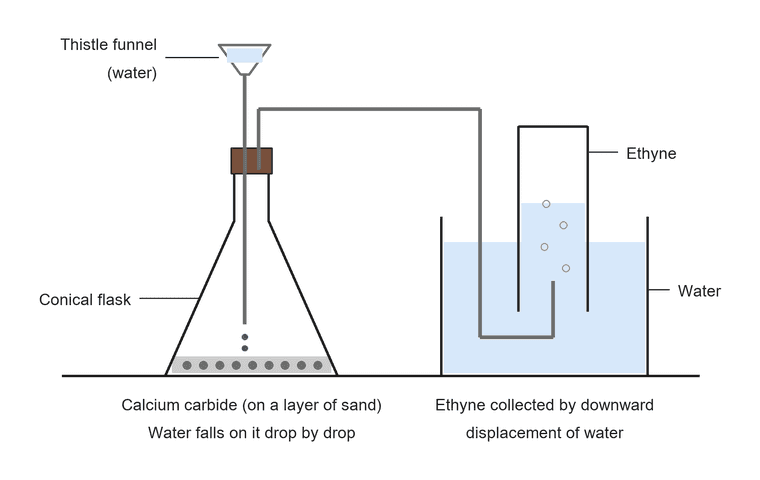
A few lumps of calcium carbide (on a layer of sand) are placed in a conical flask fitted with a thistle funnel and a delivery tube. The air in the apparatus is driven out first, because ethyne forms an explosive mixture with air. Water is then added drop by drop through the funnel:
Step 2 — (b) Write the equation.
Calcium carbide reacts with water to give calcium hydroxide and ethyne:
Step 3 — (c) Purify the gas.
The gas contains small amounts of phosphine, hydrogen sulphide and ammonia from impurities in the carbide. Ammonia is removed by washing with water, and hydrogen sulphide and phosphine by passing the gas through acidified copper sulphate solution.
Step 4 — (c) Collect the gas.
Ethyne is almost insoluble in water, so it is collected by downward displacement of water. For a dry sample it is passed over a drying agent such as fused calcium chloride and collected over mercury.
Watch out: The flask is not heated; the reaction gives out heat by itself.
Therefore, ethyne is made by dropping water on calcium carbide (CaC₂ + 2H₂O → Ca(OH)₂ + C₂H₂), purified through acidified copper sulphate, and collected over water (or, dry, over mercury).