
Question 155 marksEasy
(a) What is a homologous series ?
(b) What is the difference in the molecular formula of any two adjacent homologues :
(i) in terms of molecular mass,
(ii) in terms of number and kind of atoms per molecule?
Confirming your payment
Sign up now and get 250 free tokens.
Organic Chemistry · Question 15 of 150
(a) What is a homologous series ?
(b) What is the difference in the molecular formula of any two adjacent homologues :
(i) in terms of molecular mass,
(ii) in terms of number and kind of atoms per molecule?
Solution:
Concept: In a homologous series each member differs from the next by one group, so neighbouring members always differ by the same atoms and the same mass.
Step 1 — (a) Define a homologous series.
A homologous series is a group of organic compounds with the same general formula and similar chemical properties, in which each member differs from the next by a group. Their physical properties change gradually along the series.
Examples: alkanes (), alkenes (), alkynes (), alcohols.
Step 2 — (b)(i) Find the difference in molecular mass.
The difference is the mass of one group, using C = 12 and H = 1:
Check with methane and ethane:
Step 3 — (b)(ii) State the difference in atoms.
Adjacent homologues differ by one carbon atom and two hydrogen atoms (a group), for example → → :
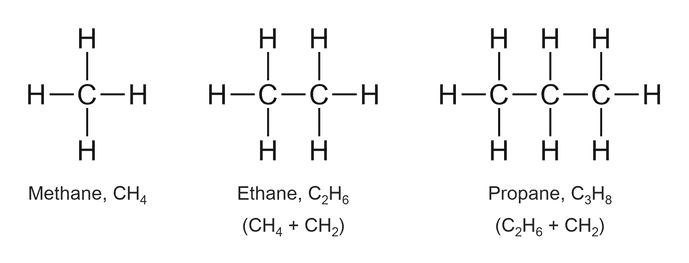
Therefore, (a) a homologous series is a family with one general formula whose members differ by CH₂; (b) adjacent members differ by (i) 14 u and (ii) one C atom and two H atoms.