
Question 1141 markMCQEasy
An organic compound undergoes addition reactions and gives a red colour precipitate with ammoniacal cuprous chloride. Therefore, the organic compound could be :
Confirming your payment
Sign up now and get 250 free tokens.
Organic Chemistry · Question 114 of 150
An organic compound undergoes addition reactions and gives a red colour precipitate with ammoniacal cuprous chloride. Therefore, the organic compound could be :
(A) Ethane
(B) Ethene
(C) Ethyne
(D) Ethanol
Answer: (C) Ethyne
Concept: addition reactions show that the compound is unsaturated (C=C or C≡C). A red precipitate (copper acetylide) with ammoniacal cuprous chloride is given only by an alkyne such as ethyne, whose H atoms sit on the triple-bonded carbons.
Step 1 — Use the first clue.
Undergoing addition rules out the saturated compounds; ethene or ethyne remain.
Step 2 — Use the second clue.
Of these, only ethyne gives the red precipitate with ammoniacal cuprous chloride:
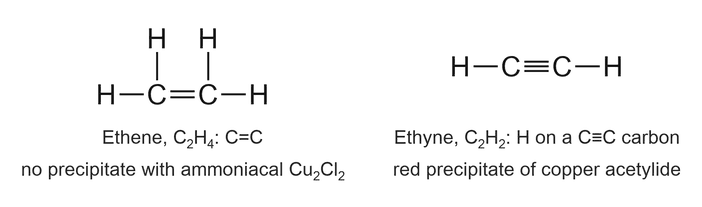
Why the other options are wrong:
Therefore, the compound is ethyne, option (C).