
Question 464 marksEasy
How is :
(a) methane and
(b) ethane prepared in the laboratory ?
Confirming your payment
Sign up now and get 250 free tokens.
Organic Chemistry · Question 46 of 150
How is :
(a) methane and
(b) ethane prepared in the laboratory ?
Solution:
Concept: Heating the sodium salt of a carboxylic acid with soda lime (NaOH + CaO) removes the –COONa group as sodium carbonate (decarboxylation), so the alkane formed has one carbon fewer than the salt.
Step 1 — (a) Methane: take the reactants.
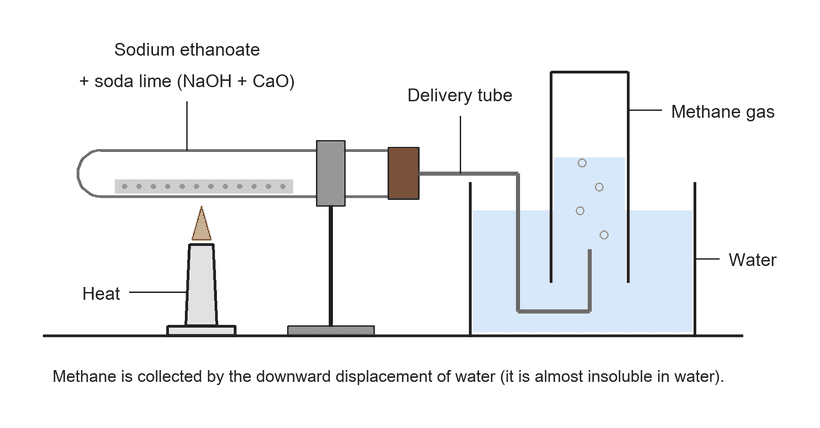
Sodium ethanoate (sodium acetate) is mixed with soda lime. Soda lime is used instead of NaOH alone because NaOH absorbs moisture (deliquescent) and attacks the glass; the CaO keeps the mixture dry.
Step 2 — (a) Methane: heat and write the equation.
The mixture is heated in a hard-glass test tube; methane is given off:
Step 3 — (a) Methane: collect the gas.
Methane is almost insoluble in water, so it is collected by the downward displacement of water:
Step 4 — (b) Ethane.
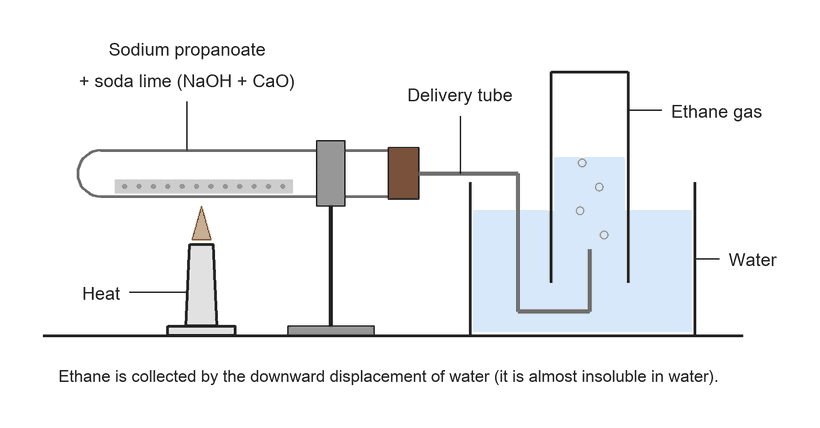
Sodium propanoate (sodium propionate) is heated with soda lime in the same apparatus, and ethane is collected over water in the same way:
Watch out: The alkane has one carbon fewer than the salt: sodium ethanoate (2 C) gives methane (1 C), sodium propanoate (3 C) gives ethane (2 C).
Therefore, methane is made by heating sodium ethanoate with soda lime, and ethane by heating sodium propanoate with soda lime; both are collected over water.