
Question 624 marksEasy
(a) Ethene when reacts with halogens (chlorine and bromine) form saturated products. Name them and write balanced equations.
(b) Give the conditions and the main product formed by hydrogenation of ethene.
Confirming your payment
Sign up now and get 250 free tokens.
Organic Chemistry · Question 62 of 150
(a) Ethene when reacts with halogens (chlorine and bromine) form saturated products. Name them and write balanced equations.
(b) Give the conditions and the main product formed by hydrogenation of ethene.
Solution:
Concept: Reagents add across the C=C double bond: one of its two bonds breaks and one new atom (or group) joins each carbon, so the product is saturated.
Step 1 — (a) Ethene with chlorine.
Chlorine adds at room temperature, one Cl on each carbon, giving 1,2-dichloroethane:
Step 2 — (a) Ethene with bromine.
Bromine (in carbon tetrachloride) adds in the same way, giving 1,2-dibromoethane; the reddish-brown colour of bromine disappears:
Step 3 — (b) Hydrogenation.
Ethene and hydrogen are passed over finely divided nickel at about 200 °C (or platinum / palladium at room temperature); the main product is ethane:
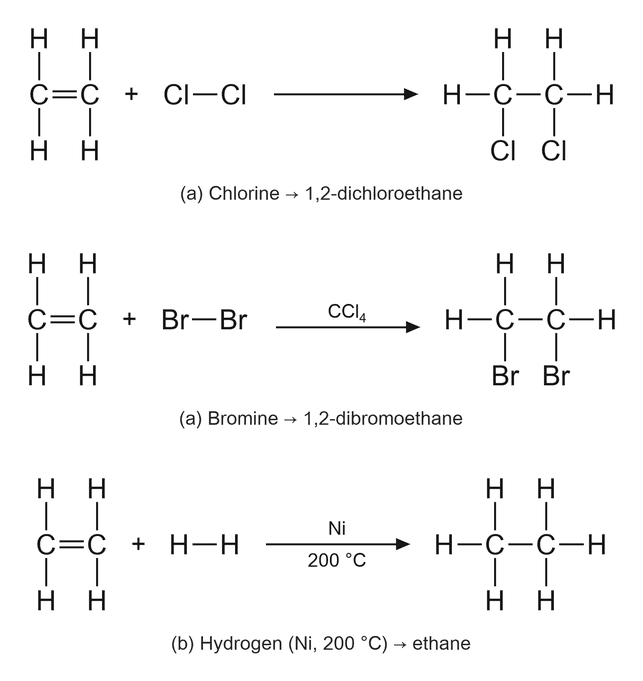
Therefore, (a) chlorine and bromine give 1,2-dichloroethane and 1,2-dibromoethane; (b) with hydrogen over nickel at 200 °C, ethene gives ethane.