Solution:
Concept: Two carbons give the root word eth-. The suffix tells the type: -ane (single bond), -ol (alcohol), -yne (triple bond).
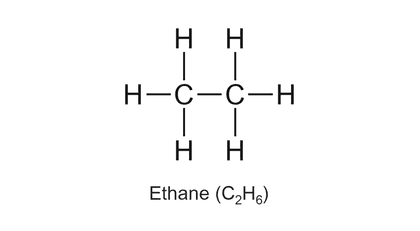
Step 1 — (a) Alkane with a C–C single bond.
This is ethane, C2H6 (CH3−CH3); each carbon has three H atoms.
Step 2 — (b) Alcohol with two carbon atoms.
This is ethanol, C2H5OH (CH3−CH2−OH); the –OH group takes the place of one H of ethane.

Step 3 — (c) Unsaturated hydrocarbon with a C≡C bond.
This is ethyne, C2H2 (HC≡CH); each carbon has one H atom.

Watch out: Check every carbon: 3 C–H + 1 C–C in ethane, but 1 C–H + the 3 bonds of C≡C in ethyne.
Therefore, (a) ethane CH₃–CH₃, (b) ethanol CH₃–CH₂–OH, (c) ethyne HC≡CH.
