
Opening your dashboard
Class 10 Chemistry Chapter 8: Study of Compounds – Hydrogen Chloride Solutions
40 textbook questions with step-by-step answers, free to read, for ICSE 2026-27.
Get talked through Ch 8, not just shown the answer
Reading a finished solution is not the same as being able to do it. The AI tutor takes one question at a time and works it with you, in your own words, until you can.
- Ask it out loud, in your own words
- It gives you the next step, not the answer
- Stuck on part (ii)? Start there
40 questions with solutions
1–5 marks · Mixed difficulty
- 11 mark
Question 1
Hydrogen chloride molecule is :
Solve with AIAnswer
- Correct
(A) Polar covalent
(B) Non polar
(C) Ionic
(D) Co-ordinate
Answer: (A) Polar covalent
Concept: A covalent bond forms when two atoms share a pair of electrons. The bond is polar when one atom pulls the shared pair more strongly (it is more electronegative), so the two ends carry small opposite charges.
Step 1 — Count the electrons each atom shares.
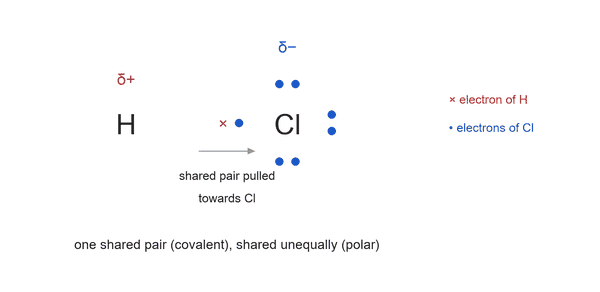
Hydrogen has 1 valence electron and chlorine (2, 8, 7) has 7. Each atom gives one electron, so they share one pair and form a single covalent bond, H–Cl. Now both atoms have a stable arrangement.
Step 2 — Decide whether the sharing is equal.
Chlorine is much more electronegative than hydrogen, so the shared pair is pulled nearer to chlorine. Chlorine gets a small negative charge (δ−) and hydrogen a small positive charge (δ+):
Step 3 — Name the bond.
The electrons are shared, so the bond is covalent; they are shared unequally, so it is polar. The molecule is polar covalent.
Watch out: A polar covalent bond is still covalent. Dry HCl has no ions; it forms ions only when it dissolves in water.
Why the other options are wrong:
- (B) Non polar: a non-polar bond shares the pair equally, as in or , where both atoms are the same. H and Cl are different atoms that pull the pair unequally.
- (C) Ionic: in an ionic bond an electron is completely transferred and ions are formed. Dry hydrogen chloride has no ions and does not conduct electricity, so it is not ionic.
- (D) Co-ordinate: in a co-ordinate bond both shared electrons come from one atom. In H–Cl each atom gives one electron.
Therefore, the hydrogen chloride molecule is polar covalent, option (A).
- 21 mark
Question 2
Hydrogen chloride gas being highly soluble in the water is dried by :
Solve with AIAnswer
(A) Anhydrous calcium chloride
(B) Phosphorous pentoxide
(C) Quick lime
- Correct
(D) Conc. Sulphuric acid
Answer: (D) Conc. Sulphuric acid
Concept: A drying agent must remove water vapour from a gas without reacting with the gas itself. Hydrogen chloride is an acidic gas, so a basic drying agent, or one that reacts with it, cannot be used.
Step 1 — Pick a drying agent that leaves HCl unchanged.
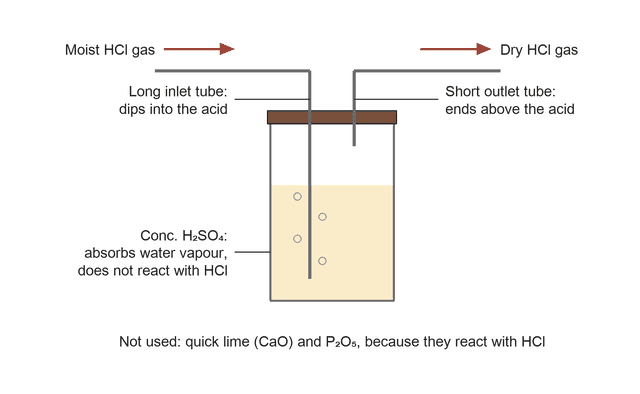
Concentrated sulphuric acid is itself an acid, so it does not react with hydrogen chloride, and it absorbs water vapour strongly. In the laboratory the moist gas is bubbled through conc. sulphuric acid in a wash bottle: the long inlet tube dips into the acid and the short outlet tube ends above it.
Step 2 — Rule out the drying agents that react.
Quick lime is a basic oxide, so it neutralises the acidic gas:
Phosphorus pentoxide also reacts with hydrogen chloride:
With either of them, the gas would be used up instead of dried.
Watch out: "good drying agent" is not enough; the drying agent must also not react with the gas being dried.
Why the other options are wrong:
- (A) Anhydrous calcium chloride: anhydrous calcium chloride is not used for hydrogen chloride in the book's method; the standard drying agent for HCl is conc. sulphuric acid.
- (B) Phosphorous pentoxide: phosphorus pentoxide reacts with hydrogen chloride (equation in Step 2), so the gas would be lost.
- (C) Quick lime: quick lime is basic and neutralises hydrogen chloride, forming calcium chloride and water.
Therefore, hydrogen chloride is dried by conc. sulphuric acid, option (D).
- 31 mark
Question 3
The aim of the Fountain experiment is to prove that :
Solve with AIAnswer
(A) HCl turns blue litmus red
(B) HCl is denser than air
- Correct
(C) HCl is highly soluble in water
(D) HCl fumes in moist air
Answer: (C) HCl is highly soluble in water
Concept: Hydrogen chloride is extremely soluble in water (one volume of water dissolves about 450 volumes of the gas). When a little water dissolves a lot of gas inside a closed flask, the pressure inside falls sharply.
Step 1 — Recall the set-up.
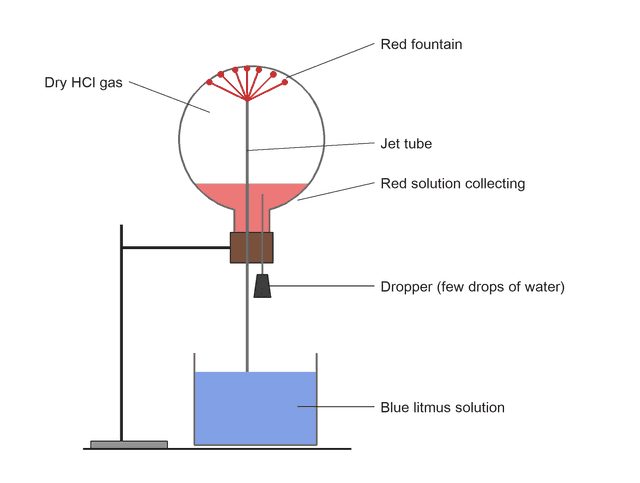
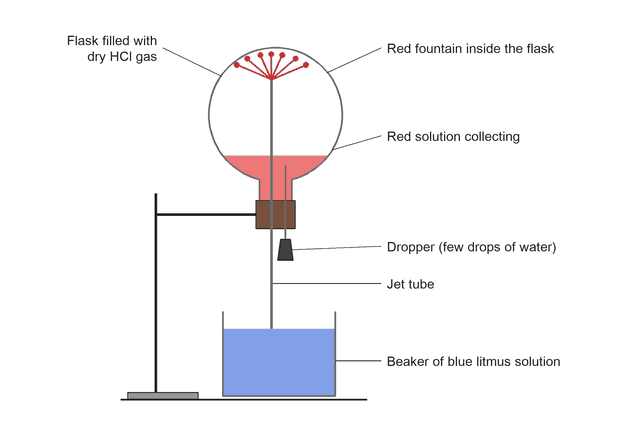
A dry round-bottom flask filled with dry HCl gas is held upside down. A jet tube passes through its stopper and dips into blue litmus solution in a beaker, and a dropper filled with water also passes through the stopper.
Step 2 — Explain why the fountain forms.
When the dropper is pressed, a few drops of water dissolve a large amount of the gas, so the pressure inside the flask falls. The air pressure outside is now greater, so it pushes the litmus solution up the jet tube, where it sprays out as a fountain.
Step 3 — State what the experiment proves.
The fountain can only form because the gas dissolves so quickly and in such a large amount. So the aim is to show that HCl is highly soluble in water.
Watch out: The red colour of the fountain is a side observation; the fountain itself is caused by the high solubility.
Why the other options are wrong:
- (A) HCl turns blue litmus red: the litmus does turn red, which shows that the solution is acidic, but that is not why the fountain forms.
- (B) HCl is denser than air: the density of HCl compared with air is shown by collecting it by upward displacement of air, not by this experiment.
- (D) HCl fumes in moist air: fuming in moist air is seen at the mouth of an open jar of the gas, not in the fountain experiment.
Therefore, the fountain experiment proves that HCl is highly soluble in water, option (C).
- 41 mark
Question 4
HCl dissolves in toluene () and the solution :
P contains hydronium ions.
Q can produce carbon dioxide on reacting with sodium carbonate.
R does not show any acidic property.
Which of the following holds true ?
Solve with AIAnswer
(A) Only P
(B) Only Q
- Correct
(C) Only R
(D) Both P and Q
Answer: (C) Only R
Concept: Hydrogen chloride shows acidic properties only when it ionises, and it ionises only in water:
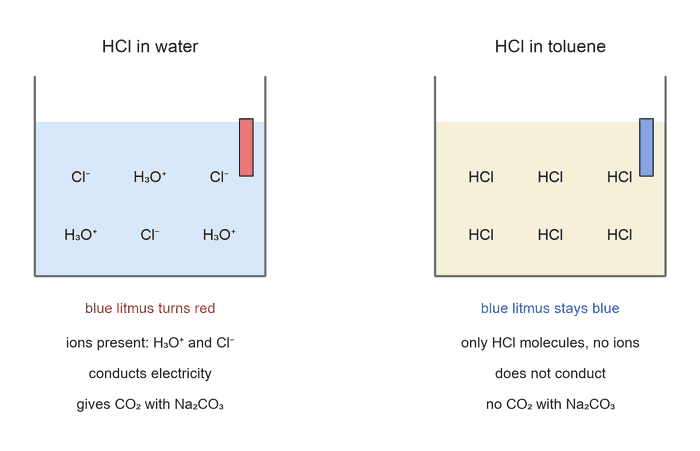
Toluene is an organic solvent with no water, so HCl dissolves in it as covalent molecules that do not ionise.
Step 1 — Test statement P.
Hydronium ions () are formed only when HCl reacts with water. Toluene contains no water, so no hydronium ions are formed. P is false.
Step 2 — Test statement Q.
Carbon dioxide is set free from sodium carbonate by ions. With no such ions in the toluene solution, no carbon dioxide is given off. Q is false.
Step 3 — Test statement R.
Without ions the solution does not turn blue litmus red, does not conduct electricity and does not react with carbonates. It shows no acidic property, so R is true.
Watch out: An acid shows its properties only in water. The same HCl gas is acidic in water and not acidic in toluene.
Why the other options are wrong:
- (A) Only P: P is false, because hydronium ions need water to form.
- (B) Only Q: Q is false, because without ions there is no reaction with the carbonate.
- (D) Both P and Q: both P and Q are false.
Therefore, only statement R holds true, option (C).
- 51 mark
Question 5
The following questions are Assertion-Reason based questions. Choose the answer based on the codes given below.
(1) Both A and R are true and R is the correct explanation of A.
(2) Both A and R are true but R is not the correct explanation of A.
(3) A is true but R is false.
(4) A is false but R is true.
Assertion (A) : HCl is produced by the reaction of hydrogen and chlorine in diffused sunlight.
Reason (R) : This reaction is explosive in sunlight.
Solve with AIAnswer
(A) (1)
- Correct
(B) (2)
(C) (3)
(D) (4)
Answer: (B) (2)
Concept: In an assertion-reason question, first judge the Assertion (A) true or false, then judge the Reason (R) true or false, and only when both are true ask whether R is the reason why A happens.
Step 1 — Judge the Assertion.
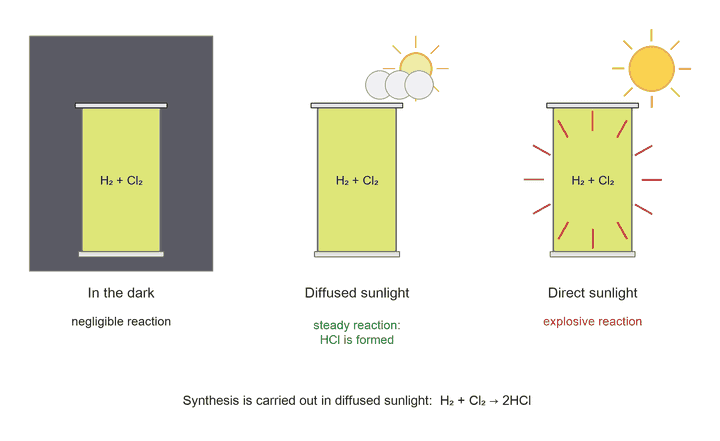
Moist hydrogen and chlorine combine steadily in diffused sunlight to form hydrogen chloride:
So A is true.
Step 2 — Judge the Reason.
In direct (bright) sunlight the same mixture reacts explosively. So R is true.
Step 3 — Ask whether R explains A.
R tells us what happens in direct sunlight. It does not explain why the gases combine steadily in diffused light, which is what A describes. So R is not the correct explanation of A.
Watch out: Both statements are about sunlight, but A is about diffused light and R is about direct light.
Why the other options are wrong:
- (A) (1): code (1) needs R to explain A, and it does not.
- (C) (3): code (3) needs R to be false, but the reaction really is explosive in direct sunlight.
- (D) (4): code (4) needs A to be false, but A is true.
Therefore, both A and R are true but R is not the correct explanation of A: code (2), option (B).
- 61 mark
Question 6
The following questions are Assertion-Reason based questions. Choose the answer based on the codes given below.
(1) Both A and R are true and R is the correct explanation of A.
(2) Both A and R are true but R is not the correct explanation of A.
(3) A is true but R is false.
(4) A is false but R is true.
Assertion (A) : The Fountain experiment is used to demonstrate the high solubility of HCl gas.
Reason (R) : Red litmus solution turns blue in Fountain experiment.
Solve with AIAnswer
(A) (1)
(B) (2)
- Correct
(C) (3)
(D) (4)
Answer: (C) (3)
Concept: In an assertion-reason question, first judge the Assertion (A) true or false, then judge the Reason (R) true or false, and only when both are true ask whether R is the reason why A happens.
Step 1 — Judge the Assertion.
The fountain experiment shows that hydrogen chloride is highly soluble in water. So A is true.
Step 2 — Judge the Reason.
In the HCl fountain experiment the beaker holds blue litmus solution. Hydrochloric acid turns blue litmus red, so a red fountain is seen. Red litmus turning blue is the change caused by a base such as ammonia, not by HCl. So R is false.
Watch out: The blue fountain belongs to the ammonia fountain experiment (red litmus in the beaker), not to HCl.
Why the other options are wrong:
- (A) (1): code (1) needs R to be true, but R is false.
- (B) (2): code (2) also needs R to be true, but R is false.
- (D) (4): code (4) needs A to be false, but A is true.
Therefore, A is true but R is false: code (3), option (C).
- 71 mark
Question 7
The following questions are Assertion-Reason based questions. Choose the answer based on the codes given below.
(1) Both A and R are true and R is the correct explanation of A.
(2) Both A and R are true but R is not the correct explanation of A.
(3) A is true but R is false.
(4) A is false but R is true.
Assertion (A) : HCl gas is collected by downward delivery.
Reason (R) : HCl gas is heavier than air.
Solve with AIAnswer
- Correct
(A) (1)
(B) (2)
(C) (3)
(D) (4)
Answer: (A) (1)
Concept: In an assertion-reason question, first judge the Assertion (A) true or false, then judge the Reason (R) true or false, and only when both are true ask whether R is the reason why A happens.
Step 1 — Judge the Reason.
We compare vapour densities. The vapour density of HCl is half its molecular mass, and that of air is 14.4:
So HCl is about 1.27 times heavier than air, and R is true.
Step 2 — Judge the Assertion.
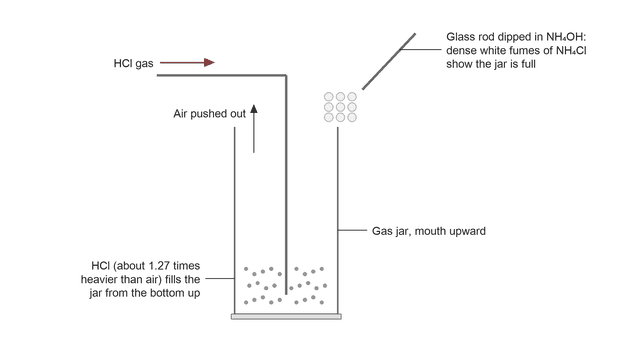
HCl is collected by downward delivery: the delivery tube reaches the bottom of an upright gas jar. This is the same as upward displacement of air. So A is true.
Step 3 — Ask whether R explains A.
The heavier gas settles at the bottom of the jar and pushes the lighter air out at the top. This works only because HCl is heavier than air, so R correctly explains A. (HCl is not collected over water, because it is highly soluble.)
Watch out: 'downward delivery' and 'upward displacement of air' describe the same method.
Why the other options are wrong:
- (B) (2): code (2) says R does not explain A, but R is exactly the reason for A.
- (C) (3): code (3) needs R to be false, but R is true.
- (D) (4): code (4) needs A to be false, but A is true.
Therefore, both A and R are true and R is the correct explanation of A: code (1), option (A).
- 81 mark
Question 8
The following questions are Assertion-Reason based questions. Choose the answer based on the codes given below.
(1) Both A and R are true and R is the correct explanation of A.
(2) Both A and R are true but R is not the correct explanation of A.
(3) A is true but R is false.
(4) A is false but R is true.
Assertion (A) : HCl gas fumes in moist air.
Reason (R) : HCl gas is highly soluble.
Solve with AIAnswer
- Correct
(A) (1)
(B) (2)
(C) (3)
(D) (4)
Answer: (A) (1)
Concept: In an assertion-reason question, first judge the Assertion (A) true or false, then judge the Reason (R) true or false, and only when both are true ask whether R is the reason why A happens.
Step 1 — Judge the Reason.
Hydrogen chloride gas is highly soluble in water. So R is true.
Step 2 — Judge the Assertion.
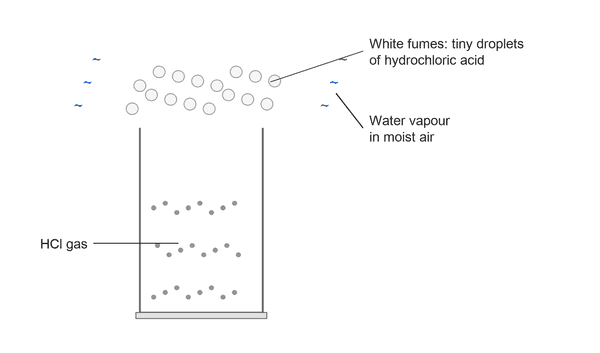
When HCl gas meets moist air, it dissolves in the water vapour of the air and forms tiny droplets of hydrochloric acid. These droplets are seen as white fumes. So A is true.
Step 3 — Ask whether R explains A.
The droplets form only because the gas dissolves so readily in water vapour. So R correctly explains A.
Watch out: The fumes are droplets of acid, not a solid. Dense white fumes of a solid (ammonium chloride) are seen only with ammonia.
Why the other options are wrong:
- (B) (2): code (2) says R does not explain A, but R is exactly the reason for A.
- (C) (3): code (3) needs R to be false, but R is true.
- (D) (4): code (4) needs A to be false, but A is true.
Therefore, both A and R are true and R is the correct explanation of A: code (1), option (A).
- 91 mark
Question 9
The following questions are Assertion-Reason based questions. Choose the answer based on the codes given below.
(1) Both A and R are true and R is the correct explanation of A.
(2) Both A and R are true but R is not the correct explanation of A.
(3) A is true but R is false.
(4) A is false but R is true.
Assertion (A) : HCl gas dissolves in water as well as organic compounds like toluene.
Reason (R) : HCl is a polar covalent compound.
Solve with AIAnswer
- Correct
(A) (1)
(B) (2)
(C) (3)
(D) (4)
Answer: (A) (1)
Concept: In an assertion-reason question, first judge the Assertion (A) true or false, then judge the Reason (R) true or false, and only when both are true ask whether R is the reason why A happens.
Step 1 — Judge the Reason.
In H–Cl the electrons are shared (covalent), and the shared pair lies nearer chlorine (polar). So HCl is a polar covalent compound, and R is true.
Step 2 — Judge the Assertion.
HCl dissolves in water, a polar solvent, and also in organic solvents such as toluene. So A is true.
Step 3 — Ask whether R explains A.
Being polar, HCl dissolves in water (and ionises there). Being covalent, it dissolves in toluene as molecules. Its polar covalent nature explains both, so R correctly explains A.
Watch out: Dissolving is not the same as ionising: HCl dissolves in toluene but does not ionise in it.
Why the other options are wrong:
- (B) (2): code (2) says R does not explain A, but R explains both parts of A.
- (C) (3): code (3) needs R to be false, but R is true.
- (D) (4): code (4) needs A to be false, but A is true.
Therefore, both A and R are true and R is the correct explanation of A: code (1), option (A).
- 101 mark
Question 10
The following questions are Assertion-Reason based questions. Choose the answer based on the codes given below.
(1) Both A and R are true and R is the correct explanation of A.
(2) Both A and R are true but R is not the correct explanation of A.
(3) A is true but R is false.
(4) A is false but R is true.
Assertion (A) : HCl gas is used in the preparation of chlorine and chlorides.
Reason (R) : Lead chloride is not produced from HCl.
Solve with AIAnswer
(A) (1)
(B) (2)
- Correct
(C) (3)
(D) (4)
Answer: (C) (3)
Concept: In an assertion-reason question, first judge the Assertion (A) true or false, then judge the Reason (R) true or false, and only when both are true ask whether R is the reason why A happens.
Step 1 — Judge the Assertion.
Hydrochloric acid is used to make chlorine (by oxidising it) and many chlorides, such as ammonium chloride for dry cells. So A is true.
Step 2 — Judge the Reason.
When hydrochloric acid is added to lead nitrate solution, a white precipitate of lead chloride forms:
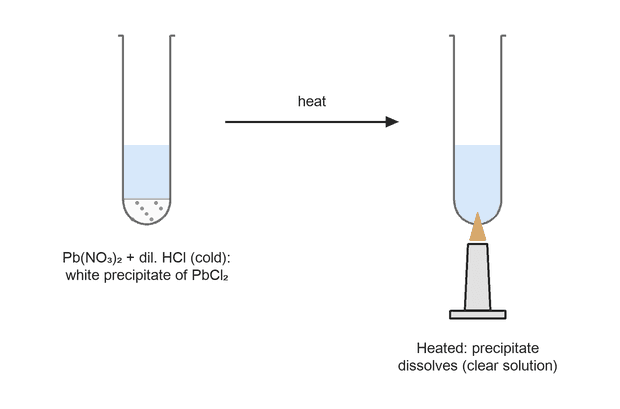
So lead chloride is produced from HCl, and R is false.
Why the other options are wrong:
- (A) (1): code (1) needs R to be true, but R is false.
- (B) (2): code (2) also needs R to be true, but R is false.
- (D) (4): code (4) needs A to be false, but A is true.
Therefore, A is true but R is false: code (3), option (C).
- 111 mark
Question 11
The following questions are Assertion-Reason based questions. Choose the answer based on the codes given below.
(1) Both A and R are true and R is the correct explanation of A.
(2) Both A and R are true but R is not the correct explanation of A.
(3) A is true but R is false.
(4) A is false but R is true.
Assertion (A) : HCl has sour taste.
Reason (R) : HCl is highly soluble in water.
Solve with AIAnswer
(A) (1)
- Correct
(B) (2)
(C) (3)
(D) (4)
Answer: (B) (2)
Concept: In an assertion-reason question, first judge the Assertion (A) true or false, then judge the Reason (R) true or false, and only when both are true ask whether R is the reason why A happens.
Step 1 — Judge the Assertion.
Hydrochloric acid tastes sour, like all acids. So A is true.
Step 2 — Judge the Reason.
HCl is highly soluble in water (one volume of water dissolves about 450 volumes of the gas). So R is true.
Step 3 — Ask whether R explains A.
Sourness comes from the hydronium ions () formed when HCl ionises in water, not from how much of it dissolves. Many very soluble substances, such as sugar, are not sour at all. So R does not explain A.
Watch out: A true Reason that sits next to a true Assertion does not have to explain it; always ask "is R the cause of A?"
Why the other options are wrong:
- (A) (1): code (1) needs R to explain A, but solubility does not cause sourness.
- (C) (3): code (3) needs R to be false, but HCl is highly soluble.
- (D) (4): code (4) needs A to be false, but HCl is sour.
Therefore, both A and R are true but R is not the correct explanation of A: code (2), option (B).
- 122 marks
Question 12
Fill in the blank from the choices in the bracket :
(a) Quicklime is not used to dry HCl gas because CaO is ............... [alkaline/acidic/neutral].
(b) When sodium chloride is heated with concentrated sulphuric acid below 200°C, one of the product formed is .................. (sodium hydrogen sulphate/ sodium sulphate/chlorine).
Solve with AIWritten solution
Solution:
Concept: A drying agent must not react with the gas it dries. In the preparation of HCl from sodium chloride and conc. sulphuric acid, the temperature decides which sodium salt is formed.
Step 1 — (a) Why quick lime is not used.
Quick lime (CaO) is a basic oxide; it is alkaline. Hydrogen chloride is an acidic gas, so quick lime neutralises it instead of drying it:
That is why HCl is dried by conc. sulphuric acid, which does not react with it.
Step 2 — (b) The product below 200 °C.
Below 200 °C only the first stage of the reaction takes place. It gives sodium hydrogen sulphate and hydrogen chloride:
Only above 200 °C does sodium hydrogen sulphate react further with sodium chloride to give sodium sulphate.
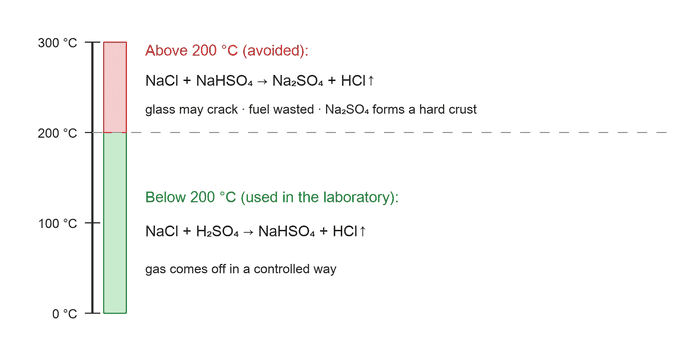
Watch out: Below 200 °C the product is sodium hydrogen sulphate, not sodium sulphate.
Therefore, (a) CaO is alkaline; (b) the product is sodium hydrogen sulphate.
- 135 marks
Question 13
Name
(a) a black metallic oxide which reacts with hydrochloric acid to give a coloured solution.
(b) two colourless gases, which when mixed produce a white solid.
(c) two gases which chemically combine to form a liquid.
(d) a chloride which is soluble in excess of ammonium hydroxide.
(e) the chemical in which gold can be dissolved.
(f) the experiment which demonstrates that hydrogen chloride is soluble in water.
(g) the gas produced when chlorine water is exposed to sunlight.
(h) The acid which on mixing with silver nitrate solution produces a white precipitate which is soluble in excess of ammonium hydroxide.
(i) The gas which produces dense white fumes with ammonia gas.
(j) An element which reacts with hydrogen to form a compound which is strongly acidic in water.
Solve with AIWritten solution
Solution:
Concept: Each answer comes from a reaction met in this chapter: acids with metal oxides, HCl with ammonia, the test for chloride ions, aqua regia, the fountain experiment and the direct union of hydrogen with chlorine.
Step 1 — (a) Black metallic oxide giving a coloured solution.
Black copper (II) oxide is a basic oxide. It dissolves in hydrochloric acid to give a bluish-green solution of copper (II) chloride:
Step 2 — (b) Two colourless gases giving a white solid.
Ammonia and hydrogen chloride are both colourless gases. When they meet they combine to form dense white fumes of solid ammonium chloride:
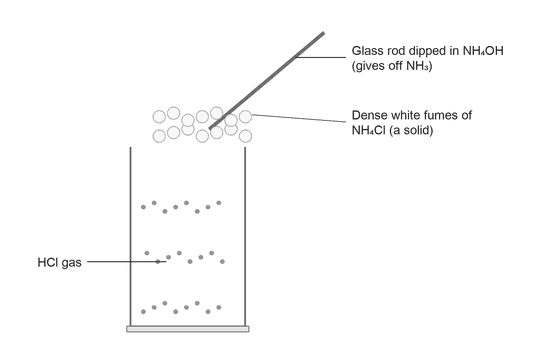
Step 3 — (c) Two gases forming a liquid.
Hydrogen and oxygen combine (for example when hydrogen burns) to form liquid water:
Step 4 — (d) A chloride soluble in excess ammonium hydroxide.
Silver chloride (white) dissolves in excess ammonium hydroxide, because it forms the soluble complex diammine silver (I) chloride:
Step 5 — (e) The chemical that dissolves gold.
Aqua regia, a mixture of 3 parts conc. hydrochloric acid and 1 part conc. nitric acid by volume. It gives nascent chlorine, which turns gold into its soluble chloride.
Step 6 — (f) Experiment showing that HCl is soluble in water.
The fountain experiment. A few drops of water dissolve so much HCl that the pressure in the flask falls, and litmus solution rushes in as a fountain.
Step 7 — (g) Gas from chlorine water in sunlight.
Oxygen. Chlorine water decomposes in sunlight, giving hydrochloric acid and oxygen:
Step 8 — (h) Acid giving a white precipitate with silver nitrate, soluble in ammonium hydroxide.
Hydrochloric acid. It gives a curdy white precipitate of silver chloride with silver nitrate solution:
The precipitate dissolves in excess ammonium hydroxide, as in part (d).
Step 9 — (i) Gas giving dense white fumes with ammonia.
Hydrogen chloride. It forms dense white fumes of ammonium chloride with ammonia, the same reaction as in part (b).
Step 10 — (j) Element whose hydride is strongly acidic in water.
Chlorine. It combines with hydrogen to form hydrogen chloride, and its solution in water (hydrochloric acid) is a strong acid:
Watch out: In (b) and (i) the white fumes are a solid (ammonium chloride), while HCl alone in moist air gives a mist of liquid droplets.
Therefore, (a) copper (II) oxide; (b) ammonia and hydrogen chloride; (c) hydrogen and oxygen; (d) silver chloride; (e) aqua regia; (f) the fountain experiment; (g) oxygen; (h) hydrochloric acid; (i) hydrogen chloride; (j) chlorine.
- 142 marks
Question 14
Identify the gas evolved when :
(a) Potassium sulphite is treated with dilute hydrochloric acid.
(b) Concentrated hydrochloric acid is made to react with manganese dioxide.
Solve with AIWritten solution
Solution:
Concept: Dilute hydrochloric acid decomposes salts of weaker acids, so a sulphite gives sulphur dioxide. Concentrated hydrochloric acid is oxidised by oxidising agents such as manganese dioxide, giving chlorine.
Step 1 — (a) Potassium sulphite with dilute HCl.
The sulphite is the salt of the weaker sulphurous acid, so the acid decomposes it and sulphur dioxide is given off:
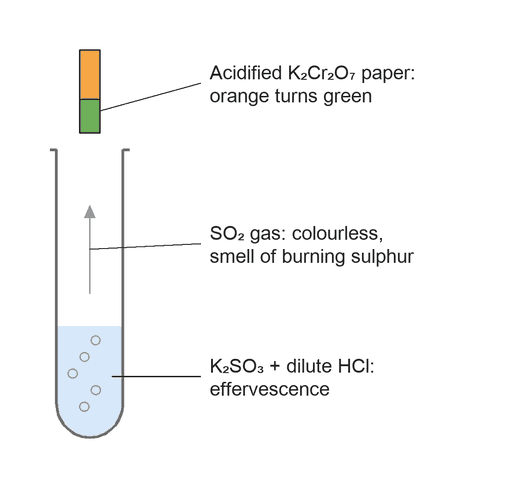
Sulphur dioxide is a colourless gas with the smell of burning sulphur, and it turns acidified potassium dichromate paper from orange to green.

Step 2 — (b) Conc. HCl with manganese dioxide.
Manganese dioxide is an oxidising agent. On heating it removes hydrogen from the acid, and chlorine is given off:
Chlorine is a greenish-yellow gas with a pungent smell, and it turns moist starch iodide paper blue-black.
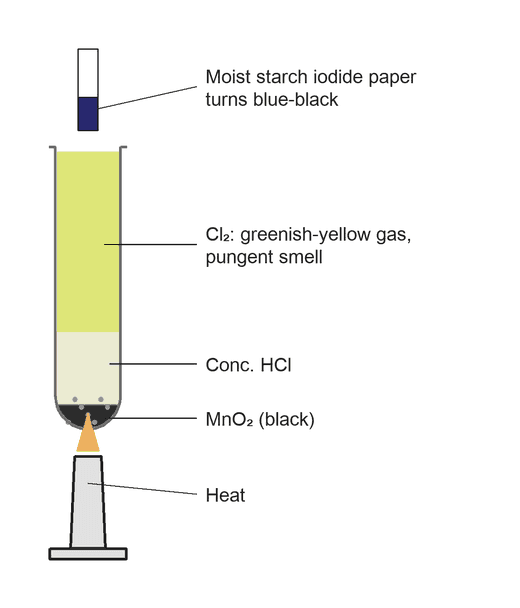
Watch out: The chlorine comes from the hydrochloric acid, not from the manganese dioxide.
Therefore, (a) the gas is sulphur dioxide, ; (b) the gas is chlorine, .
- 151 mark
Question 15
Solution A reacts with an acid B (which gives greenish yellow gas on reacting with oxidising agents like ) to give white precipitate C insoluble in nitric acid but soluble in ammonium hydroxide. Name A, B and C.
Solve with AIWritten solution
Solution:
Concept: Work from the clues one at a time. An acid that gives a greenish-yellow gas (chlorine) with an oxidising agent is hydrochloric acid. A white precipitate that is insoluble in nitric acid but soluble in ammonium hydroxide is silver chloride.
Step 1 — Identify acid B.
Red lead () is an oxidising agent. The only common acid it oxidises to a greenish-yellow gas (chlorine) is hydrochloric acid:
So B is hydrochloric acid.
Step 2 — Identify precipitate C and solution A.
A white precipitate of a chloride that does not dissolve in nitric acid but dissolves in ammonium hydroxide is silver chloride. The silver ions must come from solution A, so A is silver nitrate solution:
Step 3 — Check the behaviour of C.
Silver chloride does not dissolve in nitric acid, but it dissolves in ammonium hydroxide, forming the soluble complex diammine silver (I) chloride:
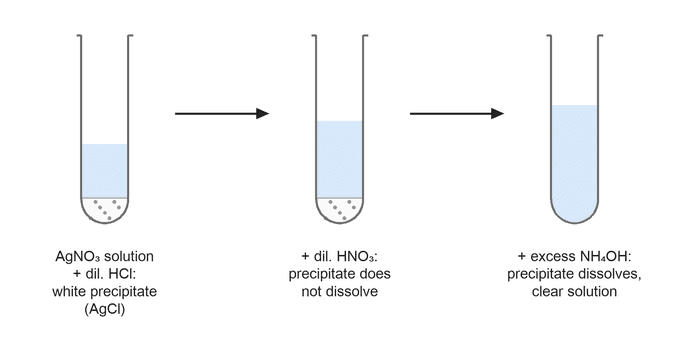
Watch out: Lead chloride is also white, but it dissolves in hot water, not in ammonium hydroxide; so C is silver chloride.
Therefore, A is silver nitrate solution, B is hydrochloric acid and C is silver chloride.
- 165 marks
Question 16
A solution of hydrogen chloride in water is prepared. The following substances are added to separate portions of the solution :
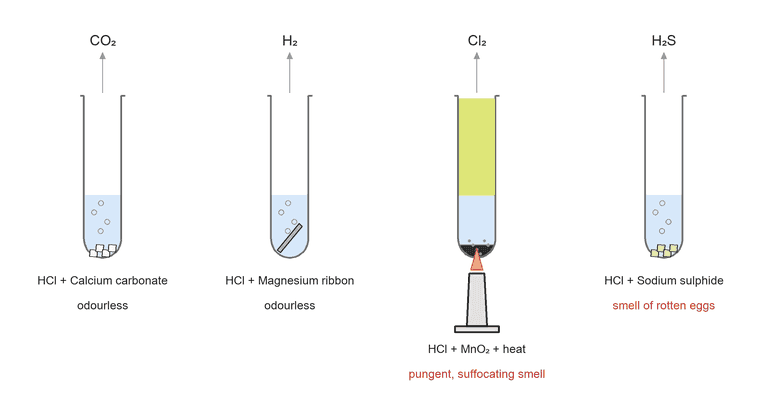
S. No. Substances added Gas evolved Odour 1. Calcium carbonate ................ ................ 2. Magnesium ribbon ................ ................ 3. Manganese (IV) oxide with heating ................ ................ 4. Sodium sulphide ................ ................ Complete the table by writing the gas evolved in each case and its odour.
Solve with AIWritten solution
Solution:
Concept: Hydrochloric acid gives a different gas with each kind of substance: carbon dioxide with carbonates, hydrogen with active metals, chlorine with oxidising agents (on heating, with the conc. acid) and hydrogen sulphide with sulphides.
Step 1 — Calcium carbonate.
Calcium carbonate is the salt of the weaker carbonic acid, so the acid decomposes it and carbon dioxide is given off. Carbon dioxide has no smell.
Step 2 — Magnesium ribbon.
Magnesium is above hydrogen in the activity series, so it displaces hydrogen from the acid. Hydrogen has no smell.
Step 3 — Manganese (IV) oxide, heated.
Manganese (IV) oxide is an oxidising agent. It oxidises the acid to greenish-yellow chlorine, which has a pungent, suffocating smell.
Step 4 — Sodium sulphide.
Sodium sulphide is the salt of the weak acid hydrogen sulphide, so the acid sets free hydrogen sulphide, which smells of rotten eggs.
Step 5 — Fill in the table.
We now write each gas and its odour in the table:
S. No. Substances added Gas evolved Odour 1. Calcium carbonate Carbon dioxide Odourless 2. Magnesium ribbon Hydrogen Odourless 3. Manganese (IV) oxide with heating Chlorine Pungent, suffocating 4. Sodium sulphide Hydrogen sulphide Rotten eggs Watch out: Carbon dioxide and hydrogen are both odourless; tell them apart by their tests (lime water turns milky; hydrogen burns with a 'pop').
Therefore, the gases are carbon dioxide (odourless), hydrogen (odourless), chlorine (pungent, suffocating) and hydrogen sulphide (rotten eggs).
- 175 marks
Question 17
Complete and balance the following reactions, state whether dilute or conc. acid is used.
(a) (b)
(c) (d)
Solve with AIWritten solution
Solution:
Concept: Neutralisation, decomposition of a salt of a weaker acid and precipitation all happen with dilute hydrochloric acid. Only the oxidation of HCl to chlorine needs the concentrated acid and heat.
Step 1 — (a) Ammonium hydroxide.
Ammonium hydroxide is a base, so dilute acid neutralises it, giving a salt and water:
Step 2 — (b) Sodium hydrogen sulphite.
A hydrogen sulphite is a salt of the weaker sulphurous acid. Dilute acid decomposes it and sulphur dioxide is given off:
Step 3 — (c) Lead nitrate.
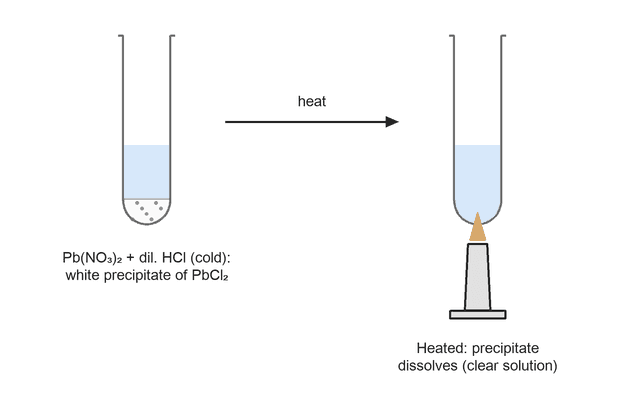
Dilute acid gives a white precipitate of lead chloride, which is insoluble in cold water (it dissolves on heating):
Step 4 — (d) Red lead.
Red lead is an oxidising agent. On heating it oxidises concentrated hydrochloric acid to chlorine:
Watch out: In (d), balance chlorine last: 8 Cl on the left = 3 × 2 in lead chloride + 2 in chlorine.
Therefore, (a), (b) and (c) use dilute acid, and (d) uses concentrated acid with heating; the balanced equations are shown above.
- 182 marks
Question 18
State the composition of aqua regia. State which component is the oxidising agent in aqua regia.
Solve with AIWritten solution
Solution:
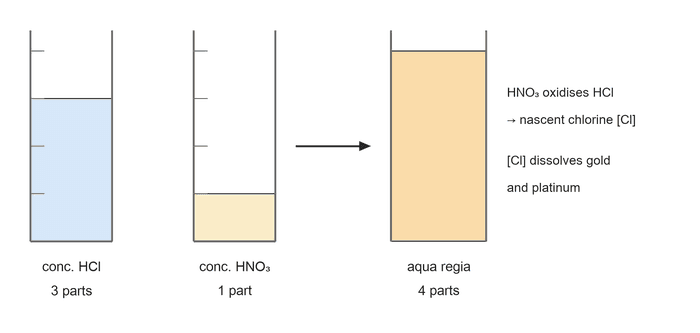
Concept: Aqua regia ("royal water") is so called because it dissolves the "royal" noble metals, gold and platinum, which neither acid can dissolve on its own.
Step 1 — State the composition.
Aqua regia is a freshly prepared mixture of 3 parts of conc. hydrochloric acid and 1 part of conc. nitric acid by volume.
Step 2 — Find the oxidising agent.
Conc. nitric acid is the oxidising agent. It oxidises hydrochloric acid and sets free nascent chlorine, [Cl]:
Step 3 — See how the noble metal dissolves.
The very reactive nascent chlorine attacks the noble metal and forms its soluble chloride, for example:
Watch out: The ratio is 3 : 1 of hydrochloric acid to nitric acid, not the other way round.
Therefore, aqua regia is 3 parts conc. HCl and 1 part conc. , and conc. nitric acid is the oxidising agent.
- 194 marks
Question 19
How will the action of dilute hydrochloric acid enable you to distinguish between the following :
(a) Sodium carbonate and sodium sulphite
(b) Sodium thiosulphate and sodium sulphite.
Solve with AIWritten solution
Solution:
Concept: Add dilute HCl to each salt and identify the product: the gas given off (and its test), or a precipitate in the solution.
Step 1 — (a) Sodium carbonate: the gas and its test.
Both salts effervesce with dilute HCl, but the gases differ. Sodium carbonate gives carbon dioxide, which is odourless and turns lime water milky:
Carbon dioxide has no effect on acidified potassium dichromate paper.
Step 2 — (a) Sodium sulphite: the gas and its test.
Sodium sulphite gives sulphur dioxide, which smells of burning sulphur and turns acidified potassium dichromate paper from orange to green:

Step 3 — (b) Sodium thiosulphate.
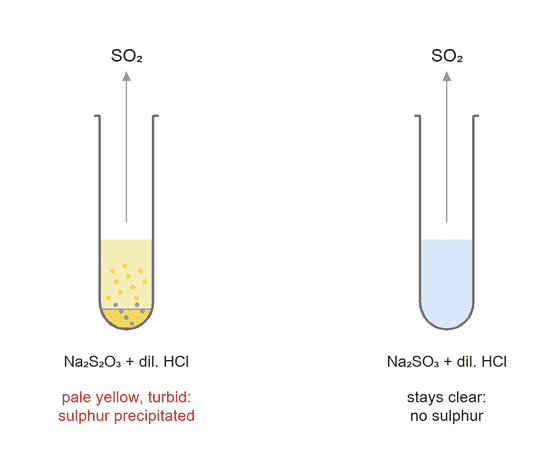
Sodium thiosulphate also gives sulphur dioxide, so the gas alone cannot tell it apart from the sulphite. Look at the solution instead: thiosulphate also gives a pale yellow precipitate of sulphur, so the solution turns turbid:
Step 4 — (b) Sodium sulphite.
Sodium sulphite gives sulphur dioxide but no precipitate; the solution stays clear (equation as in Step 2).
Watch out: Sulphur dioxide also turns lime water milky, so for (a) use the dichromate paper (or the smell), not lime water.
Therefore, (a) sodium carbonate gives odourless (no effect on dichromate paper), while sodium sulphite gives (turns dichromate paper green); (b) sodium thiosulphate gives a pale yellow precipitate of sulphur, while sodium sulphite gives a clear solution.
- 202 marks
Question 20
, and red lead react with conc. HCl acid liberate . What is the common property being shown by these metal oxides ?
Solve with AIWritten solution
Solution:
Concept: When chlorine is formed from HCl, the hydrogen of HCl is removed (it ends up in water). Removing hydrogen is oxidation, so a substance that does it is an oxidising agent.
Step 1 — Write the three reactions.
Each oxide is heated with conc. hydrochloric acid, and chlorine is given off:
Step 2 — See what the oxides do.
In each case the hydrogen of HCl joins the oxygen of the oxide to form water, and the chlorine is set free. The oxides remove hydrogen from HCl, so they oxidise it.
Step 3 — Name the property.
All three oxides therefore act as oxidising agents. Looked at the other way round, hydrochloric acid acts as a reducing agent towards them. The greenish-yellow gas turns moist starch iodide paper blue-black.
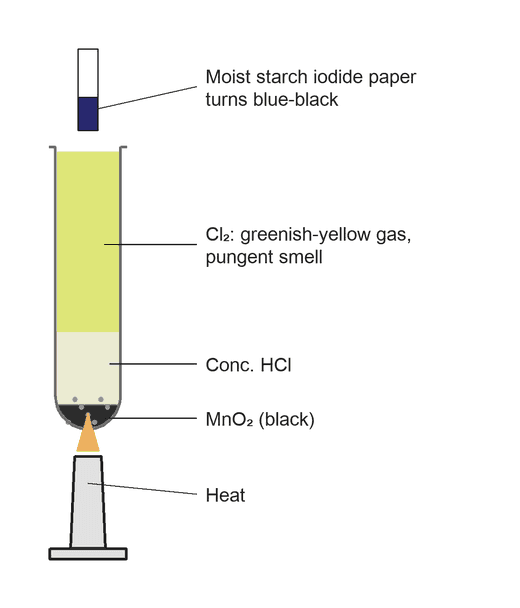
Watch out: The oxides are not acting as bases here; with conc. HCl and heat they act as oxidising agents.
Therefore, , and red lead are all oxidising agents.
- 215 marks
Question 21
Write an equation for the reactions of hydrochloric acid on :
(a) silver nitrate solution, (b) magnesium foil,
(c) caustic soda solution, (d) zinc carbonate,
(e) manganese (IV) oxide, (f) copper oxide.
Solve with AIWritten solution
Solution:
Concept: Hydrochloric acid shows the typical reactions of an acid (with metals, bases and carbonates), gives a precipitate with silver nitrate, and is oxidised to chlorine by manganese (IV) oxide.
Step 1 — (a) Silver nitrate solution.
Chloride ions combine with silver ions to give a curdy white precipitate of silver chloride:
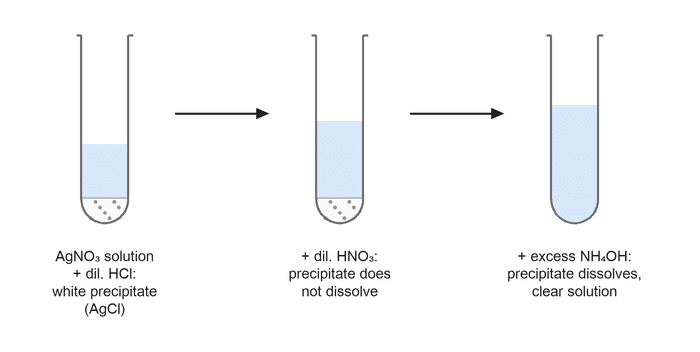
Step 2 — (b) Magnesium foil.
Magnesium is above hydrogen in the activity series, so it displaces hydrogen:
Step 3 — (c) Caustic soda solution.
Caustic soda (sodium hydroxide) is a base, so the acid neutralises it, giving salt and water:
Step 4 — (d) Zinc carbonate.
The carbonate is decomposed with effervescence of carbon dioxide:
Step 5 — (e) Manganese (IV) oxide.
With the conc. acid on heating, manganese (IV) oxide oxidises the acid to chlorine:
Step 6 — (f) Copper oxide.
Copper (II) oxide is a basic oxide. It dissolves to give a bluish-green solution of copper (II) chloride and water:
Watch out: Count the chlorine atoms: one HCl for silver nitrate and caustic soda, two for magnesium, zinc carbonate and copper oxide, four for manganese (IV) oxide.
Therefore, the six balanced equations are as written in Steps 1 to 6.
- 225 marks
Question 22
Write balanced equations for the reactions of dilute hydrochloric acid with each of the following :
(a) iron, (b) sodium hydrogen carbonate,
(c) iron (II) sulphide, (d) magnesium sulphite,
Solve with AIWritten solution
Solution:
Concept: With dilute hydrochloric acid, a metal gives hydrogen, a hydrogen carbonate gives carbon dioxide, a sulphide gives hydrogen sulphide and a sulphite gives sulphur dioxide. The metal always ends up as its chloride.
Step 1 — (a) Iron.
Iron is above hydrogen in the activity series, so it displaces hydrogen. With dilute HCl it forms iron (II) chloride:
Step 2 — (b) Sodium hydrogen carbonate.
The hydrogen carbonate is decomposed with brisk effervescence of carbon dioxide:
Step 3 — (c) Iron (II) sulphide.
The sulphide gives hydrogen sulphide, which smells of rotten eggs:

Step 4 — (d) Magnesium sulphite.
The sulphite gives sulphur dioxide, which smells of burning sulphur:
Watch out: Iron gives iron (II) chloride with dilute HCl, not iron (III) chloride.
Therefore, the four balanced equations are as written in Steps 1 to 4.
- 232 marks
Question 23
How would you distinguish between dilute HCl and dilute , by addition of only one solution.
Solve with AIWritten solution
Solution:
Concept: Only hydrochloric acid contains chloride ions. Chloride ions give a white precipitate with silver ions; nitrate ions do not.
Step 1 — Choose the reagent.
We add a few drops of silver nitrate solution to a little of each acid, because silver ions pick out chloride ions.
Step 2 — Observe dilute HCl.
A curdy white precipitate of silver chloride forms. It does not dissolve in nitric acid but dissolves in ammonium hydroxide.
Step 3 — Observe dilute nitric acid.
There is no precipitate; the solution stays clear, because there are no chloride ions to combine with the silver ions.

Watch out: Both acids turn blue litmus red, so an indicator cannot tell them apart.
Therefore, silver nitrate solution gives a curdy white precipitate with dilute HCl and no precipitate with dilute .
- 245 marks
Question 24
State one appropriate observation when
(a) Copper sulphide is treated with dilute hydrochloric acid.
(b) A few drops of dil. HCl are added to solution, followed by addition of solution.
(c) Lead nitrate solution is mixed with dilute hydrochloric acid and heated.
(d) A small piece of zinc is added to dilute hydrochloric acid.
(e) Dilute HCl is added to sodium carbonate crystals
(f) Concentrated HCl is added to manganese dioxide.
Solve with AIWritten solution
Solution:
Concept: An observation is what you see or smell: a gas (with its colour or smell), a precipitate (with its colour), or a precipitate dissolving.
Step 1 — (a) Copper sulphide with dilute HCl.
The expected observation is a colourless gas with the smell of rotten eggs (hydrogen sulphide):
In practice copper sulphide is very insoluble and reacts only slightly with dilute HCl, but the book expects the smell of hydrogen sulphide.
Step 2 — (b) Dilute HCl and silver nitrate, then ammonium hydroxide.
A curdy white precipitate of silver chloride forms first:
When ammonium hydroxide is added, the precipitate dissolves to give a clear, colourless solution:
Step 3 — (c) Lead nitrate solution with dilute HCl, heated.
A white precipitate of lead chloride forms, and it dissolves on heating, because lead chloride is soluble in hot water:
Step 4 — (d) Zinc in dilute HCl.
There is brisk effervescence; the zinc dissolves and a colourless gas is given off that burns with a 'pop' sound (hydrogen):
Step 5 — (e) Dilute HCl on sodium carbonate crystals.
There is brisk effervescence of a colourless, odourless gas that turns lime water milky (carbon dioxide):
Step 6 — (f) Conc. HCl on manganese dioxide.
On warming, a greenish-yellow gas with a pungent, suffocating smell (chlorine) is given off:
Watch out: Write what is seen, not just the name of the product: "a white precipitate that dissolves on heating", not "lead chloride is formed".
Therefore, (a) smell of rotten eggs; (b) white precipitate that dissolves in ammonium hydroxide; (c) white precipitate that dissolves on heating; (d) effervescence, gas burns with a pop; (e) effervescence, gas turns lime water milky; (f) greenish-yellow gas with a pungent smell.
- 255 marks
Question 25
Write balanced chemical equations for the following :
(a) Sodium thiosulphate is reacted with dilute hydrochloric acid.
(b) Calcium bicarbonate reacts with dilute hydrochloric acid.
(c) Conc. hydrochloric acid reacts with potassium permanganate solution.
(d) Action of dilute hydrochloric acid on sodium sulphide.
(e) Action of hydrochloric acid on sodium bicarbonate.
Solve with AIWritten solution
Solution:
Concept: Write the products from the type of reaction, then balance by counting each kind of atom on both sides.
Step 1 — (a) Sodium thiosulphate with dilute HCl.
Sulphur dioxide is given off and pale yellow sulphur is precipitated:
Step 2 — (b) Calcium bicarbonate with dilute HCl.
Each hydrogen carbonate group gives one carbon dioxide and one water, and there are two such groups:
Step 3 — (c) Conc. HCl with potassium permanganate.
Permanganate is a strong oxidising agent, and it oxidises the acid to chlorine even without heating:
We check chlorine because it is the hardest to balance. On the left there are 16 Cl atoms. On the right there are 2 in KCl, 4 in and 10 in chlorine gas:
Step 4 — (d) Dilute HCl on sodium sulphide.
Hydrogen sulphide is given off:
Step 5 — (e) HCl on sodium bicarbonate.
Carbon dioxide is given off with effervescence:
Watch out: In (c) the coefficients are 2 : 16 → 2 : 2 : 8 : 5; check every element, not only chlorine.
Therefore, the five balanced equations are as written in Steps 1 to 5.
- 265 marks
Question 26
Give balanced equations with conditions, if any, for the following conversions.
(a) Sodium chloride → Hydrogen chloride
(b) Hydrogen chloride → Iron (II) chloride
(c) Hydrogen chloride → Ammonium chloride
(d) Hydrogen chloride → Lead chloride
Solve with AIWritten solution
Solution:
Concept: Make HCl from sodium chloride by the laboratory method, then use the typical reactions of HCl: with a metal, with ammonia and with lead nitrate.
Step 1 — (a) Sodium chloride → hydrogen chloride.
We heat sodium chloride with conc. sulphuric acid, keeping the temperature below 200 °C:
Step 2 — (b) Hydrogen chloride → iron (II) chloride.
We pass the gas over heated iron, or add dilute hydrochloric acid to iron filings; iron displaces hydrogen:
Step 3 — (c) Hydrogen chloride → ammonium chloride.
We bring the gas into contact with ammonia gas; dense white fumes of ammonium chloride form:
Step 4 — (d) Hydrogen chloride → lead chloride.
We pass the gas into lead nitrate solution; a white precipitate of lead chloride forms:
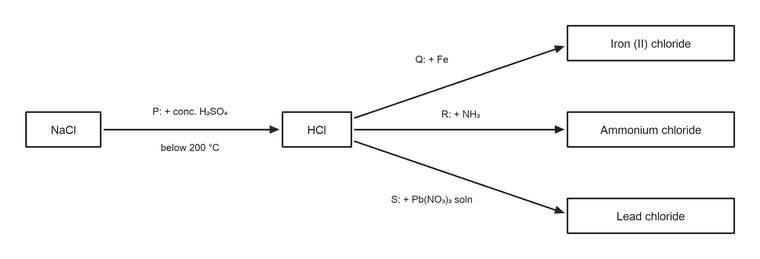
Watch out: In (a) do not write sodium sulphate; below 200 °C the product is sodium hydrogen sulphate.
Therefore, the four conversions and their conditions are as written in Steps 1 to 4.
- 275 marks
Question 27
Explain why :
(a) anhydrous HCl is a poor conductor while aqueous HCl is an excellent conductor.
(b) when the stopper of a bottle full of hydrogen chloride gas is opened there are fumes in the air.
(c) a solution of hydrogen chloride in water turns blue litmus red, and conducts electricity, while a solution of the same gas in toluene :
(i) has no effect on litmus, and
(ii) does not conduct electricity.
(d) thick white fumes are formed when a glass rod dipped in is brought near the mouth of a bottle full of HCl gas.
(e) dry hydrogen chloride gas does not affect a dry strip of blue litmus paper but it turns red in the presence of a drop of water.
(f) hydrogen chloride gas is not collected over water.
(g) dilute hydrochloric acid cannot be concentrated by boiling beyond 22.2%.
(h) Hydrogen chloride gas cannot be dried over quick lime.
Solve with AIWritten solution
Solution:
Concept: Hydrogen chloride is a polar covalent gas. As a dry gas, as a liquid or in toluene it exists as molecules with no ions. Only in water does it ionise:
Step 1 — (a) Anhydrous HCl conducts poorly; aqueous HCl conducts well.
Electricity is carried through a liquid by moving ions. Anhydrous HCl is covalent and has no ions, so it does not conduct. In water it ionises almost completely into and ions, which carry the current.
Step 2 — (b) Fumes when a bottle of HCl gas is opened.
The escaping gas dissolves in the water vapour of the air and forms tiny droplets of hydrochloric acid. These droplets are seen as white fumes.
Step 3 — (c) Water solution and toluene solution.
In water HCl ionises: the ions turn blue litmus red, and the free ions conduct electricity. Toluene is an organic solvent in which HCl stays as covalent molecules, so:
- (i) there are no ions, so there is no effect on litmus;
- (ii) there are no free ions, so it does not conduct electricity.

Step 4 — (d) Dense white fumes with a rod dipped in ammonium hydroxide.
Ammonia gas escapes from the ammonium hydroxide and combines with hydrogen chloride to form tiny particles of solid ammonium chloride, seen as dense white fumes:
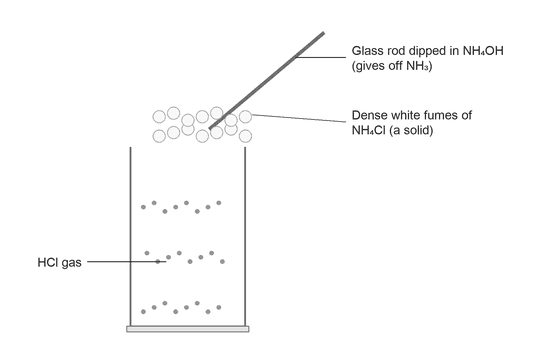
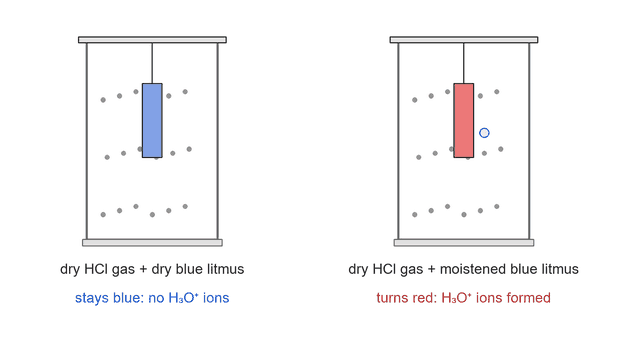
Step 5 — (e) Dry HCl and dry blue litmus.
Dry HCl does not ionise, so it has no ions to act on the litmus. A drop of water lets the gas ionise, and the ions formed turn the blue litmus red.
Step 6 — (f) HCl not collected over water.
HCl is extremely soluble in water (one volume of water dissolves about 450 volumes of the gas), so it would dissolve in the water instead of collecting in the jar. It is collected by upward displacement of air.
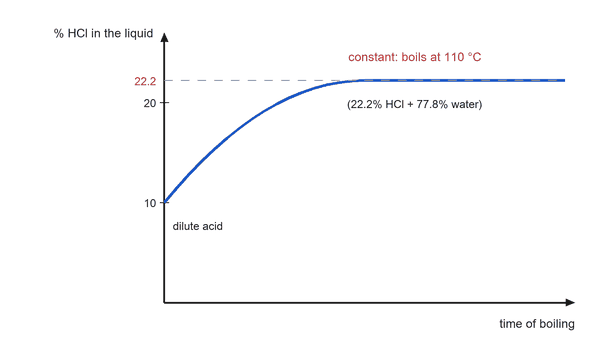
Step 7 — (g) Dilute HCl cannot be concentrated beyond 22.2% by boiling.
On boiling dilute acid, mostly water escapes at first, so the acid becomes stronger. At 22.2% HCl the solution becomes a constant boiling mixture (azeotrope), which boils at 110 °C. Its vapour now has the same composition as the liquid, so further boiling does not change the concentration.
Step 8 — (h) HCl not dried over quick lime.
Quick lime is a basic oxide and reacts with the acidic gas, so the gas would be absorbed instead of dried:
Watch out: "no ions, no acidic properties": dry HCl, liquid HCl and HCl in toluene behave alike, and only the water solution is acidic.
Note: 22.2% and 110 °C are the values given in the textbook. Modern data give the constant boiling mixture as about 20.2% HCl, boiling at about 108.6 °C at normal pressure; for the exam, use the book's values.
Therefore, every part follows from one fact: HCl forms ions only in water, and it is very soluble in water.
- 285 marks
Question 28
Draw a labelled diagram for the laboratory preparation of hydrogen chloride gas and answer the following.
(a) Name the acid used. Why is this particular acid preferred to other acids ?
(b) Give the balanced equation for the reaction.
(c) Name the drying agent used in drying hydrogen chloride gas.
(d) Phosphorus pentoxide and calcium oxide are good drying agents but they cannot be used to dry hydrogen chloride gas. Why ?
(e) Why is direct absorption of HCl gas in water not feasible ?
(f) What arrangement is done to dissolve HCl gas in water ?
Solve with AIWritten solution
Solution:
Concept: Hydrogen chloride is made by heating sodium chloride with conc. sulphuric acid below 200 °C. The gas is dried by bubbling it through conc. sulphuric acid and collected by upward displacement of air, because it is about 1.27 times heavier than air.
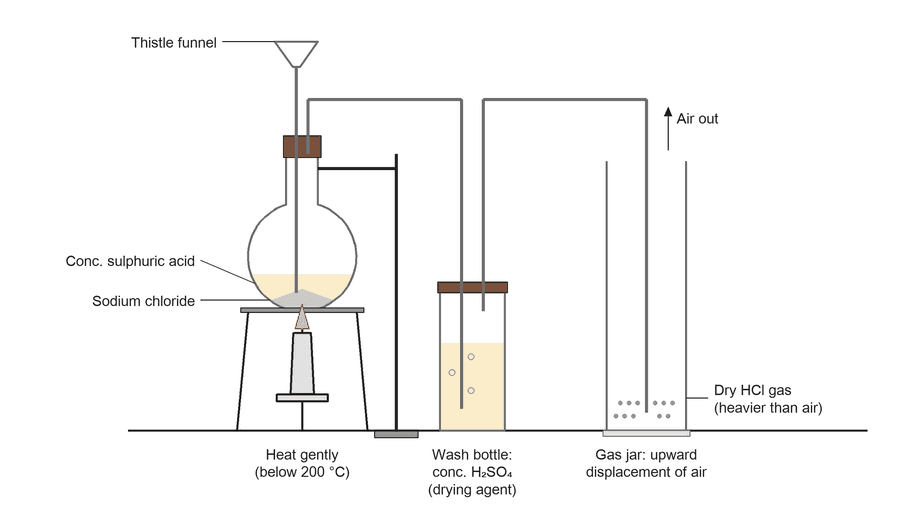
Step 1 — Draw the labelled diagram.
The flask holds sodium chloride and conc. sulphuric acid, with a thistle funnel dipping into the acid. The gas passes through a wash bottle of conc. sulphuric acid (long tube in, short tube out) and is led to the bottom of an upright gas jar.
Step 2 — (a) The acid used, and why.
Concentrated sulphuric acid is used. It is non-volatile (it has a high boiling point), so on heating it drives the volatile hydrogen chloride out of sodium chloride while it stays in the flask itself. Conc. nitric acid is not used because it is volatile: it would vaporise and come out mixed with the hydrogen chloride.

Step 3 — (b) The balanced equation.
At a temperature below 200 °C the reaction is:
Step 4 — (c) The drying agent.
Concentrated sulphuric acid is used, because it absorbs moisture but does not react with HCl.
Step 5 — (d) Why not phosphorus pentoxide or calcium oxide.
A drying agent must not react with the gas it dries. Both of these react with hydrogen chloride, so the gas would be used up instead of dried:
Step 6 — (e) Why HCl is not absorbed directly in water.
HCl is so highly soluble that it dissolves faster than it is produced. If the delivery tube dipped straight into water, the pressure in the tube and flask would fall and water would be sucked back into the generating flask of hot conc. sulphuric acid. Water meeting hot conc. sulphuric acid gives out a lot of heat, which can crack the flask or even cause an explosion.
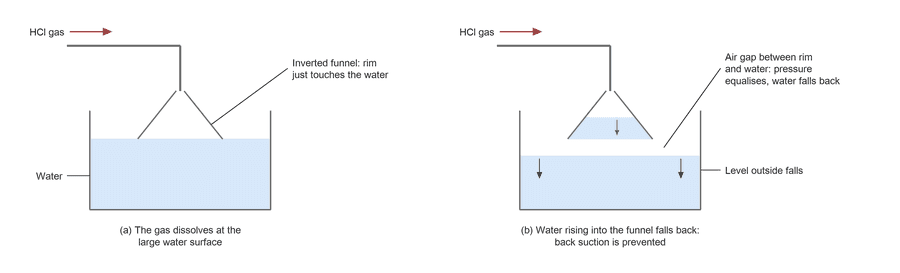
Step 7 — (f) The arrangement for dissolving HCl in water.
The delivery tube is joined to an inverted funnel whose rim just touches the water in a beaker. When water starts to rise into the funnel, the water level in the beaker falls below the rim. Air then enters under the rim, the pressure inside and outside becomes equal, and the water falls back. So the water can never be sucked back into the generating flask. The wide funnel also gives a large surface area for the gas to dissolve.
Watch out: The thistle funnel must dip into the acid, or the gas would escape through it; the delivery tube must start above the liquid.
Therefore, (a) conc. sulphuric acid, as it is non-volatile; (b) NaCl + H₂SO₄ → NaHSO₄ + HCl below 200 °C; (c) conc. sulphuric acid; (d) they react with HCl; (e) back suction would occur; (f) an inverted funnel with its rim just touching the water.
- 295 marks
Question 29
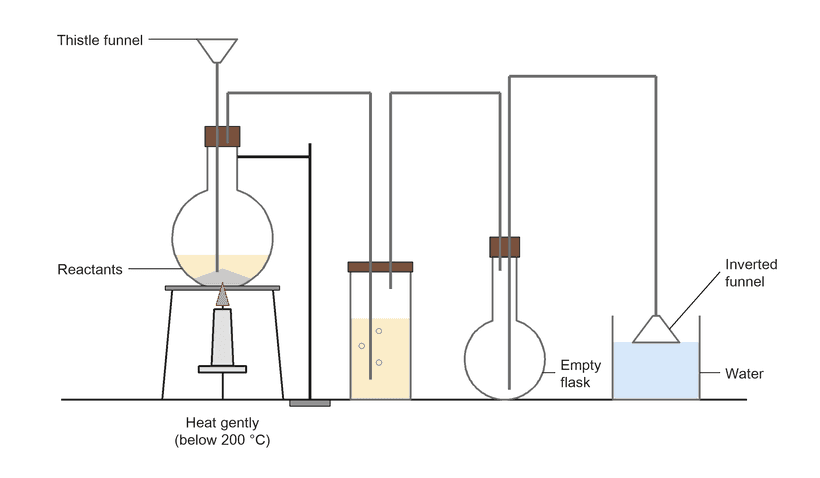
The given set up in the figure is for the preparation of an acid.
(a) Name the acid prepared by this method.
(b) Name the reactants used.
(c) Why an empty flask is used ?
(d) What is the drying agent used ? Why is this drying agent chosen ?
(e) What is the role of inverted funnel in the arrangement?
Solve with AIWritten solution
Solution:
Concept: This is the laboratory preparation of hydrochloric acid: HCl gas is generated, dried, passed through an empty safety flask and then dissolved in water through an inverted funnel.
Step 1 — (a) The acid prepared.
The gas is finally dissolved in water, so the acid prepared is hydrochloric acid (a solution of hydrogen chloride gas in water).
Step 2 — (b) The reactants.
The reactants are sodium chloride and concentrated sulphuric acid, heated below 200 °C:
Step 3 — (c) Why an empty flask is used.
The empty flask is an anti-suction device. If water is sucked back from the beaker, it collects in this empty flask and does not reach the hot conc. sulphuric acid in the generating flask, which could otherwise crack or explode. The tube to the water side reaches the bottom of the flask, while the tube from the generator side ends just below the stopper, so the trapped water cannot pass on.
Step 4 — (d) The drying agent, and why.
The drying agent is concentrated sulphuric acid in the wash bottle. It absorbs moisture but does not react with hydrogen chloride, unlike quick lime and phosphorus pentoxide, which react with it.
Step 5 — (e) The role of the inverted funnel.
With its rim just touching the water, the funnel does two jobs:
- it prevents back suction of water: when water starts to rise into the funnel, the water level in the beaker falls below the rim. Air then enters under the rim, the pressure inside and outside becomes equal, and the water falls back. So the water can never be sucked back into the generating flask.
- it provides a large surface area for the gas to dissolve.
Watch out: The empty flask and the inverted funnel both guard against back suction, but only the funnel also helps the gas to dissolve.
Therefore, (a) hydrochloric acid; (b) sodium chloride and conc. sulphuric acid; (c) to trap any sucked-back water; (d) conc. sulphuric acid, as it does not react with HCl; (e) it prevents back suction and gives a large surface for absorption.
- 305 marks
Question 30
How will you prove that Hydrochloric acid contains (i) hydrogen (ii) chlorine. Write equations for the reactions.
Solve with AIWritten solution
Solution:
Concept: To show that the acid contains an element, we set that element free as a gas and identify it: an active metal sets free the hydrogen, and an oxidising agent sets free the chlorine.
Step 1 — (i) Show that it contains hydrogen.
We add zinc granules to dilute hydrochloric acid. There is brisk effervescence, and the colourless gas burns with a 'pop' sound when a burning splint is brought near. The gas is hydrogen, and it can only have come from the acid:

Step 2 — (ii) Show that it contains chlorine.
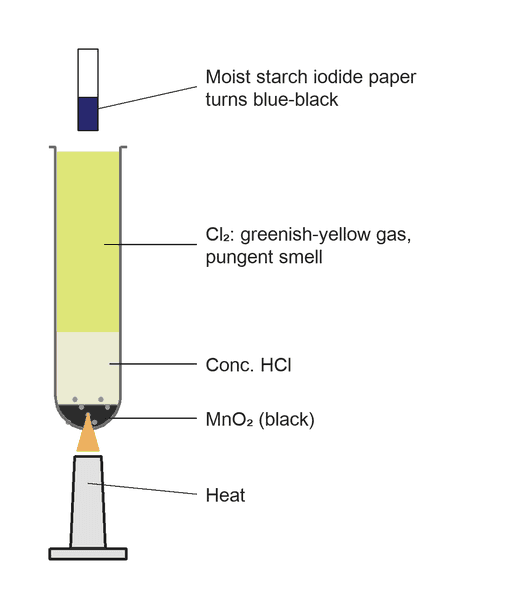
We heat conc. hydrochloric acid with manganese dioxide. A greenish-yellow gas with a pungent smell is given off, and it turns moist starch iodide paper blue-black. The gas is chlorine, and it came from the acid:
The paper turns blue-black because chlorine sets free iodine, which colours the starch:
Watch out: Zinc supplies no hydrogen and manganese dioxide supplies no chlorine, so each gas must come from the acid.
Therefore, zinc sets free hydrogen (pop test) and manganese dioxide sets free chlorine (starch iodide paper turns blue-black), proving that hydrochloric acid contains both elements.
- 313 marks
Question 31
Give three distinct tests [apart from using an indicator] you would carry out with solution of HCl to illustrate the typical properties of an acid.
Solve with AIWritten solution
Solution:
Concept: Typical acids react with active metals (giving hydrogen), with carbonates (giving carbon dioxide) and with bases (giving salt and water only). Each test below shows one of these properties.
Step 1 — Test 1: with an active metal.
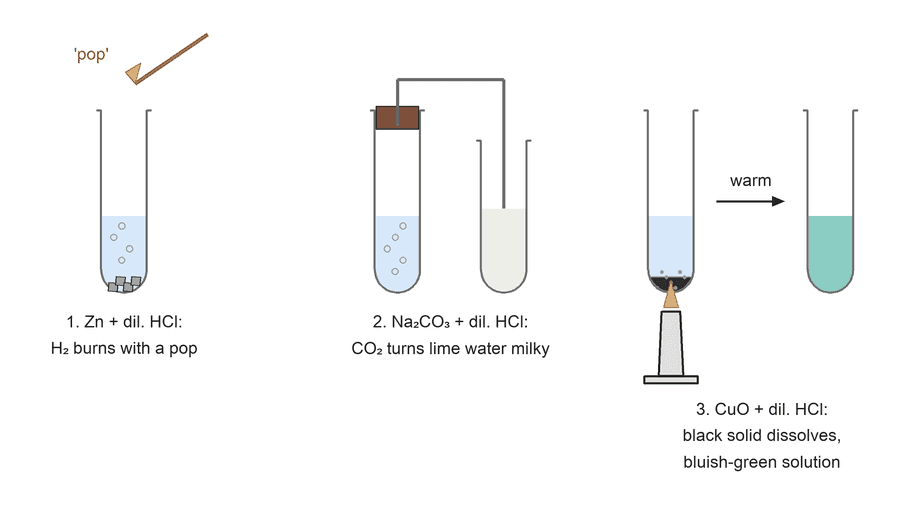
We add zinc granules to the acid. Hydrogen is given off, which burns with a 'pop' sound:
Step 2 — Test 2: with a carbonate.
We add sodium carbonate. There is brisk effervescence of carbon dioxide, which turns lime water milky:
Step 3 — Test 3: with a base.
We add black copper (II) oxide and warm. It dissolves to give a bluish-green solution of copper (II) chloride and water only, which is neutralisation:
Watch out: The question excludes indicators, so a litmus test does not count as one of the three.
Therefore, HCl gives hydrogen with zinc, carbon dioxide with sodium carbonate, and salt and water with copper (II) oxide.
- 325 marks
Question 32
Convert :
(a) Two soluble metallic nitrates to insoluble metallic chlorides.
(b) Insoluble iron (II) oxide to a soluble compound.
(c) Insoluble metal carbonate to a soluble chloride.
(d) Metal sulphide to an offensive smelling gas.
Solve with AIWritten solution
Solution:
Concept: In each case we add dilute hydrochloric acid. It precipitates insoluble chlorides from nitrate solutions, dissolves basic oxides and carbonates as soluble chlorides, and sets free hydrogen sulphide from sulphides.
Step 1 — (a) Two soluble nitrates to insoluble chlorides.
Silver chloride and lead chloride are insoluble in cold water, so silver nitrate and lead nitrate solutions give white precipitates:
Step 2 — (b) Insoluble iron (II) oxide to a soluble compound.
Iron (II) oxide is a basic oxide, so it dissolves in the acid as soluble iron (II) chloride:
Step 3 — (c) Insoluble carbonate to a soluble chloride.
Calcium carbonate dissolves with effervescence, forming soluble calcium chloride:
Step 4 — (d) Metal sulphide to an offensive-smelling gas.
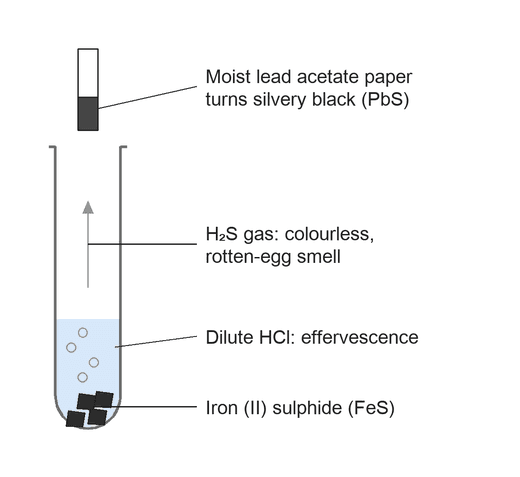
Iron (II) sulphide gives hydrogen sulphide, which smells of rotten eggs:
Watch out: In (a) the chloride must be insoluble; most chlorides are soluble, but silver and lead chlorides are not.
Therefore, each conversion is made with dilute hydrochloric acid, as shown by the equations in Steps 1 to 4.
- 335 marks
Question 33
Study the flow chart and give balanced equations with conditions for the conversions A, B, C, D and E.
 Solve with AI
Written solution
Solution:
Concept: A is the laboratory preparation of HCl. B, C and D are reactions of hydrochloric acid: with a metal, with silver nitrate and with an oxidising agent. E turns HCl back into sodium chloride by neutralisation.
Step 1 — A: NaCl → HCl.
We heat sodium chloride with conc. sulphuric acid, below 200 °C:
Step 2 — B: HCl → ZnCl₂.
We add zinc to dilute hydrochloric acid; zinc displaces hydrogen:
Step 3 — C: HCl → AgCl.
We add silver nitrate solution; a curdy white precipitate of silver chloride forms:
Step 4 — D: HCl → MnCl₂.
We heat conc. hydrochloric acid with manganese dioxide; chlorine is given off:
Step 5 — E: HCl → NaCl.
We neutralise the acid with sodium hydroxide solution:
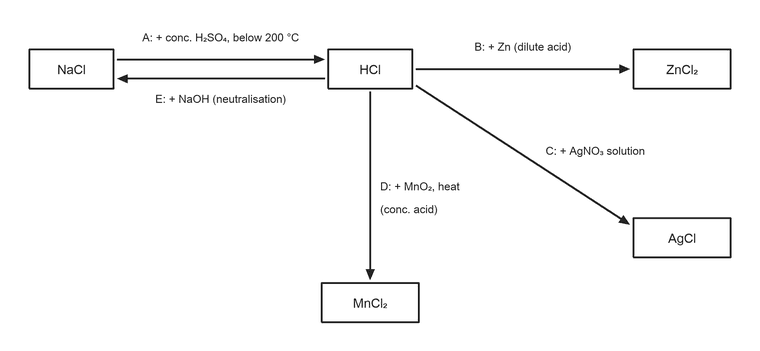
Watch out: D needs the concentrated acid and heat; dilute acid does not give chlorine with manganese dioxide.
Therefore, the conversions A to E are as written in Steps 1 to 5.
- 345 marks
Question 34
In the laboratory preparation of hydrochloric acid, hydrogen chloride gas is dissolved in water.
(a) Draw a diagram to show the arrangment used for the absorption of HCl gas in water.
(b) State why such an arrangment is necessary. Give two reasons for the same.
(c) Write balanced chemical equations for the laboratory preparation of HCl gas when the reaction is :
A. Below 200°C B. Above 200°C
Solve with AIWritten solution
Solution:
Concept: HCl gas is so soluble that a tube dipping straight into water would suck water back. So it is dissolved through an inverted funnel whose rim just touches the water.
Step 1 — (a) Draw the arrangement.
The delivery tube carrying HCl gas ends in an inverted funnel, and the rim of the funnel just touches the water in a beaker.

Step 2 — (b) Why the arrangement is needed.
It does two jobs:
- it prevents back suction of water into the generating flask of hot conc. sulphuric acid: when water starts to rise into the funnel, the water level in the beaker falls below the rim. Air then enters under the rim, the pressure inside and outside becomes equal, and the water falls back. So the water can never be sucked back into the generating flask.
- it provides a large surface area for the absorption of the gas.
Step 3 — (c) A. Below 200 °C.
Sodium chloride reacts with conc. sulphuric acid to give sodium hydrogen sulphate:
Step 4 — (c) B. Above 200 °C.
The sodium hydrogen sulphate reacts further with more sodium chloride to give sodium sulphate:
In the laboratory the temperature is kept below 200 °C: above it the glass may crack, fuel is wasted, and sodium sulphate forms a hard crust that sticks to the flask.
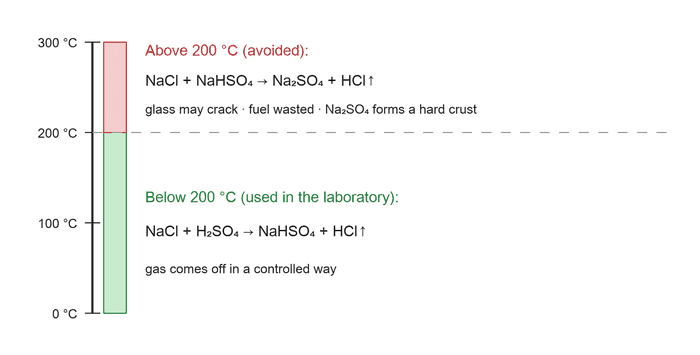
Watch out: Above 200 °C the second equation uses NaCl and , not NaCl and again.
Therefore, the inverted funnel prevents back suction and gives a large surface for absorption; below 200 °C sodium hydrogen sulphate forms, and above 200 °C sodium sulphate forms.
- 355 marks
Question 35
Study the figure and answer the questions that follow :
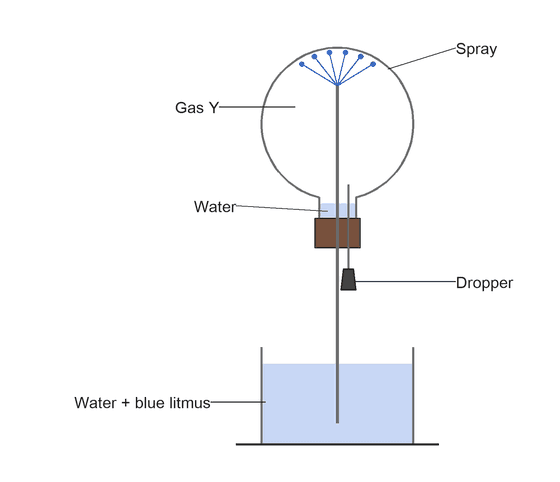
(a) Identify the gas Y.
(b) What property of gas Y does this experiment demonstrate ?
(c) Name another gas which has the same property and can be demonstrated through this experiment.
Solve with AIWritten solution
Solution:
Concept: This is the fountain experiment. A few drops of water from the dropper dissolve so much of gas Y that the pressure in the flask falls, and the outside air pressure pushes the litmus solution up as a spray.
Step 1 — (a) Identify gas Y.
The beaker holds blue litmus solution, and a gas that is very soluble and gives an acidic solution turns it red in the flask. In this chapter that gas is hydrogen chloride (HCl).
Step 2 — (b) The property shown.
The experiment shows the very high solubility of the gas in water (one volume of water dissolves about 450 volumes of HCl). The red colour of the fountain also shows that its solution is acidic.
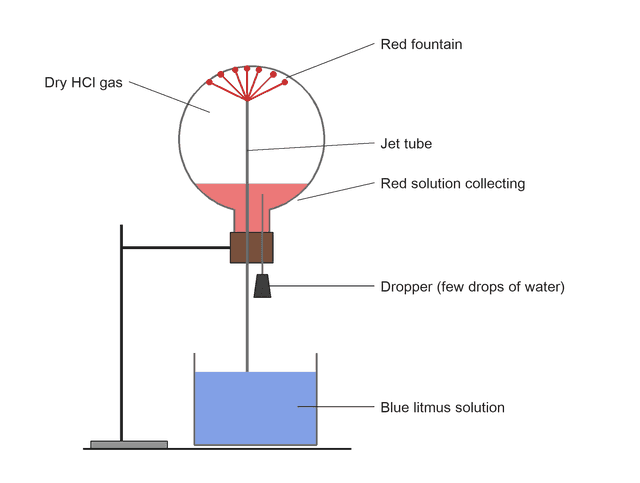
Step 3 — (c) Another gas.
Ammonia () is also highly soluble in water. With red litmus solution in the beaker, it gives a blue fountain, because ammonia solution is basic.
Watch out: The flask and the gas must both be dry; if the flask is wet, the gas dissolves early and the fountain fails.
Therefore, (a) Y is hydrogen chloride; (b) its high solubility in water; (c) ammonia.
- 365 marks
Question 36
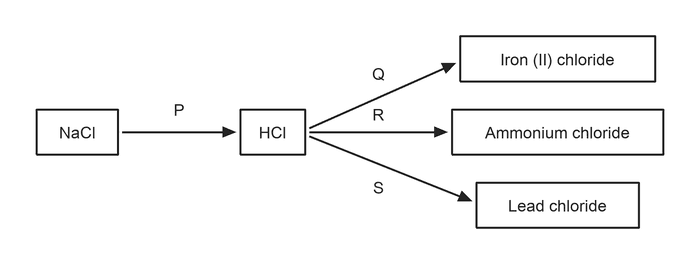
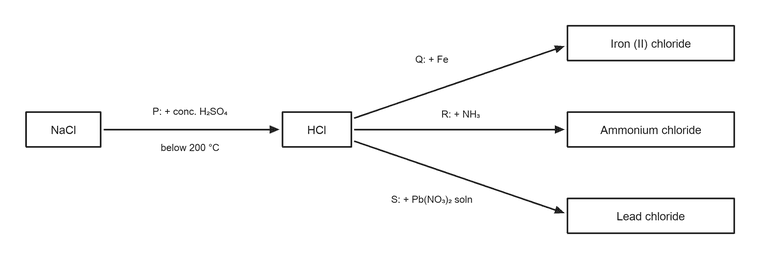
Refer to the diagram given below and write balanced equations with conditions, if any, for the following conversions P to S.
 Solve with AI
Written solution
Solution:
Concept: P is the laboratory preparation of HCl from sodium chloride. Q, R and S are reactions of hydrogen chloride that form chlorides: with a metal, with ammonia and with lead nitrate.
Step 1 — P: NaCl → HCl.
We heat sodium chloride with conc. sulphuric acid, below 200 °C:
Step 2 — Q: HCl → iron (II) chloride.
We react the acid with iron; iron (II) chloride and hydrogen are formed:
Step 3 — R: HCl → ammonium chloride.
We bring the gas into contact with ammonia; dense white fumes of ammonium chloride form:
Step 4 — S: HCl → lead chloride.
We pass the gas into lead nitrate solution; a white precipitate of lead chloride forms:
Watch out: Iron gives iron (II) chloride (ferrous chloride) with HCl, not iron (III) chloride.
Therefore, the conversions P to S are as written in Steps 1 to 4.
- 375 marks
Question 37
State your observations :
(a) HCl gas is passed through lead nitrate solution and the mixture is heated.
(b) Hydrochloric acid is added to silver nitrate solution.
(c) Ammonium hydroxide solution is added to the resultant product of part (b).
Solve with AIWritten solution
Solution:
Concept: Lead chloride and silver chloride are both white precipitates. Lead chloride dissolves in hot water; silver chloride dissolves in ammonium hydroxide.
Step 1 — (a) HCl gas through lead nitrate solution, then heated.
A white precipitate of lead chloride forms. It dissolves when the mixture is heated, because lead chloride is soluble in hot water, and it separates out again on cooling.

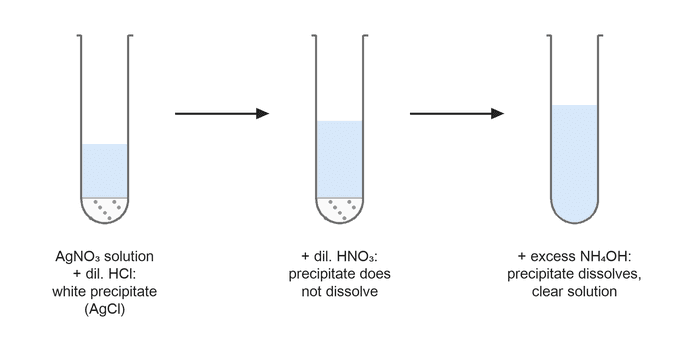
Step 2 — (b) Hydrochloric acid added to silver nitrate solution.
A thick, curdy white precipitate of silver chloride forms:
Step 3 — (c) Ammonium hydroxide added to the product of (b).
The white precipitate dissolves, giving a clear, colourless solution of the complex salt diammine silver (I) chloride:
Watch out: Heating dissolves lead chloride but not silver chloride; ammonium hydroxide dissolves silver chloride.
Therefore, (a) a white precipitate that dissolves on heating; (b) a curdy white precipitate; (c) the precipitate dissolves to give a clear, colourless solution.
- 385 marks
Question 38
Distinguish by using HCl.
(a) Lead nitrate solution and silver nitrate solution.
(b) Potassium sulphite and potassium sulphide.
Solve with AIWritten solution
Solution:
Concept: Add dilute HCl to each and compare what forms. In (a) both give white precipitates, so we then heat them; in (b) the two gases have different smells and tests.
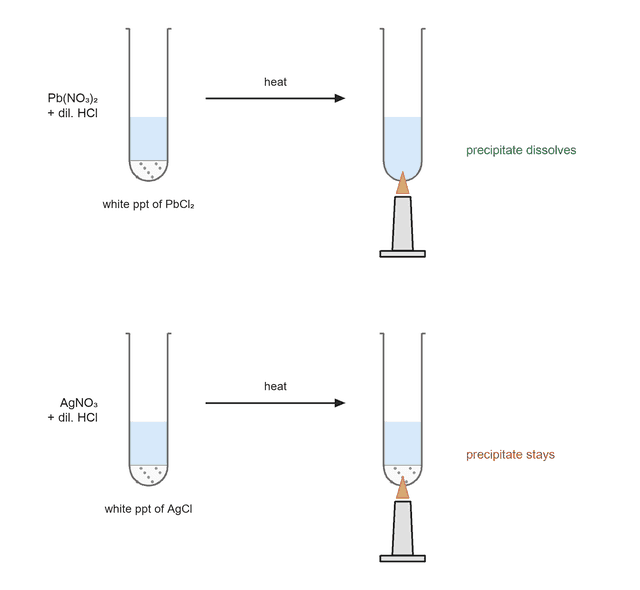
Step 1 — (a) Add dilute HCl to both nitrate solutions.
Both give a white precipitate, so this step alone cannot tell them apart:
Step 2 — (a) Heat both precipitates.
Now we heat each mixture. The lead chloride precipitate dissolves, because it is soluble in hot water. The silver chloride precipitate does not dissolve (it dissolves only in ammonium hydroxide).
Step 3 — (b) Potassium sulphite.
Potassium sulphite gives sulphur dioxide, which smells of burning sulphur and turns acidified potassium dichromate paper from orange to green:
Step 4 — (b) Potassium sulphide.
Potassium sulphide gives hydrogen sulphide, which smells of rotten eggs and turns moist lead acetate paper silvery black:
Watch out: In (a) the first observation is the same for both; the difference appears only on heating.
Therefore, (a) the precipitate from lead nitrate dissolves on heating, while that from silver nitrate does not; (b) potassium sulphite gives (burning-sulphur smell), while potassium sulphide gives (rotten-egg smell).
- 395 marks
Question 39
The following questions pertain to the laboratory preparation of hydrogen chloride gas.
(a) Write the equation for its preparation, mentioning the conditions required.
(b) Name the drying agent used in the above preparation and give a reason for the choice.
(c) State a safety precaution taken during the preparation of hydrochloric acid.
Solve with AIWritten solution
Solution:
Concept: Sodium chloride is heated with conc. sulphuric acid, keeping the temperature below 200 °C. The gas is dried with conc. sulphuric acid and collected by upward displacement of air.
Step 1 — (a) The equation and conditions.
Sodium chloride is heated gently with concentrated sulphuric acid at a temperature below 200 °C:
Above 200 °C sodium sulphate forms a hard crust, the glass may crack and fuel is wasted, so the higher temperature is avoided.
Step 2 — (b) The drying agent and the reason.
The drying agent is concentrated sulphuric acid, because it absorbs moisture but does not react with HCl. Quick lime and phosphorus pentoxide cannot be used, because they react with HCl.
Step 3 — (c) A safety precaution in preparing hydrochloric acid.
The gas is dissolved in water through an inverted funnel whose rim just touches the water, so that water is not sucked back into the flask of hot conc. sulphuric acid. An empty flask between the generator and the water also traps any water that is sucked back.
Watch out: The condition is "conc. acid, below 200 °C"; leaving out the temperature loses the mark for conditions.
Therefore, (a) NaCl + H₂SO₄ → NaHSO₄ + HCl, with conc. acid below 200 °C; (b) conc. sulphuric acid, as it does not react with HCl; (c) the gas is dissolved through an inverted funnel to prevent back suction.
- 405 marks
Question 40
Identify the gas evolved and give chemical test in each of the following cases.
Dilute hydrochloric acid reacts with :
(i) Iron (II) sulphide (ii) Sodium sulphite.
Solve with AIWritten solution
Solution:
Concept: Dilute HCl gives hydrogen sulphide with a sulphide and sulphur dioxide with a sulphite. Each gas has its own test paper.
Step 1 — (i) Iron (II) sulphide: the gas.
The sulphide is the salt of the weak acid hydrogen sulphide, so the gas given off is hydrogen sulphide:
Step 2 — (i) Iron (II) sulphide: the test.
Hydrogen sulphide smells of rotten eggs and turns moist lead acetate paper silvery black, because black lead sulphide forms:
Step 3 — (ii) Sodium sulphite: the gas.
The sulphite gives sulphur dioxide:
Step 4 — (ii) Sodium sulphite: the test.
Sulphur dioxide smells of burning sulphur and turns acidified potassium dichromate paper from orange to green, because the orange dichromate is reduced to green chromium (III) sulphate:
Watch out: The lead acetate test is for and the dichromate test is for ; do not swap them.
Therefore, (i) the gas is hydrogen sulphide, which turns lead acetate paper silvery black; (ii) the gas is sulphur dioxide, which turns acidified potassium dichromate paper green.
What Class 10 Chemistry Ch 8 covers
The sections of the chapter, in the order the book takes them. Every question above comes from one of these.
- 01Occurrence
- 02General Preparation of Hydrogen Chloride Gas
- 03Laboratory Preparation of Hydrogen Chloride Gas
- 04Physical Properties of Hydrogen Chloride Gas
- 05Chemical Properties of Hydrogen Chloride Gas
- 06Hydrochloric Acid
More ways to study this chapter
The same chapter asked three other ways. Practise it, revise it, and see what the board has set on Ch 8 before.
- Competency-Based Questions (CBQ)Case study questions: a situation, and the part of the chapter that answers it.40questionsOpen
- Previous Year QuestionsQuestions that have actually appeared in board papers, each tagged with its year.27questionsOpen
- Practice QuestionsExtra questions per chapter, for when one attempt at a method is not enough.43questionsOpen
Ch 8 in past ICSE papers
The same chapter as the board has actually asked it. These are worded differently from the textbook exercise, which is the point of reading them.
- 11 mark
Board paper question 1
The aim of the Fountain Experiment is to prove that:
Solve with AIAnswer
(A) HCl turns blue litmus red
(B) HCl is denser than air
- Correct
(C) HCl is highly soluble in water
(D) HCl fumes in moist air.
Answer: (C) HCl is highly soluble in water
Concept: Hydrogen chloride is extremely soluble in water: one volume of water dissolves about 450 volumes of the gas. When a little water dissolves a large amount of gas inside a closed flask, the pressure inside the flask falls sharply, and the air pressure outside pushes liquid in.
Step 1 — Recall the set-up.
A dry round-bottom flask is filled with dry hydrogen chloride and clamped upside down. A long jet tube runs from inside the flask down into a beaker of blue litmus solution, and a dropper holding a few drops of water passes through the stopper.
Step 2 — Follow what happens when the dropper is pressed.
The few drops of water dissolve a very large volume of hydrogen chloride. So much gas disappears that the pressure inside the flask becomes much lower than the air pressure outside.
Step 3 — Explain the fountain.
The higher air pressure outside pushes the litmus solution up the jet tube, and it sprays into the flask as a fountain. A fountain can only form if the gas dissolves very fast and in very large amounts, so the experiment proves that hydrogen chloride is highly soluble in water. The fountain is red because the dissolved gas forms hydrochloric acid.
Watch out: The red colour of the fountain is a second observation (the solution is acidic); it is not the aim of the experiment.
Why the other options are wrong:
- (A) HCl turns blue litmus red: the fountain does turn red, so the solution is acidic, but that is only a side observation. The fountain itself forms because the gas dissolves so readily.
- (B) HCl is denser than air: that HCl is denser than air is shown by collecting it by upward displacement of air, not by the fountain experiment.
- (D) HCl fumes in moist air: fuming in moist air is seen at the mouth of a jar of the gas; the fountain experiment is not set up to show it.
Therefore, the fountain experiment proves that HCl is highly soluble in water, option (C).
- 25 marks
Board paper question 2
State your observations when:
(i) Dilute Hydrochloric acid is added to Lead nitrate solution and the mixture is heated.
(ii) Barium chloride solution is mixed with Sodium Sulphate Solution.
(iii) Concentrated Sulphuric acid is added to Sugar Crystals.
(iv) Dilute Hydrochloric acid is added to Copper carbonate.
(v) Dilute Hydrochloric acid is added to Sodium thiosulphate.
Solve with AIWritten solution
Solution:
Concept: Each observation comes from the product that forms: a precipitate (and its colour), a gas (and its smell or test), or a change in colour. For each mixture we name the product first, then say what is seen.
Step 1 — (i) Dilute hydrochloric acid with lead nitrate solution, then heated.
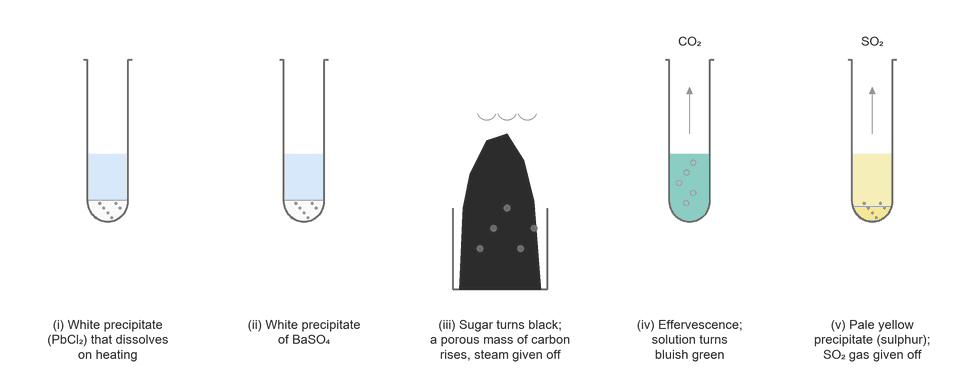
Hydrochloric acid gives lead chloride, which is insoluble in cold water, so a white precipitate forms. Lead chloride is soluble in hot water, so the precipitate dissolves on heating to give a clear solution (it comes back as crystals when the solution cools).
Step 2 — (ii) Barium chloride solution with sodium sulphate solution.
Barium ions and sulphate ions form barium sulphate, which is insoluble in water, so a white precipitate forms. It does not dissolve in dilute hydrochloric or nitric acid.
Step 3 — (iii) Concentrated sulphuric acid added to sugar crystals.
Concentrated sulphuric acid is a strong dehydrating agent: it removes the elements of water (hydrogen and oxygen in the ratio 2 : 1) from sugar. The white sugar turns yellow, then brown and finally black, and a black, spongy (porous) mass of carbon rises up. The mixture becomes very hot and steam is given off.
Step 4 — (iv) Dilute hydrochloric acid added to copper carbonate.
An acid decomposes a carbonate and gives carbon dioxide, so there is brisk effervescence of a colourless, odourless gas that turns lime water milky. The green copper carbonate dissolves and the solution turns bluish green because copper (II) chloride forms.
Step 5 — (v) Dilute hydrochloric acid added to sodium thiosulphate.
The acid decomposes thiosulphate into sulphur and sulphur dioxide. A pale yellow precipitate of sulphur appears (the solution turns cloudy yellow), and a colourless gas with the smell of burning sulphur (sulphur dioxide) is given off.
Watch out: In (i) the precipitate dissolves only when the mixture is HOT; in (v) the yellow colour comes from sulphur particles, not from the gas.
Therefore, (i) a white precipitate that dissolves on heating; (ii) a white precipitate (BaSO₄); (iii) sugar chars to a black porous mass of carbon, with heat and steam; (iv) brisk effervescence of CO₂ and a bluish-green solution; (v) a pale yellow precipitate of sulphur and SO₂ gas with the smell of burning sulphur.
- 31 mark
Board paper question 3
Fill in the blanks from the choices given in brackets:
Potassium sulphite on reacting with hydrochloric acid releases .............. gas. (, , )
Solve with AIWritten solution
Solution:
Concept: Dilute hydrochloric acid decomposes the salts of weaker, unstable acids. A sulphite gives sulphur dioxide, a sulphide gives hydrogen sulphide and a carbonate gives carbon dioxide.
Step 1 — Identify the salt.
Potassium sulphite, , is a sulphite, so with hydrochloric acid it gives sulphur dioxide, water and potassium chloride.
Step 2 — Rule out the other two gases.
Chlorine forms only when hydrochloric acid is oxidised by an oxidising agent such as manganese dioxide; a sulphite does not do this. Hydrogen sulphide comes from a sulphide (S²⁻), not from a sulphite (SO₃²⁻).
Step 3 — Confirm the gas.
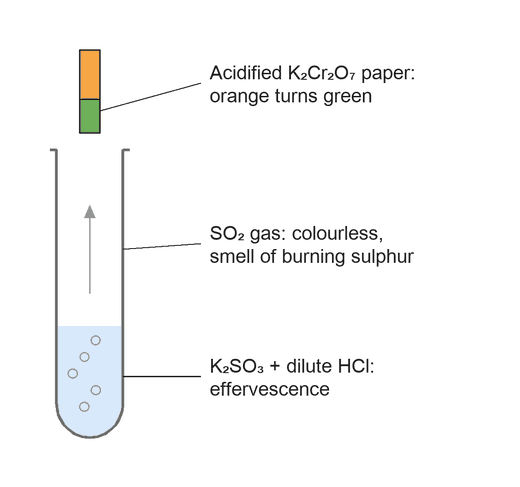
Sulphur dioxide is colourless, smells of burning sulphur and turns acidified potassium dichromate paper from orange to green.
Watch out: Sulphite (SO₃²⁻) gives SO₂, while sulphide (S²⁻) gives H₂S; read the name of the salt carefully.
Therefore, potassium sulphite on reacting with hydrochloric acid releases SO₂ (sulphur dioxide) gas.
- 41 mark
Board paper question 4
State one relevant observation for each of the following reactions:
Action of dilute Hydrochloric acid on iron (II) sulphide.
Solve with AIWritten solution
Solution:
Concept: Dilute hydrochloric acid decomposes a metal sulphide and gives the metal chloride and hydrogen sulphide gas, which has the smell of rotten eggs.
Step 1 — Write the reaction.
Iron (II) sulphide reacts with dilute hydrochloric acid to give iron (II) chloride and hydrogen sulphide.
Step 2 — State what is seen.
There is effervescence, and a colourless gas with the smell of rotten eggs is given off.
Step 3 — Confirm the gas.
The gas turns moist lead acetate paper black, because black lead sulphide forms on the paper.
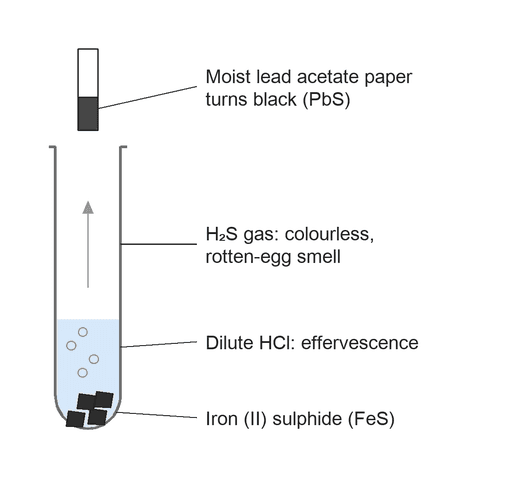
Watch out: The gas itself is colourless; the black colour appears only on the lead acetate paper.
Therefore, a colourless gas with the smell of rotten eggs (H₂S) is given off with effervescence; it turns moist lead acetate paper black.
- 51 mark
Board paper question 5
State one relevant observation for each of the following:
Lead nitrate solution is mixed with dilute hydrochloric acid and heated.
Solve with AIWritten solution
Solution:
Concept: Lead chloride is insoluble in cold water but soluble in hot water. So it precipitates when the solutions are mixed and dissolves again when the mixture is heated.
Step 1 — Mix the solutions.
Hydrochloric acid gives lead chloride with lead nitrate. Lead chloride does not dissolve in cold water, so a white precipitate forms.
Step 2 — Heat the mixture.
Lead chloride dissolves in hot water, so on heating the white precipitate dissolves and a clear, colourless solution is left. On cooling, lead chloride separates out again as white crystals.
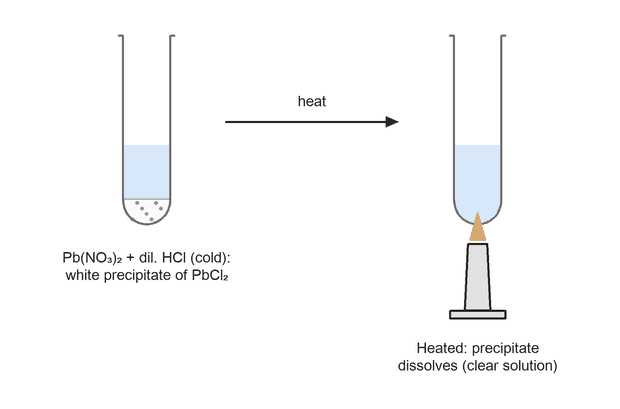
Watch out: The observation asked for includes the heating; 'white precipitate' alone is only half the answer.
Therefore, a white precipitate of lead chloride forms, and it dissolves on heating to give a clear, colourless solution.
- 61 mark
Board paper question 6
Name the gas that is produced in each of the following cases:
Action of dilute hydrochloric acid on sodium sulphide.
Solve with AIWritten solution
Solution:
Concept: Dilute hydrochloric acid decomposes sulphides and sets free hydrogen sulphide gas.
Step 1 — Write the reaction.
Sodium sulphide reacts with dilute hydrochloric acid to give sodium chloride and hydrogen sulphide.
Step 2 — Describe the gas.
Hydrogen sulphide is a colourless gas with the smell of rotten eggs. It turns moist lead acetate paper black, because black lead sulphide forms.
Therefore, the gas produced is hydrogen sulphide (H₂S).
All 27 board paper questions for this chapter, solved the same way.
Class 10 Chemistry Ch 8 questions students ask
How many questions are there in Class 10 Chemistry Ch 8?
40 questions. Every one is solved step by step on this page.
Are these Class 10 Chemistry solutions free?
Yes. Every question and its full working is free to read, with no account needed.
Can I download the Class 10 Chemistry Ch 8 solutions as a PDF?
There is no PDF to download. Every solution is on this page instead, which means it is searchable, always the current syllabus, and readable on a phone. Use your browser's print option if you want it on paper.