
Question 151 markMedium
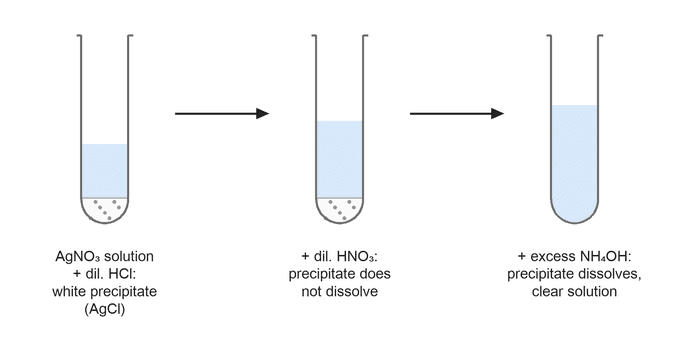
Solution A reacts with an acid B (which gives greenish yellow gas on reacting with oxidising agents like ) to give white precipitate C insoluble in nitric acid but soluble in ammonium hydroxide. Name A, B and C.
Confirming your payment
Sign up now and get 250 free tokens.
Study of Compounds – Hydrogen Chloride · Question 15 of 40
Solution A reacts with an acid B (which gives greenish yellow gas on reacting with oxidising agents like ) to give white precipitate C insoluble in nitric acid but soluble in ammonium hydroxide. Name A, B and C.
Solution:
Concept: Work from the clues one at a time. An acid that gives a greenish-yellow gas (chlorine) with an oxidising agent is hydrochloric acid. A white precipitate that is insoluble in nitric acid but soluble in ammonium hydroxide is silver chloride.
Step 1 — Identify acid B.
Red lead () is an oxidising agent. The only common acid it oxidises to a greenish-yellow gas (chlorine) is hydrochloric acid:
So B is hydrochloric acid.
Step 2 — Identify precipitate C and solution A.
A white precipitate of a chloride that does not dissolve in nitric acid but dissolves in ammonium hydroxide is silver chloride. The silver ions must come from solution A, so A is silver nitrate solution:
Step 3 — Check the behaviour of C.
Silver chloride does not dissolve in nitric acid, but it dissolves in ammonium hydroxide, forming the soluble complex diammine silver (I) chloride:
Watch out: Lead chloride is also white, but it dissolves in hot water, not in ammonium hydroxide; so C is silver chloride.
Therefore, A is silver nitrate solution, B is hydrochloric acid and C is silver chloride.