Study of Compounds – Hydrogen Chloride · Question 16 of 40
A solution of hydrogen chloride in water is prepared.
Question 165 marksEasy
A solution of hydrogen chloride in water is prepared. The following substances are added to separate portions of the solution :
S. No.
Substances added
Gas evolved
Odour
1.
Calcium carbonate
................
................
2.
Magnesium ribbon
................
................
3.
Manganese (IV) oxide with heating
................
................
4.
Sodium sulphide
................
................
Complete the table by writing the gas evolved in each case and its odour.
Solution:
Concept: Hydrochloric acid gives a different gas with each kind of substance: carbon dioxide with carbonates, hydrogen with active metals, chlorine with oxidising agents (on heating, with the conc. acid) and hydrogen sulphide with sulphides.
Step 1 — Calcium carbonate.
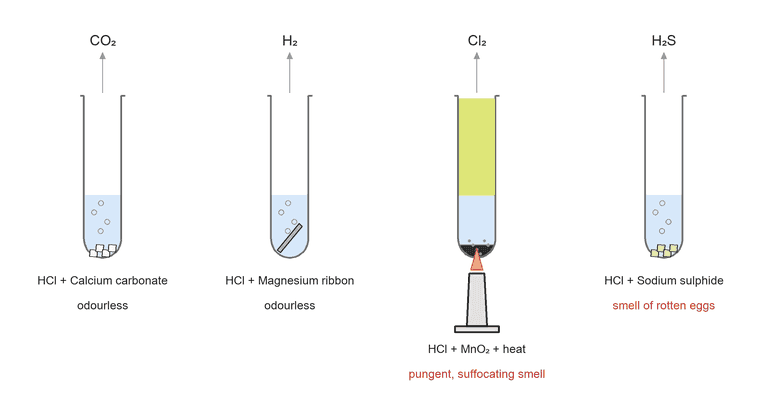
Calcium carbonate is the salt of the weaker carbonic acid, so the acid decomposes it and carbon dioxide is given off. Carbon dioxide has no smell.
CaCO3+2HCl→CaCl2+H2O+CO2↑
Step 2 — Magnesium ribbon.
Magnesium is above hydrogen in the activity series, so it displaces hydrogen from the acid. Hydrogen has no smell.
Mg+2HCl→MgCl2+H2↑
Step 3 — Manganese (IV) oxide, heated.
Manganese (IV) oxide is an oxidising agent. It oxidises the acid to greenish-yellow chlorine, which has a pungent, suffocating smell.
MnO2+4HClΔMnCl2+2H2O+Cl2↑
Step 4 — Sodium sulphide.
Sodium sulphide is the salt of the weak acid hydrogen sulphide, so the acid sets free hydrogen sulphide, which smells of rotten eggs.
Na2S+2HCl→2NaCl+H2S↑
Step 5 — Fill in the table.
We now write each gas and its odour in the table:
S. No.
Substances added
Gas evolved
Odour
1.
Calcium carbonate
Carbon dioxide
Odourless
2.
Magnesium ribbon
Hydrogen
Odourless
3.
Manganese (IV) oxide with heating
Chlorine
Pungent, suffocating
4.
Sodium sulphide
Hydrogen sulphide
Rotten eggs
Watch out: Carbon dioxide and hydrogen are both odourless; tell them apart by their tests (lime water turns milky; hydrogen burns with a 'pop').
Therefore, the gases are carbon dioxide (odourless), hydrogen (odourless), chlorine (pungent, suffocating) and hydrogen sulphide (rotten eggs).