
Question 175 marksMedium
Complete and balance the following reactions, state whether dilute or conc. acid is used.
(a) (b)
(c) (d)
Confirming your payment
Sign up now and get 250 free tokens.
Study of Compounds – Hydrogen Chloride · Question 17 of 40
Complete and balance the following reactions, state whether dilute or conc. acid is used.
(a) (b)
(c) (d)
Solution:
Concept: Neutralisation, decomposition of a salt of a weaker acid and precipitation all happen with dilute hydrochloric acid. Only the oxidation of HCl to chlorine needs the concentrated acid and heat.
Step 1 — (a) Ammonium hydroxide.
Ammonium hydroxide is a base, so dilute acid neutralises it, giving a salt and water:
Step 2 — (b) Sodium hydrogen sulphite.
A hydrogen sulphite is a salt of the weaker sulphurous acid. Dilute acid decomposes it and sulphur dioxide is given off:
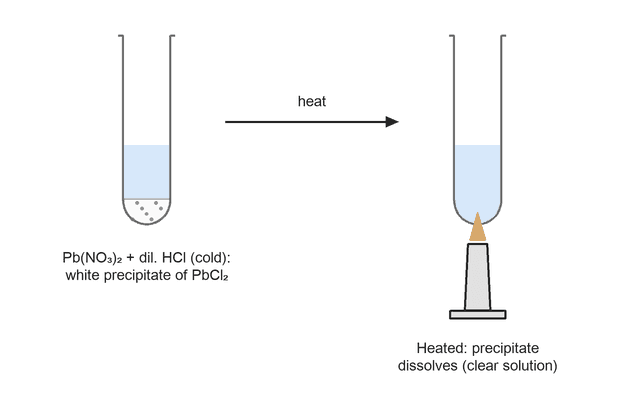
Step 3 — (c) Lead nitrate.
Dilute acid gives a white precipitate of lead chloride, which is insoluble in cold water (it dissolves on heating):
Step 4 — (d) Red lead.
Red lead is an oxidising agent. On heating it oxidises concentrated hydrochloric acid to chlorine:
Watch out: In (d), balance chlorine last: 8 Cl on the left = 3 × 2 in lead chloride + 2 in chlorine.
Therefore, (a), (b) and (c) use dilute acid, and (d) uses concentrated acid with heating; the balanced equations are shown above.