
Question 142 marksEasy
Identify the gas evolved when :
(a) Potassium sulphite is treated with dilute hydrochloric acid.
(b) Concentrated hydrochloric acid is made to react with manganese dioxide.
Confirming your payment
Sign up now and get 250 free tokens.
Study of Compounds – Hydrogen Chloride · Question 14 of 40
Identify the gas evolved when :
(a) Potassium sulphite is treated with dilute hydrochloric acid.
(b) Concentrated hydrochloric acid is made to react with manganese dioxide.
Solution:
Concept: Dilute hydrochloric acid decomposes salts of weaker acids, so a sulphite gives sulphur dioxide. Concentrated hydrochloric acid is oxidised by oxidising agents such as manganese dioxide, giving chlorine.
Step 1 — (a) Potassium sulphite with dilute HCl.
The sulphite is the salt of the weaker sulphurous acid, so the acid decomposes it and sulphur dioxide is given off:
Sulphur dioxide is a colourless gas with the smell of burning sulphur, and it turns acidified potassium dichromate paper from orange to green.

Step 2 — (b) Conc. HCl with manganese dioxide.
Manganese dioxide is an oxidising agent. On heating it removes hydrogen from the acid, and chlorine is given off:
Chlorine is a greenish-yellow gas with a pungent smell, and it turns moist starch iodide paper blue-black.
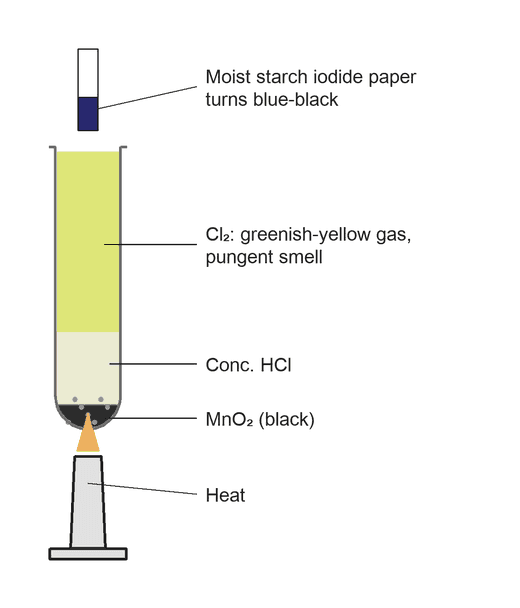
Watch out: The chlorine comes from the hydrochloric acid, not from the manganese dioxide.
Therefore, (a) the gas is sulphur dioxide, ; (b) the gas is chlorine, .