Study of Compounds – Hydrogen Chloride · Question 13 of 40
Name (a) a black metallic oxide which reacts with hydrochloric acid to give a coloured solution.
Question 135 marksEasy
Name
(a) a black metallic oxide which reacts with hydrochloric acid to give a coloured solution.
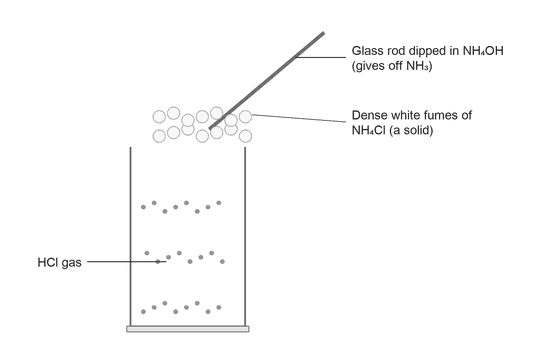
(b) two colourless gases, which when mixed produce a white solid.
(c) two gases which chemically combine to form a liquid.
(d) a chloride which is soluble in excess of ammonium hydroxide.
(e) the chemical in which gold can be dissolved.
(f) the experiment which demonstrates that hydrogen chloride is soluble in water.
(g) the gas produced when chlorine water is exposed to sunlight.
(h) The acid which on mixing with silver nitrate solution produces a white precipitate which is soluble in excess of ammonium hydroxide.
(i) The gas which produces dense white fumes with ammonia gas.
(j) An element which reacts with hydrogen to form a compound which is strongly acidic in water.
Solution:
Concept: Each answer comes from a reaction met in this chapter: acids with metal oxides, HCl with ammonia, the test for chloride ions, aqua regia, the fountain experiment and the direct union of hydrogen with chlorine.
Step 1 — (a) Black metallic oxide giving a coloured solution.
Black copper (II) oxide is a basic oxide. It dissolves in hydrochloric acid to give a bluish-green solution of copper (II) chloride:
CuO+2HCl→CuCl2+H2O
Step 2 — (b) Two colourless gases giving a white solid.
Ammonia and hydrogen chloride are both colourless gases. When they meet they combine to form dense white fumes of solid ammonium chloride:
NH3+HCl→NH4Cl
Step 3 — (c) Two gases forming a liquid.
Hydrogen and oxygen combine (for example when hydrogen burns) to form liquid water:
2H2+O2→2H2O
Step 4 — (d) A chloride soluble in excess ammonium hydroxide.
Silver chloride (white) dissolves in excess ammonium hydroxide, because it forms the soluble complex diammine silver (I) chloride:
AgCl+2NH4OH→[Ag(NH3)2]Cl+2H2O
Step 5 — (e) The chemical that dissolves gold.
Aqua regia, a mixture of 3 parts conc. hydrochloric acid and 1 part conc. nitric acid by volume. It gives nascent chlorine, which turns gold into its soluble chloride.
Step 6 — (f) Experiment showing that HCl is soluble in water.
The fountain experiment. A few drops of water dissolve so much HCl that the pressure in the flask falls, and litmus solution rushes in as a fountain.
Step 7 — (g) Gas from chlorine water in sunlight.
Oxygen. Chlorine water decomposes in sunlight, giving hydrochloric acid and oxygen:
2Cl2+2H2Osunlight4HCl+O2↑
Step 8 — (h) Acid giving a white precipitate with silver nitrate, soluble in ammonium hydroxide.
Hydrochloric acid. It gives a curdy white precipitate of silver chloride with silver nitrate solution:
AgNO3+HCl→AgCl↓+HNO3
The precipitate dissolves in excess ammonium hydroxide, as in part (d).
Step 9 — (i) Gas giving dense white fumes with ammonia.
Hydrogen chloride. It forms dense white fumes of ammonium chloride with ammonia, the same reaction as in part (b).
Step 10 — (j) Element whose hydride is strongly acidic in water.
Chlorine. It combines with hydrogen to form hydrogen chloride, and its solution in water (hydrochloric acid) is a strong acid:
H2+Cl2diffused sunlight2HCl
Watch out: In (b) and (i) the white fumes are a solid (ammonium chloride), while HCl alone in moist air gives a mist of liquid droplets.
Therefore, (a) copper (II) oxide; (b) ammonia and hydrogen chloride; (c) hydrogen and oxygen; (d) silver chloride; (e) aqua regia; (f) the fountain experiment; (g) oxygen; (h) hydrochloric acid; (i) hydrogen chloride; (j) chlorine.