Study of Compounds – Hydrogen Chloride · Question 5 of 40
The following questions are Assertion-Reason based questions. Choose the answer based on the codes given below.
Question 51 markMCQEasy
The following questions are Assertion-Reason based questions. Choose the answer based on the codes given below.
(1) Both A and R are true and R is the correct explanation of A.
(2) Both A and R are true but R is not the correct explanation of A.
(3) A is true but R is false.
(4) A is false but R is true.
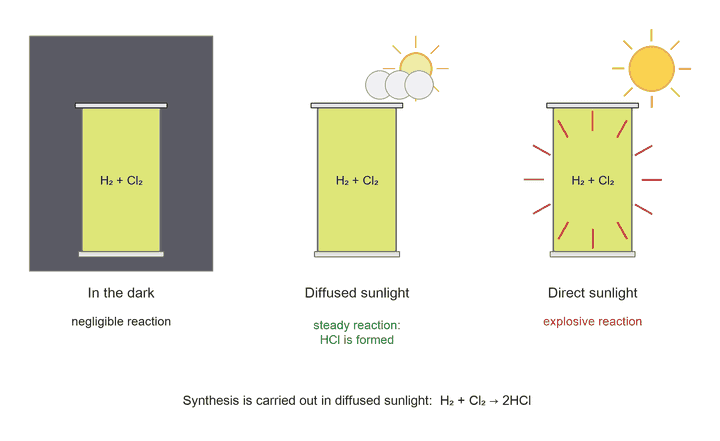
Assertion (A) : HCl is produced by the reaction of hydrogen and chlorine in diffused sunlight.
Reason (R) : This reaction is explosive in sunlight.
Select your answer
(A) (1)
(B) (2)
Correct answer
(C) (3)
(D) (4)
Answer: (B) (2)
Concept: In an assertion-reason question, first judge the Assertion (A) true or false, then judge the Reason (R) true or false, and only when both are true ask whether R is the reason why A happens.
Step 1 — Judge the Assertion.
Moist hydrogen and chlorine combine steadily in diffused sunlight to form hydrogen chloride:
H2+Cl2diffused sunlight2HCl
So A is true.
Step 2 — Judge the Reason.
In direct (bright) sunlight the same mixture reacts explosively. So R is true.
Step 3 — Ask whether R explains A.
R tells us what happens in direct sunlight. It does not explain why the gases combine steadily in diffused light, which is what A describes. So R is not the correct explanation of A.
Watch out: Both statements are about sunlight, but A is about diffused light and R is about direct light.
Why the other options are wrong:
(A) (1): code (1) needs R to explain A, and it does not.
(C) (3): code (3) needs R to be false, but the reaction really is explosive in direct sunlight.
(D) (4): code (4) needs A to be false, but A is true.
Therefore, both A and R are true but R is not the correct explanation of A: code (2), option (B).