
Question 41 markMCQMedium
HCl dissolves in toluene () and the solution :
P contains hydronium ions.
Q can produce carbon dioxide on reacting with sodium carbonate.
R does not show any acidic property.
Which of the following holds true ?
Confirming your payment
Sign up now and get 250 free tokens.
Study of Compounds – Hydrogen Chloride · Question 4 of 40
HCl dissolves in toluene () and the solution :
P contains hydronium ions.
Q can produce carbon dioxide on reacting with sodium carbonate.
R does not show any acidic property.
Which of the following holds true ?
(A) Only P
(B) Only Q
(C) Only R
(D) Both P and Q
Answer: (C) Only R
Concept: Hydrogen chloride shows acidic properties only when it ionises, and it ionises only in water:
Toluene is an organic solvent with no water, so HCl dissolves in it as covalent molecules that do not ionise.
Step 1 — Test statement P.
Hydronium ions () are formed only when HCl reacts with water. Toluene contains no water, so no hydronium ions are formed. P is false.
Step 2 — Test statement Q.
Carbon dioxide is set free from sodium carbonate by ions. With no such ions in the toluene solution, no carbon dioxide is given off. Q is false.
Step 3 — Test statement R.
Without ions the solution does not turn blue litmus red, does not conduct electricity and does not react with carbonates. It shows no acidic property, so R is true.
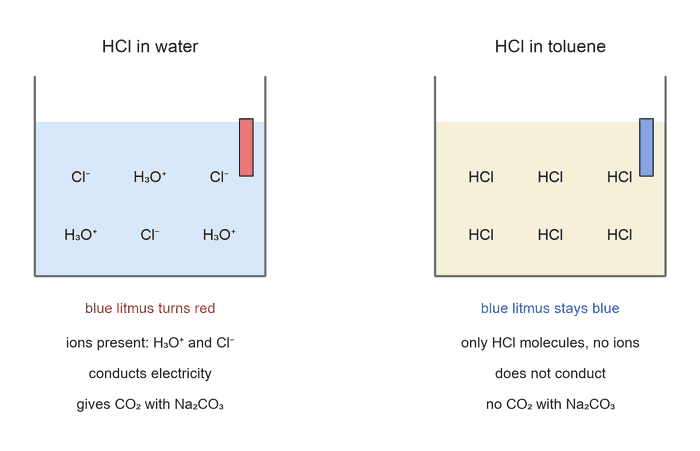
Watch out: An acid shows its properties only in water. The same HCl gas is acidic in water and not acidic in toluene.
Why the other options are wrong:
Therefore, only statement R holds true, option (C).