
Question 31 markMCQEasy
The aim of the Fountain experiment is to prove that :
Confirming your payment
Sign up now and get 250 free tokens.
Study of Compounds – Hydrogen Chloride · Question 3 of 40
The aim of the Fountain experiment is to prove that :
(A) HCl turns blue litmus red
(B) HCl is denser than air
(C) HCl is highly soluble in water
(D) HCl fumes in moist air
Answer: (C) HCl is highly soluble in water
Concept: Hydrogen chloride is extremely soluble in water (one volume of water dissolves about 450 volumes of the gas). When a little water dissolves a lot of gas inside a closed flask, the pressure inside falls sharply.
Step 1 — Recall the set-up.
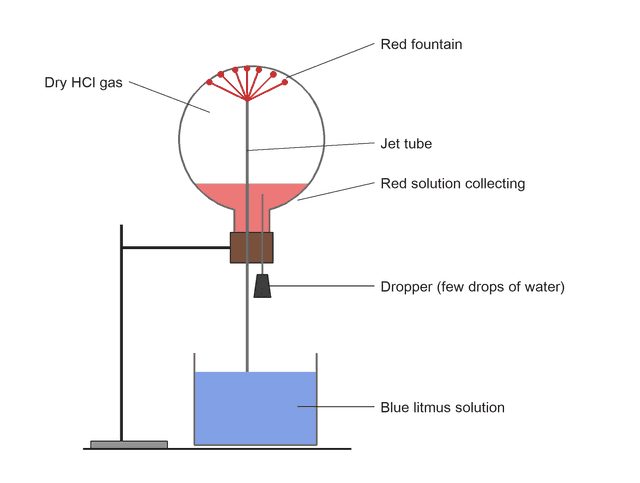
A dry round-bottom flask filled with dry HCl gas is held upside down. A jet tube passes through its stopper and dips into blue litmus solution in a beaker, and a dropper filled with water also passes through the stopper.
Step 2 — Explain why the fountain forms.
When the dropper is pressed, a few drops of water dissolve a large amount of the gas, so the pressure inside the flask falls. The air pressure outside is now greater, so it pushes the litmus solution up the jet tube, where it sprays out as a fountain.
Step 3 — State what the experiment proves.
The fountain can only form because the gas dissolves so quickly and in such a large amount. So the aim is to show that HCl is highly soluble in water.
Watch out: The red colour of the fountain is a side observation; the fountain itself is caused by the high solubility.
Why the other options are wrong:
Therefore, the fountain experiment proves that HCl is highly soluble in water, option (C).