
Question 21 markMCQEasy
Hydrogen chloride gas being highly soluble in the water is dried by :
Confirming your payment
Sign up now and get 250 free tokens.
Study of Compounds – Hydrogen Chloride · Question 2 of 40
Hydrogen chloride gas being highly soluble in the water is dried by :
(A) Anhydrous calcium chloride
(B) Phosphorous pentoxide
(C) Quick lime
(D) Conc. Sulphuric acid
Answer: (D) Conc. Sulphuric acid
Concept: A drying agent must remove water vapour from a gas without reacting with the gas itself. Hydrogen chloride is an acidic gas, so a basic drying agent, or one that reacts with it, cannot be used.
Step 1 — Pick a drying agent that leaves HCl unchanged.
Concentrated sulphuric acid is itself an acid, so it does not react with hydrogen chloride, and it absorbs water vapour strongly. In the laboratory the moist gas is bubbled through conc. sulphuric acid in a wash bottle: the long inlet tube dips into the acid and the short outlet tube ends above it.
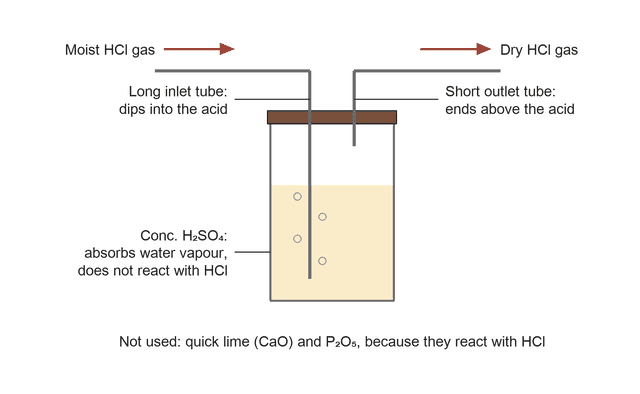
Step 2 — Rule out the drying agents that react.
Quick lime is a basic oxide, so it neutralises the acidic gas:
Phosphorus pentoxide also reacts with hydrogen chloride:
With either of them, the gas would be used up instead of dried.
Watch out: "good drying agent" is not enough; the drying agent must also not react with the gas being dried.
Why the other options are wrong:
Therefore, hydrogen chloride is dried by conc. sulphuric acid, option (D).