
Question 11 markMCQEasy
Hydrogen chloride molecule is :
Confirming your payment
Sign up now and get 250 free tokens.
Study of Compounds – Hydrogen Chloride · Question 1 of 40
Hydrogen chloride molecule is :
(A) Polar covalent
(B) Non polar
(C) Ionic
(D) Co-ordinate
Answer: (A) Polar covalent
Concept: A covalent bond forms when two atoms share a pair of electrons. The bond is polar when one atom pulls the shared pair more strongly (it is more electronegative), so the two ends carry small opposite charges.
Step 1 — Count the electrons each atom shares.
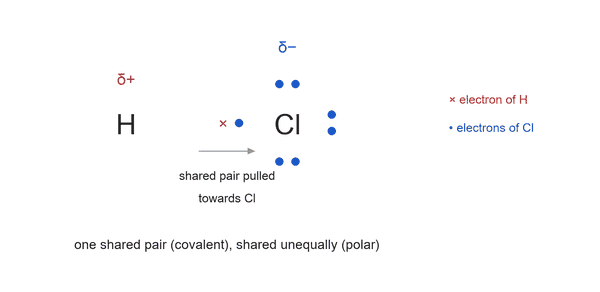
Hydrogen has 1 valence electron and chlorine (2, 8, 7) has 7. Each atom gives one electron, so they share one pair and form a single covalent bond, H–Cl. Now both atoms have a stable arrangement.
Step 2 — Decide whether the sharing is equal.
Chlorine is much more electronegative than hydrogen, so the shared pair is pulled nearer to chlorine. Chlorine gets a small negative charge (δ−) and hydrogen a small positive charge (δ+):
Step 3 — Name the bond.
The electrons are shared, so the bond is covalent; they are shared unequally, so it is polar. The molecule is polar covalent.
Watch out: A polar covalent bond is still covalent. Dry HCl has no ions; it forms ions only when it dissolves in water.
Why the other options are wrong:
Therefore, the hydrogen chloride molecule is polar covalent, option (A).