Question 61 markMCQEasy
The following questions are Assertion-Reason based questions. Choose the answer based on the codes given below.
(1) Both A and R are true and R is the correct explanation of A.
(2) Both A and R are true but R is not the correct explanation of A.
(3) A is true but R is false.
(4) A is false but R is true.
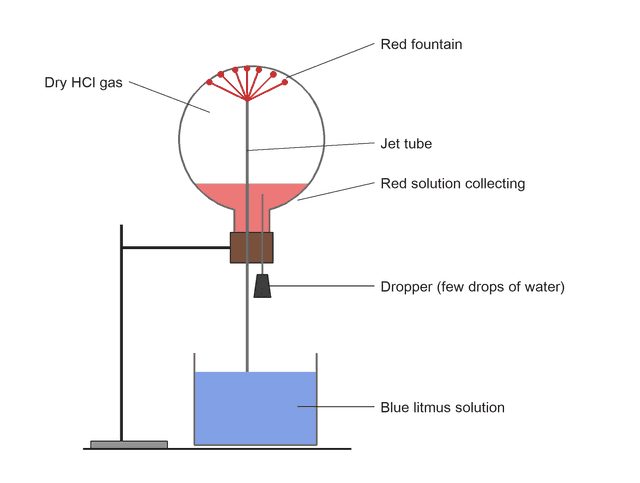
Assertion (A) : The Fountain experiment is used to demonstrate the high solubility of HCl gas.
Reason (R) : Red litmus solution turns blue in Fountain experiment.