Answer: (A) (1)
Concept: In an assertion-reason question, first judge the Assertion (A) true or false, then judge the Reason (R) true or false, and only when both are true ask whether R is the reason why A happens.
Step 1 — Judge the Reason.
We compare vapour densities. The vapour density of HCl is half its molecular mass, and that of air is 14.4:
V.D. of HCl=236.5=18.25
V.D. of airV.D. of HCl=14.418.25=1.27
So HCl is about 1.27 times heavier than air, and R is true.
Step 2 — Judge the Assertion.
HCl is collected by downward delivery: the delivery tube reaches the bottom of an upright gas jar. This is the same as upward displacement of air. So A is true.
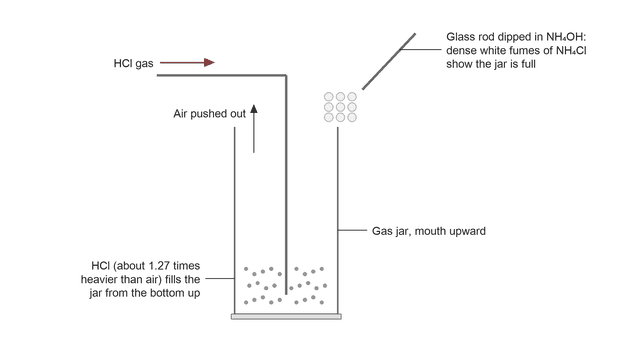
Step 3 — Ask whether R explains A.
The heavier gas settles at the bottom of the jar and pushes the lighter air out at the top. This works only because HCl is heavier than air, so R correctly explains A. (HCl is not collected over water, because it is highly soluble.)
Watch out: 'downward delivery' and 'upward displacement of air' describe the same method.
Why the other options are wrong:
- (B) (2): code (2) says R does not explain A, but R is exactly the reason for A.
- (C) (3): code (3) needs R to be false, but R is true.
- (D) (4): code (4) needs A to be false, but A is true.
Therefore, both A and R are true and R is the correct explanation of A: code (1), option (A).
