Answer: (A) (1)
Concept: In an assertion-reason question, first judge the Assertion (A) true or false, then judge the Reason (R) true or false, and only when both are true ask whether R is the reason why A happens.
Step 1 — Judge the Reason.
Hydrogen chloride gas is highly soluble in water. So R is true.
Step 2 — Judge the Assertion.
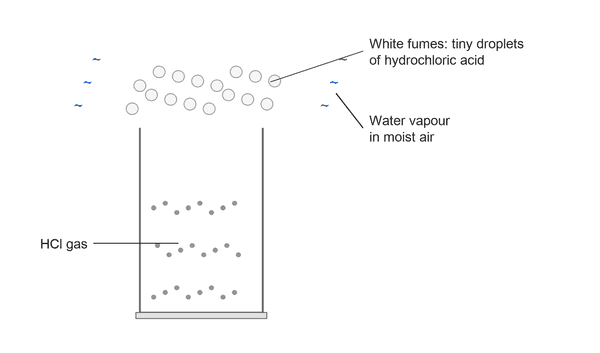
When HCl gas meets moist air, it dissolves in the water vapour of the air and forms tiny droplets of hydrochloric acid. These droplets are seen as white fumes. So A is true.
Step 3 — Ask whether R explains A.
The droplets form only because the gas dissolves so readily in water vapour. So R correctly explains A.
Watch out: The fumes are droplets of acid, not a solid. Dense white fumes of a solid (ammonium chloride) are seen only with ammonia.
Why the other options are wrong:
- (B) (2): code (2) says R does not explain A, but R is exactly the reason for A.
- (C) (3): code (3) needs R to be false, but R is true.
- (D) (4): code (4) needs A to be false, but A is true.
Therefore, both A and R are true and R is the correct explanation of A: code (1), option (A).
