Study of Compounds – Hydrogen Chloride · Question 34 of 40
In the laboratory preparation of hydrochloric acid, hydrogen chloride gas is dissolved in water.
Question 345 marksMedium
In the laboratory preparation of hydrochloric acid, hydrogen chloride gas is dissolved in water.
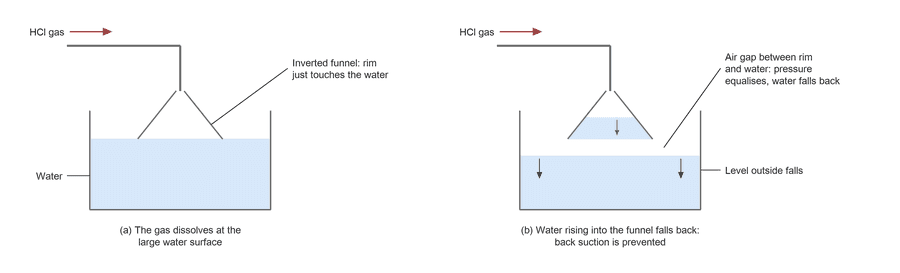
(a) Draw a diagram to show the arrangment used for the absorption of HCl gas in water.
(b) State why such an arrangment is necessary. Give two reasons for the same.
(c) Write balanced chemical equations for the laboratory preparation of HCl gas when the reaction is :
A. Below 200°C B. Above 200°C
Solution:
Concept: HCl gas is so soluble that a tube dipping straight into water would suck water back. So it is dissolved through an inverted funnel whose rim just touches the water.
Step 1 — (a) Draw the arrangement.
The delivery tube carrying HCl gas ends in an inverted funnel, and the rim of the funnel just touches the water in a beaker.
Step 2 — (b) Why the arrangement is needed.
It does two jobs:
it prevents back suction of water into the generating flask of hot conc. sulphuric acid: when water starts to rise into the funnel, the water level in the beaker falls below the rim. Air then enters under the rim, the pressure inside and outside becomes equal, and the water falls back. So the water can never be sucked back into the generating flask.
it provides a large surface area for the absorption of the gas.
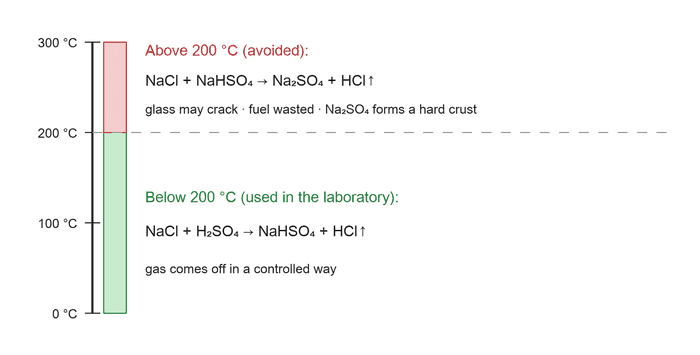
Step 3 — (c) A. Below 200 °C.
Sodium chloride reacts with conc. sulphuric acid to give sodium hydrogen sulphate:
NaCl+H2SO4below 200 °CNaHSO4+HCl↑
Step 4 — (c) B. Above 200 °C.
The sodium hydrogen sulphate reacts further with more sodium chloride to give sodium sulphate:
NaCl+NaHSO4above 200 °CNa2SO4+HCl↑
In the laboratory the temperature is kept below 200 °C: above it the glass may crack, fuel is wasted, and sodium sulphate forms a hard crust that sticks to the flask.
Watch out: Above 200 °C the second equation uses NaCl and NaHSO4, not NaCl and H2SO4 again.
Therefore, the inverted funnel prevents back suction and gives a large surface for absorption; below 200 °C sodium hydrogen sulphate forms, and above 200 °C sodium sulphate forms.