Study of Compounds – Hydrogen Chloride · Question 24 of 40
State one appropriate observation when
Question 245 marksEasy
State one appropriate observation when
(a) Copper sulphide is treated with dilute hydrochloric acid.
(b) A few drops of dil. HCl are added to AgNO3 solution, followed by addition of NH4OH solution.
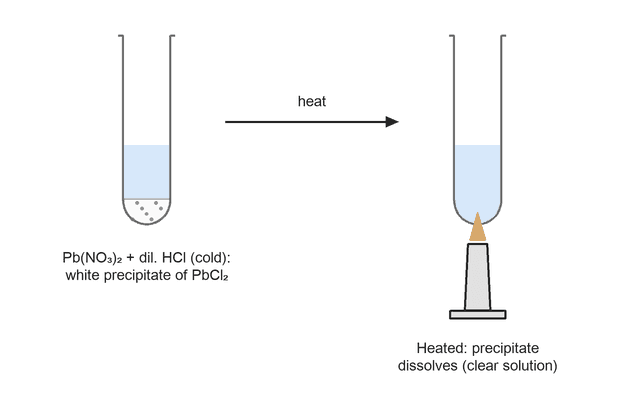
(c) Lead nitrate solution is mixed with dilute hydrochloric acid and heated.
(d) A small piece of zinc is added to dilute hydrochloric acid.
(e) Dilute HCl is added to sodium carbonate crystals
(f) Concentrated HCl is added to manganese dioxide.
Solution:
Concept: An observation is what you see or smell: a gas (with its colour or smell), a precipitate (with its colour), or a precipitate dissolving.
Step 1 — (a) Copper sulphide with dilute HCl.
The expected observation is a colourless gas with the smell of rotten eggs (hydrogen sulphide):
CuS+2HCl→CuCl2+H2S↑
In practice copper sulphide is very insoluble and reacts only slightly with dilute HCl, but the book expects the smell of hydrogen sulphide.
Step 2 — (b) Dilute HCl and silver nitrate, then ammonium hydroxide.
A curdy white precipitate of silver chloride forms first:
AgNO3+HCl→AgCl↓+HNO3
When ammonium hydroxide is added, the precipitate dissolves to give a clear, colourless solution:
AgCl+2NH4OH→[Ag(NH3)2]Cl+2H2O
Step 3 — (c) Lead nitrate solution with dilute HCl, heated.
A white precipitate of lead chloride forms, and it dissolves on heating, because lead chloride is soluble in hot water:
Pb(NO3)2+2HCl→PbCl2↓+2HNO3
Step 4 — (d) Zinc in dilute HCl.
There is brisk effervescence; the zinc dissolves and a colourless gas is given off that burns with a 'pop' sound (hydrogen):
Zn+2HCl→ZnCl2+H2↑
Step 5 — (e) Dilute HCl on sodium carbonate crystals.
There is brisk effervescence of a colourless, odourless gas that turns lime water milky (carbon dioxide):
Na2CO3+2HCl→2NaCl+H2O+CO2↑
Step 6 — (f) Conc. HCl on manganese dioxide.
On warming, a greenish-yellow gas with a pungent, suffocating smell (chlorine) is given off:
MnO2+4HClΔMnCl2+2H2O+Cl2↑
Watch out: Write what is seen, not just the name of the product: "a white precipitate that dissolves on heating", not "lead chloride is formed".
Therefore, (a) smell of rotten eggs; (b) white precipitate that dissolves in ammonium hydroxide; (c) white precipitate that dissolves on heating; (d) effervescence, gas burns with a pop; (e) effervescence, gas turns lime water milky; (f) greenish-yellow gas with a pungent smell.