Solution:
Concept: Write the products from the type of reaction, then balance by counting each kind of atom on both sides.
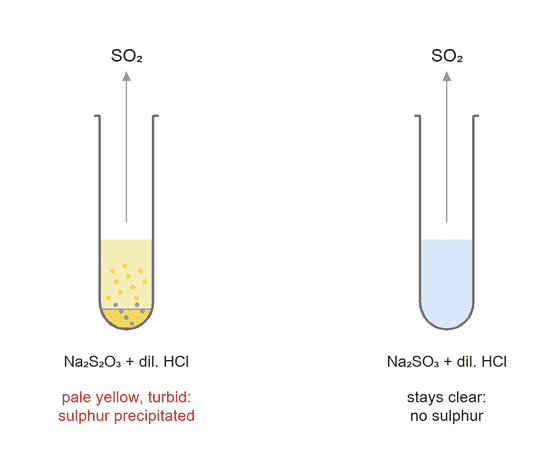
Step 1 — (a) Sodium thiosulphate with dilute HCl.
Sulphur dioxide is given off and pale yellow sulphur is precipitated:
Na2S2O3+2HCl→2NaCl+H2O+SO2↑+S↓
Step 2 — (b) Calcium bicarbonate with dilute HCl.
Each hydrogen carbonate group gives one carbon dioxide and one water, and there are two such groups:
Ca(HCO3)2+2HCl→CaCl2+2H2O+2CO2↑
Step 3 — (c) Conc. HCl with potassium permanganate.
Permanganate is a strong oxidising agent, and it oxidises the acid to chlorine even without heating:
2KMnO4+16HCl→2KCl+2MnCl2+8H2O+5Cl2↑
We check chlorine because it is the hardest to balance. On the left there are 16 Cl atoms. On the right there are 2 in KCl, 4 in MnCl2 and 10 in chlorine gas:
Cl on the right=2+4+10=16
Step 4 — (d) Dilute HCl on sodium sulphide.
Hydrogen sulphide is given off:
Na2S+2HCl→2NaCl+H2S↑
Step 5 — (e) HCl on sodium bicarbonate.
Carbon dioxide is given off with effervescence:
NaHCO3+HCl→NaCl+H2O+CO2↑
Watch out: In (c) the coefficients are 2 : 16 → 2 : 2 : 8 : 5; check every element, not only chlorine.
Therefore, the five balanced equations are as written in Steps 1 to 5.
