
Opening your dashboard
Class 10 Chemistry Chapter 8 Study of Compounds – Hydrogen Chloride: Competency-Based Questions (CBQ)
40 questions on Chapter 8, each worked through on its own page with the AI tutor. Class 10 Chemistry, ICSE 2026-27.
40 questions
1–5 marks · Mixed difficulty
- 11 mark
Question 1
Cognitive domain: Recall & Understanding · CISCE Competency-Focused Practice Questions 2024, Q2
Which metal does not react with to form a colourless, odourless gas which burns with a pop sound?
- 21 mark
Question 2
Cognitive domain: Evaluate · CISCE Competency-Focused Practice Questions 2024, Q17
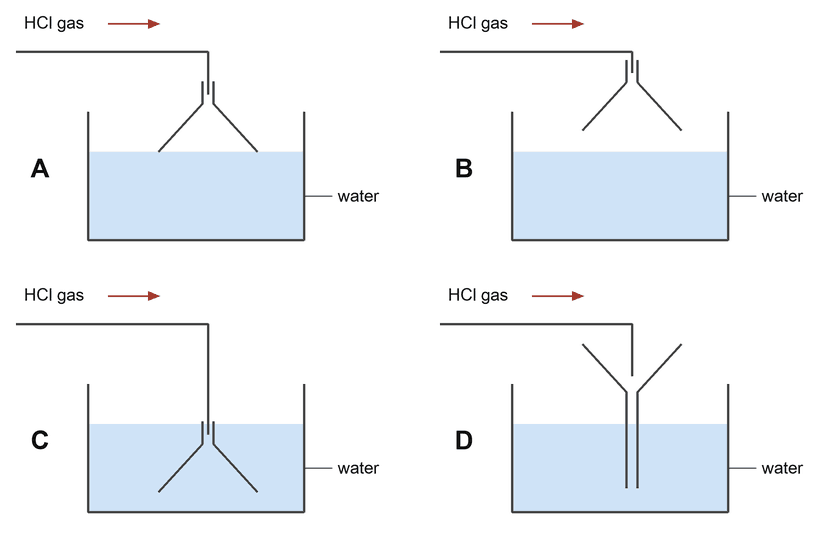
Given below are four different illustrations of preparing hydrochloric acid drawn by students. Which of these is correct?
- 31 mark
Question 3
Cognitive domain: Application · CISCE Competency-Focused Practice Questions 2024, Q85
Hydrogen chloride fumes in the air. Justify.
- 41 mark
Question 4
Cognitive domain: Analysis
Sana prepares hydrogen chloride gas from sodium chloride and concentrated sulphuric acid on two days, using a fresh flask each time. When each flask has cooled, she looks at the solid left in it and then shakes a little of the solid with water.
Run Temperature of the flask Solid left in the flask Solution of the solid in water 1 kept just below 200 °C white solid turns blue litmus red; gives brisk effervescence with sodium carbonate 2 heated strongly, well above 200 °C hard white crust stuck to the glass has no effect on litmus Which option names the two solids correctly and picks the run that suits a school laboratory?
- 51 mark
Question 5
Cognitive domain: Understanding
Kavya tests bore-well water for chlorides. She adds a little dilute nitric acid and then silver nitrate solution, and a curdy white precipitate forms. She leaves the test tube on a sunny window sill. An hour later the precipitate has turned greyish black, and she thinks her sample has become contaminated.
Which statement explains the change correctly?
- 61 mark
Question 6
Cognitive domain: Understanding
Assertion (A): In the laboratory preparation of hydrogen chloride, the reaction between sodium chloride and concentrated sulphuric acid goes to completion even though it is a reversible reaction.
Reason (R): Hydrogen chloride leaves the reaction mixture continuously as a gas.
- 71 mark
Question 7
Cognitive domain: Understanding
Assertion (A): Liquefied hydrogen chloride turns dry blue litmus paper red.
Reason (R): Hydrogen chloride forms hydronium ions only when it ionises in water.
- 81 mark
Question 8
Cognitive domain: Understanding
Fill in the blanks.
In a demonstration, dry hydrogen chloride gas is passed through a hard-glass tube containing heated iron filings. The solid formed in the tube is ________, and the gas leaving the tube burns with a pop sound, so it is ________. In a second demonstration, the dry gas alone is heated above 500 °C. It ________ into hydrogen and chlorine.
- 91 mark
Question 9
Cognitive domain: Application
Arjun sets up the fountain experiment with a dry round-bottomed flask full of dry hydrogen chloride gas. The laboratory has run out of blue litmus solution, so he fills the beaker with water to which a few drops of methyl orange have been added. He then presses the dropper.
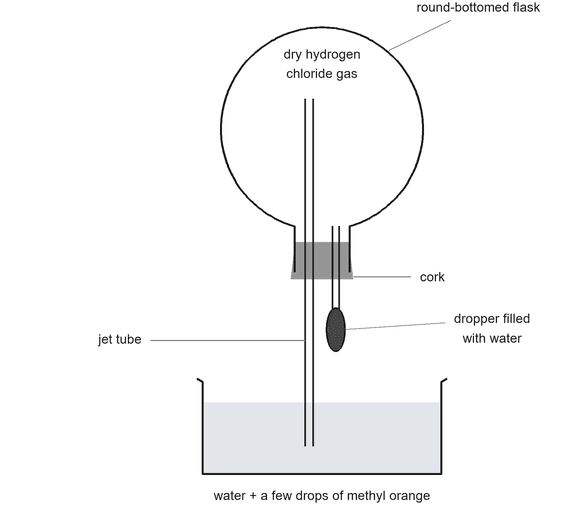
Predict what Arjun sees, mentioning the colours.
- 102 marks
Question 10
Cognitive domain: Application
A laboratory assistant weighs out 11.7 g of pure, dry sodium chloride, covers it with excess concentrated sulphuric acid and warms the flask gently. She keeps the temperature below 200 °C until all the salt has reacted.
(H = 1, O = 16, Na = 23, S = 32, Cl = 35.5; one mole of a gas occupies 22.4 dm³ at s.t.p.)
(a) How many gas jars, each of capacity 560 cm³, can the hydrogen chloride formed fill, if the gas is measured at s.t.p.?
(b) Name the solid left in the flask and calculate its mass.
- 112 marks
Question 11
Cognitive domain: Evaluation
Meena finds an unlabelled bottle of a colourless liquid in the laboratory. She adds a few drops of silver nitrate solution to a sample of it and gets a curdy white precipitate. In her notebook she writes: "The liquid is hydrochloric acid."
Evaluate Meena's conclusion. Describe one more test, with its result, that she should carry out before she labels the bottle.
- 122 marks
Question 12
Cognitive domain: Application
Two reagent bottles have lost their labels. One contains dilute hydrochloric acid and the other contains dilute sulphuric acid. Farhan has only lead nitrate solution, test tubes and a burner. (Lead sulphate is a white solid that does not dissolve in water, whether cold or hot.)
Explain how Farhan can find out which bottle is which. Give the equation for the reaction of the hydrochloric acid.
- 134 marks
Question 13
Cognitive domain: Application
The gastric juice in our stomach contains about 0.2 to 0.4 per cent hydrochloric acid. When the stomach makes too much acid, we feel a burning pain called acidity, and an antacid tablet brings relief. The strip of antacid tablets that Rehan's grandmother uses lists the active ingredients of each tablet as shown below. Rehan notices that she often burps a little while after chewing a tablet.
Active ingredient Mass in one tablet Magnesium hydroxide 0.58 g Sodium hydrogen carbonate 0.84 g (H = 1, C = 12, O = 16, Na = 23, Mg = 24, Cl = 35.5)
(a) State two ways in which the hydrochloric acid of the gastric juice helps the body.
(b) Write a balanced equation for the reaction of each active ingredient with hydrochloric acid. Which ingredient accounts for the burp? Give a reason.
(c) Calculate the total mass of hydrogen chloride that one tablet can remove. What mass of gastric juice containing 0.3 per cent hydrochloric acid holds this much acid?
- 144 marks
Question 14
Cognitive domain: Analysis
The water of a swimming pool is usually kept between pH 7.2 and pH 7.8. At a sports club, the pool is disinfected with bleaching powder. One week the water became too alkaline, so the attendant, Mr Kale, stirred in cans of dilute hydrochloric acid (sold to pool owners as muriatic acid) one at a time and tested the water after each can. He saw tiny bubbles where the acid entered the water. A notice on the store-room door reads: "Acid cans and bleaching powder must never be kept on the same shelf."
Cans of acid added pH of the pool water 0 8.4 1 8.1 2 7.8 3 7.5 (a) Use the table to explain why Mr Kale stopped after the third can. What would have happened to the water if he had gone on adding many more cans?
(b) The alkalinity was partly due to dissolved sodium carbonate. Write the balanced equation for its reaction with the acid and name the gas in the bubbles.
(c) Explain the notice on the store-room door. Include a balanced equation, the name and appearance of the gas concerned, a test for it, and say what the bleaching powder does to the hydrochloric acid.
- 155 marks
Question 15
Cognitive domain: Creativity
Ms Rao clamps a dry glass tube, 100 cm long, in a horizontal position. At the same moment she plugs one end with cotton wool soaked in concentrated hydrochloric acid and the other end with cotton wool soaked in concentrated ammonia solution. After a few minutes a white ring appears inside the tube, about 60 cm from the ammonia end.

(Vapour density: hydrogen chloride = 18.25, ammonia = 8.5.)
(a) Name the substance that forms the white ring and write the equation for its formation. What is unusual about the physical states in this reaction?
(b) Which gas travelled farther before the two gases met? Suggest a reason, using the vapour densities.
(c) When Ms Rao repeats the experiment with a tube that has been rinsed with water and not dried, no clear ring forms. Explain why.
(d) Rohit thinks that the ring would form sooner if the room were warmer. Design a fair test of his idea. State what you would change, what you would measure, what you would keep the same, and one safety precaution.
- 161 mark
Question 16
Cognitive domain: Evaluation
Dhruv sets up the generator for hydrogen chloride gas in a fume cupboard, using sodium chloride and concentrated sulphuric acid. To dry the gas, he places a wash bottle holding concentrated sulphuric acid between the generating flask and the gas jar. Four classmates sketch the wash bottle, with arrows showing the direction of the gas.
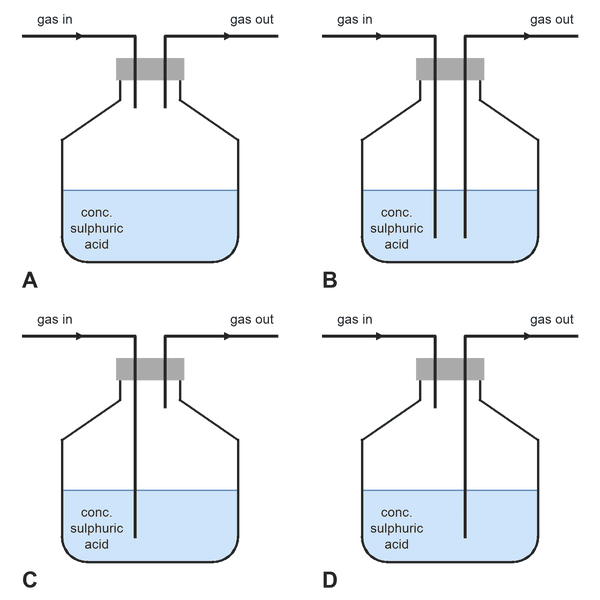
Which sketch shows the arrangement that dries the gas correctly and safely?
- 171 mark
Question 17
Cognitive domain: Application
A teacher passes 100 cm³ of dry hydrogen chloride gas slowly through a hard-glass tube that holds an excess of heated zinc granules. All the hydrogen chloride reacts. The gas that leaves the tube is cooled and measured at the same temperature and pressure as the hydrogen chloride.
What gas leaves the tube, and what is its volume?
- 181 mark
Question 18
Cognitive domain: Application
A chemical plant makes hydrogen chloride by burning a steady jet of hydrogen in chlorine inside a closed burner. The two gases are never mixed beforehand and left to stand in light.
Which is the best reason for using a burning jet?
- 191 mark
Question 19
Cognitive domain: Understanding
Assertion (A): Magnesium oxide dissolves in dilute hydrochloric acid without any bubbles of gas.
Reason (R): Dilute hydrochloric acid reacts with metals that lie above hydrogen in the activity series and sets hydrogen free.
- 201 mark
Question 20
Cognitive domain: Understanding
Assertion (A): When dilute hydrochloric acid is added to sodium thiosulphate solution, the clear solution slowly turns cloudy and pale yellow.
Reason (R): Sulphur dioxide gas is given off when dilute hydrochloric acid reacts with sodium thiosulphate.
- 211 mark
Question 21
Cognitive domain: Analysis
A volcanologist brings a sample of a colourless gas, collected from a volcanic vent, to a school laboratory. Wearing goggles and gloves, the teacher tests the gas in a fume cupboard and records the results below.
Test Observation Moist blue litmus paper held in the gas turns red Glass rod dipped in ammonia solution held in the gas dense white fumes Gas bubbled into silver nitrate solution, then dilute nitric acid added curdy white precipitate that does not dissolve Which gas is it?
- 221 mark
Question 22
Cognitive domain: Understanding
Bone black is a black powder made by heating animal bones. It is mostly carbon, but it also contains calcium phosphate, , that comes from the bones. A factory washes bone black with dilute hydrochloric acid and then with water to purify it.
Which statement gives the correct reason for using the acid?
- 231 mark
Question 23
Cognitive domain: Evaluation
Ritu has to prepare a few gas jars of dry hydrogen chloride from sodium chloride and concentrated sulphuric acid. Four classmates write a plan each.
Which plan is both correct and safe?
- 241 mark
Question 24
Cognitive domain: Application
A bottle of hydrochloric acid in a laboratory is labelled "36.5 per cent hydrogen chloride by mass". (Hypothetical label.) A student wants to neutralise exactly 4.0 g of solid sodium hydroxide with this acid.
(H = 1, O = 16, Na = 23, Cl = 35.5)
What mass of the acid from the bottle is needed?
- 251 mark
Question 25
Cognitive domain: Analysis
Neeta adds 1.00 g of each of three metal powders, magnesium, zinc and iron, to three separate flasks. Every flask holds the same volume of the same dilute hydrochloric acid, in excess, at the same temperature. She collects the hydrogen from each flask and plots its volume, corrected to s.t.p., against time, which gives the curves P, Q and R. (Hypothetical data.)
(Mg = 24, Zn = 65, Fe = 56; one mole of a gas occupies 22.4 dm³ at s.t.p.)
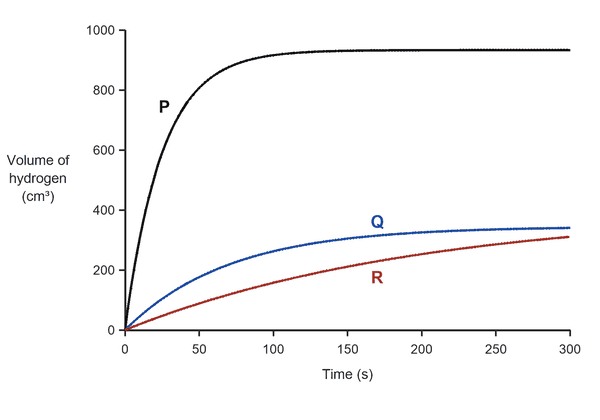
Which row names the metals of the curves P, Q and R respectively?
- 262 marks
Question 26
Cognitive domain: Application
A small unit makes ammonium chloride for dry cells by passing ammonia gas into hydrochloric acid. One day it uses a batch of acid that contains 146 g of hydrogen chloride. (Hypothetical data.)
(H = 1, N = 14, Cl = 35.5; one mole of a gas occupies 22.4 dm³ at s.t.p.)
(a) Write the balanced equation for the reaction.
(b) Calculate the mass of ammonium chloride formed, and the volume of ammonia, measured at s.t.p., that neutralises the acid completely.
- 272 marks
Question 27
Cognitive domain: Evaluation
Tarun's uncle has been told by his doctor to take a few drops of dilute hydrochloric acid after meals, because his stomach makes too little acid. At home, Tarun finds a bottle of "muriatic acid" that is sold for cleaning tiles. He says: "The doctor prescribed hydrochloric acid, and this is hydrochloric acid, so Uncle can use it."
Evaluate Tarun's idea. Give two reasons.
- 282 marks
Question 28
Cognitive domain: Analysis
A sealed hard-glass tube holds 100 cm³ of dry hydrogen chloride gas. The tube is heated well above 500 °C and the gases are measured again at the same temperature and pressure as before. Suppose that 30 per cent of the hydrogen chloride has dissociated. (Hypothetical data; the real fraction at this temperature is far smaller.)
(a) Write the equation for the dissociation, and find the volume of each of the three gases in the tube after heating.
(b) The total volume is the same as at the start. Explain why.
- 292 marks
Question 29
Cognitive domain: Application
In a practical, Isha adds an excess of dilute hydrochloric acid to a solution that contains 3.31 g of lead nitrate. She wears gloves and goggles, because lead compounds are poisonous, and she keeps the waste in a labelled container. Assume that all the lead chloride separates as a solid. (Hypothetical data.)
(N = 14, O = 16, Cl = 35.5, Pb = 207)
(a) Write the balanced equation and calculate the mass of the white precipitate formed.
(b) She then heats the test tube. State what she sees and what it shows about the precipitate.
- 302 marks
Question 30
Cognitive domain: Understanding
Some crater lakes of active volcanoes are strongly acidic. Scientists who test the water of one such lake find that it turns blue litmus paper red, that it gives a curdy white precipitate with silver nitrate solution which does not dissolve in dilute nitric acid, and that the nearby volcanic vent releases hydrogen chloride gas. They also notice that the steel bolts of a small footbridge over the stream that drains the lake are eaten away much faster than bolts on bridges elsewhere.
(a) Name the two ions in the lake water that account for the first two observations, and write the equation that shows how they form when hydrogen chloride dissolves in water.
(b) Explain why the bolts are eaten away. Write a balanced equation for the reaction of the iron in the bolts, and name the gas that forms.
- 312 marks
Question 31
Cognitive domain: Application
Some laboratories and factories receive hydrogen chloride as a liquid in a steel cylinder. At 10 °C, the gas turns into a liquid under a pressure of about 40 atmospheres, and its boiling point is . On a humid day, a worker sees a thin white haze near a small leak at the valve of such a cylinder.
(a) Explain why a substance that is a gas at room temperature and normal pressure can be stored as a liquid in the cylinder.
(b) Explain the white haze, and state the sensible first step for the worker.
- 323 marks
Question 32
Cognitive domain: Analysis
In a trial run, a student heats 11.7 g of dry sodium chloride with 9.8 g of pure sulphuric acid, in a flask fitted in the usual way, and keeps the temperature below 200 °C until no more gas comes off. (Hypothetical data.)
(H = 1, O = 16, Na = 23, S = 32, Cl = 35.5; one mole of a gas occupies 22.4 dm³ at s.t.p.)
(a) Which reactant is used up first? What volume of hydrogen chloride, at s.t.p., is formed?
(b) Name the solid left in the flask, find its mass, and state how much of the other reactant is left unused.
(c) The student now heats the flask above 200 °C. Write the balanced equation for the further reaction, and find the extra volume of hydrogen chloride, at s.t.p., that is obtained.
- 333 marks
Question 33
Cognitive domain: Analysis
Aarav sets up the fountain experiment, but he stops filling the dry round-bottomed flask too early. It holds a mixture of 200 cm³ of dry hydrogen chloride and 50 cm³ of dry air, at atmospheric pressure, so its capacity is 250 cm³. (Hypothetical data.) The long jet tube dips into a beaker of water that contains blue litmus solution. He presses the dropper. Assume that all the hydrogen chloride dissolves, and ignore the water from the dropper.
(a) What volume of liquid ends up in the flask? Explain.
(b) What is the colour of the liquid in the flask, and why?
(c) The jet stops before the flask is full. Why?
- 343 marks
Question 34
Cognitive domain: Application
A student drops a 10.0 g piece of brass, an alloy of copper and zinc, into excess dilute hydrochloric acid. The beaker is warmed in a hot-water bath and not over a flame, because hydrogen is flammable. Bubbles come off steadily, and 1.12 dm³ of hydrogen, measured at s.t.p., is collected. (Hypothetical data.)
(Cu = 63.5, Zn = 65; one mole of a gas occupies 22.4 dm³ at s.t.p.)
(a) What does the student see in the beaker, and why does one of the two metals not react?
(b) Write the balanced equation for the reaction that gives the gas, and find the mass of zinc in the piece.
(c) Find the percentage of copper in the brass, and name the test for the gas.
- 353 marks
Question 35
Cognitive domain: Creativity
Sheela wants to find out how much hydrogen chloride a bottle of tile-cleaning acid contains. She has a conical flask, an electronic balance that reads to 0.01 g, marble chips (calcium carbonate), cotton wool, gloves and goggles. In a trial, she takes 10.00 g of the acid and finds that the flask and its contents lose 1.10 g by the time the reaction is over. (Hypothetical data.)
(H = 1, C = 12, O = 16, Cl = 35.5)
(a) Design her method. Say what she should put in the flask, what she should weigh and when, and how she knows that the reaction is over.
(b) Write the balanced equation, and use her trial result to find the percentage by mass of hydrogen chloride in the acid.
(c) Explain why she plugs the mouth of the flask with cotton wool, and state one safety precaution.
- 363 marks
Question 36
Cognitive domain: Evaluation
A school wants to prepare about eight jars of dry hydrogen chloride gas for a class. The store has all the chemicals listed below and a fume cupboard. (Hypothetical situation.) The science teacher lists three methods.
Method Reactants and conditions P sodium chloride and concentrated sulphuric acid, warmed gently below 200 °C Q hydrogen and chlorine gases, in diffused sunlight R copper(II) chloride and concentrated sulphuric acid, heated Which method would you recommend? Give two reasons for your choice, one reason against each of the other two methods, and the balanced equation for the method that you choose.
- 374 marks
Question 37
Cognitive domain: Analysis
In a school laboratory, Vimal makes hydrochloric acid by dissolving hydrogen chloride gas in water through an inverted funnel, inside a fume cupboard. The empty beaker weighs 150.0 g and it holds 100.0 g of water at the start. He weighs the beaker with its contents every ten minutes, and he stops the supply of gas after 40 minutes. The readings are shown in the table. (Hypothetical data.)
(H = 1, Cl = 35.5; one mole of a gas occupies 22.4 dm³ at s.t.p.)
Time (min) 0 10 20 30 40 Mass of beaker and contents (g) 250.0 281.5 300.2 305.6 306.3 (a) Find the gain in mass in each ten-minute interval, and describe the pattern.
(b) Suggest two reasons for the pattern in (a).
(c) Calculate the percentage by mass of hydrogen chloride in the acid at the end, and the volume of the gas, at s.t.p., that dissolved.
- 384 marks
Question 38
Cognitive domain: Application
In 1648 the German chemist Glauber heated common salt with concentrated sulphuric acid and obtained a sharp, fuming acid, which he called spirit of salt. The French chemist Lavoisier later named it muriatic acid, and he believed that every acid contains oxygen. In 1810 Davy showed that the acid contains only hydrogen and chlorine, and the name hydrochloric acid came into use. A modern analysis shows that 3.65 g of pure hydrogen chloride contains 0.10 g of hydrogen and 3.55 g of chlorine.
(H = 1, Cl = 35.5)
(a) Write the balanced equation for Glauber's method when the mixture is heated above 200 °C.
(b) Hydrogen chloride can also be made by direct synthesis. Write the equation for this reaction with its condition, and explain how it supports Davy's view.
(c) Use the analysis to show that hydrogen chloride contains no oxygen, and find the simplest ratio of hydrogen atoms to chlorine atoms in it.
- 395 marks
Question 39
Cognitive domain: Application
During a practical class, a bottle of concentrated hydrochloric acid slips from a student's hand. About 200 g of the acid, which is 36.5 per cent hydrogen chloride by mass, spreads on the floor. (Hypothetical data.) The teacher asks everyone to leave the room. Wearing goggles, gloves and an apron, she switches on the exhaust fan, opens the windows, and sprinkles solid sodium hydrogen carbonate (baking soda) over the spill, a little at a time, until the fizzing stops. Only then does she mop up with plenty of water.
(H = 1, C = 12, O = 16, Na = 23, Cl = 35.5; one mole of a gas occupies 22.4 dm³ at s.t.p.)
(a) Why were the students sent out of the room and the room ventilated?
(b) Write a balanced equation for the neutralisation, and calculate the mass of sodium hydrogen carbonate that is just enough.
(c) Find the volume of carbon dioxide, at s.t.p., given off. Explain why the powder is added a little at a time, and why sodium hydroxide is not used instead.
- 404 marks
Question 40
Cognitive domain: Analysis
A school store room in a hot city can reach 40 °C on summer afternoons. When Mr Naik opens a bottle of concentrated hydrochloric acid in the afternoon, thick white fumes pour out, but on cool mornings the fumes are much thinner. His student Ria finds how much hydrogen chloride dissolves in 100 g of water at different temperatures, and she plots a graph. (Values rounded from measured data, for the gas at normal atmospheric pressure.)
Temperature (°C) 0 20 40 60 Mass of hydrogen chloride dissolved in 100 g of water (g) 82 72 63 56 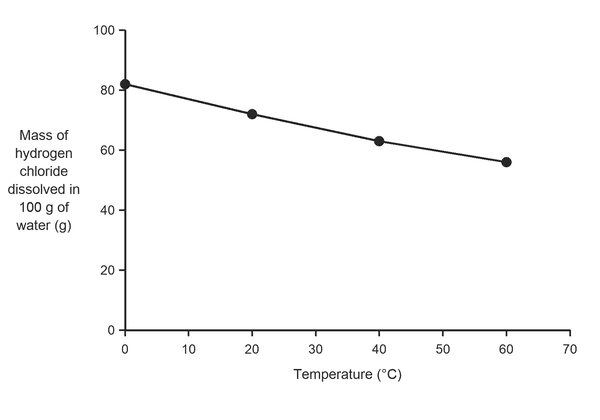
(a) What does the graph show about the solubility of hydrogen chloride as the temperature rises? How much less dissolves at 40 °C than at 20 °C in 100 g of water?
(b) Use the graph to explain why the fumes are thicker in the afternoon.
(c) A solution made with 200 g of water is saturated at 20 °C. It is warmed to 40 °C. What mass of hydrogen chloride gas escapes? How should Ria make the strongest acid, and how should the bottle be stored?