
Question 194 marksMedium
How will the action of dilute hydrochloric acid enable you to distinguish between the following :
(a) Sodium carbonate and sodium sulphite
(b) Sodium thiosulphate and sodium sulphite.
Confirming your payment
Sign up now and get 250 free tokens.
Study of Compounds – Hydrogen Chloride · Question 19 of 40
How will the action of dilute hydrochloric acid enable you to distinguish between the following :
(a) Sodium carbonate and sodium sulphite
(b) Sodium thiosulphate and sodium sulphite.
Solution:
Concept: Add dilute HCl to each salt and identify the product: the gas given off (and its test), or a precipitate in the solution.
Step 1 — (a) Sodium carbonate: the gas and its test.
Both salts effervesce with dilute HCl, but the gases differ. Sodium carbonate gives carbon dioxide, which is odourless and turns lime water milky:
Carbon dioxide has no effect on acidified potassium dichromate paper.
Step 2 — (a) Sodium sulphite: the gas and its test.
Sodium sulphite gives sulphur dioxide, which smells of burning sulphur and turns acidified potassium dichromate paper from orange to green:

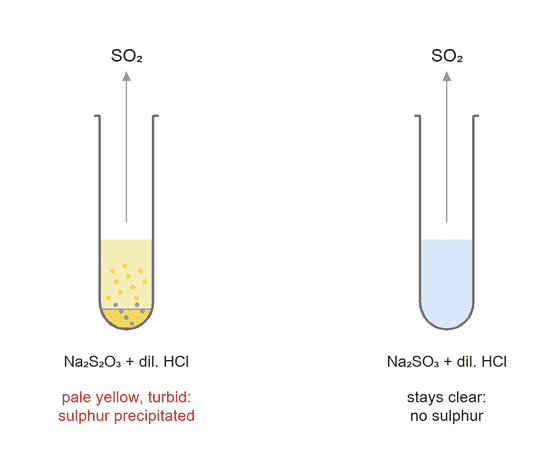
Step 3 — (b) Sodium thiosulphate.
Sodium thiosulphate also gives sulphur dioxide, so the gas alone cannot tell it apart from the sulphite. Look at the solution instead: thiosulphate also gives a pale yellow precipitate of sulphur, so the solution turns turbid:
Step 4 — (b) Sodium sulphite.
Sodium sulphite gives sulphur dioxide but no precipitate; the solution stays clear (equation as in Step 2).
Watch out: Sulphur dioxide also turns lime water milky, so for (a) use the dichromate paper (or the smell), not lime water.
Therefore, (a) sodium carbonate gives odourless (no effect on dichromate paper), while sodium sulphite gives (turns dichromate paper green); (b) sodium thiosulphate gives a pale yellow precipitate of sulphur, while sodium sulphite gives a clear solution.