
Question 31 markAsked 2017Easy
Fill in the blanks from the choices given in brackets:
Potassium sulphite on reacting with hydrochloric acid releases .............. gas. (, , )
Confirming your payment
Sign up now and get 250 free tokens.
Previous Year Questions · Question 3 of 27
Fill in the blanks from the choices given in brackets:
Potassium sulphite on reacting with hydrochloric acid releases .............. gas. (, , )
Solution:
Concept: Dilute hydrochloric acid decomposes the salts of weaker, unstable acids. A sulphite gives sulphur dioxide, a sulphide gives hydrogen sulphide and a carbonate gives carbon dioxide.
Step 1 — Identify the salt.
Potassium sulphite, , is a sulphite, so with hydrochloric acid it gives sulphur dioxide, water and potassium chloride.
Step 2 — Rule out the other two gases.
Chlorine forms only when hydrochloric acid is oxidised by an oxidising agent such as manganese dioxide; a sulphite does not do this. Hydrogen sulphide comes from a sulphide (S²⁻), not from a sulphite (SO₃²⁻).
Step 3 — Confirm the gas.
Sulphur dioxide is colourless, smells of burning sulphur and turns acidified potassium dichromate paper from orange to green.
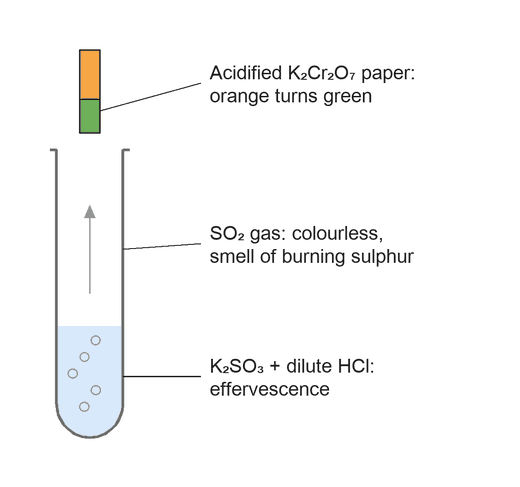
Watch out: Sulphite (SO₃²⁻) gives SO₂, while sulphide (S²⁻) gives H₂S; read the name of the salt carefully.
Therefore, potassium sulphite on reacting with hydrochloric acid releases SO₂ (sulphur dioxide) gas.