(i) Dilute Hydrochloric acid is added to Lead nitrate solution and the mixture is heated.
(ii) Barium chloride solution is mixed with Sodium Sulphate Solution.
(iii) Concentrated Sulphuric acid is added to Sugar Crystals.
(iv) Dilute Hydrochloric acid is added to Copper carbonate.
(v) Dilute Hydrochloric acid is added to Sodium thiosulphate.
Solution:
Concept: Each observation comes from the product that forms: a precipitate (and its colour), a gas (and its smell or test), or a change in colour. For each mixture we name the product first, then say what is seen.
Step 1 — (i) Dilute hydrochloric acid with lead nitrate solution, then heated.
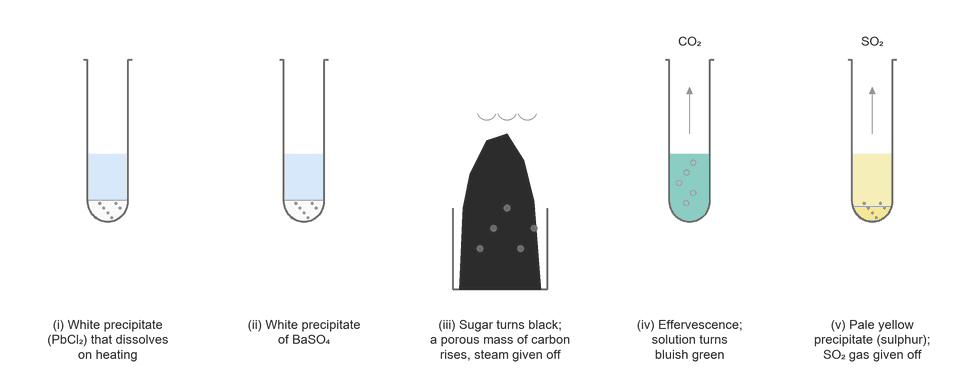
Hydrochloric acid gives lead chloride, which is insoluble in cold water, so a white precipitate forms. Lead chloride is soluble in hot water, so the precipitate dissolves on heating to give a clear solution (it comes back as crystals when the solution cools).
Pb(NO3)2+2HCl→PbCl2↓+2HNO3
Step 2 — (ii) Barium chloride solution with sodium sulphate solution.
Barium ions and sulphate ions form barium sulphate, which is insoluble in water, so a white precipitate forms. It does not dissolve in dilute hydrochloric or nitric acid.
Concentrated sulphuric acid is a strong dehydrating agent: it removes the elements of water (hydrogen and oxygen in the ratio 2 : 1) from sugar. The white sugar turns yellow, then brown and finally black, and a black, spongy (porous) mass of carbon rises up. The mixture becomes very hot and steam is given off.
An acid decomposes a carbonate and gives carbon dioxide, so there is brisk effervescence of a colourless, odourless gas that turns lime water milky. The green copper carbonate dissolves and the solution turns bluish green because copper (II) chloride forms.
The acid decomposes thiosulphate into sulphur and sulphur dioxide. A pale yellow precipitate of sulphur appears (the solution turns cloudy yellow), and a colourless gas with the smell of burning sulphur (sulphur dioxide) is given off.
Na2S2O3+2HCl→2NaCl+H2O+SO2↑+S↓
Watch out: In (i) the precipitate dissolves only when the mixture is HOT; in (v) the yellow colour comes from sulphur particles, not from the gas.
Therefore, (i) a white precipitate that dissolves on heating; (ii) a white precipitate (BaSO₄); (iii) sugar chars to a black porous mass of carbon, with heat and steam; (iv) brisk effervescence of CO₂ and a bluish-green solution; (v) a pale yellow precipitate of sulphur and SO₂ gas with the smell of burning sulphur.